Sara Dosa makes documentaries about people who have given themselves to a mountain, a wood or a glacier. On the evidence of Fire of Love she has a fine eye for other people's footage and a weakness for narration the pictures do not need.
Fi1m perspective
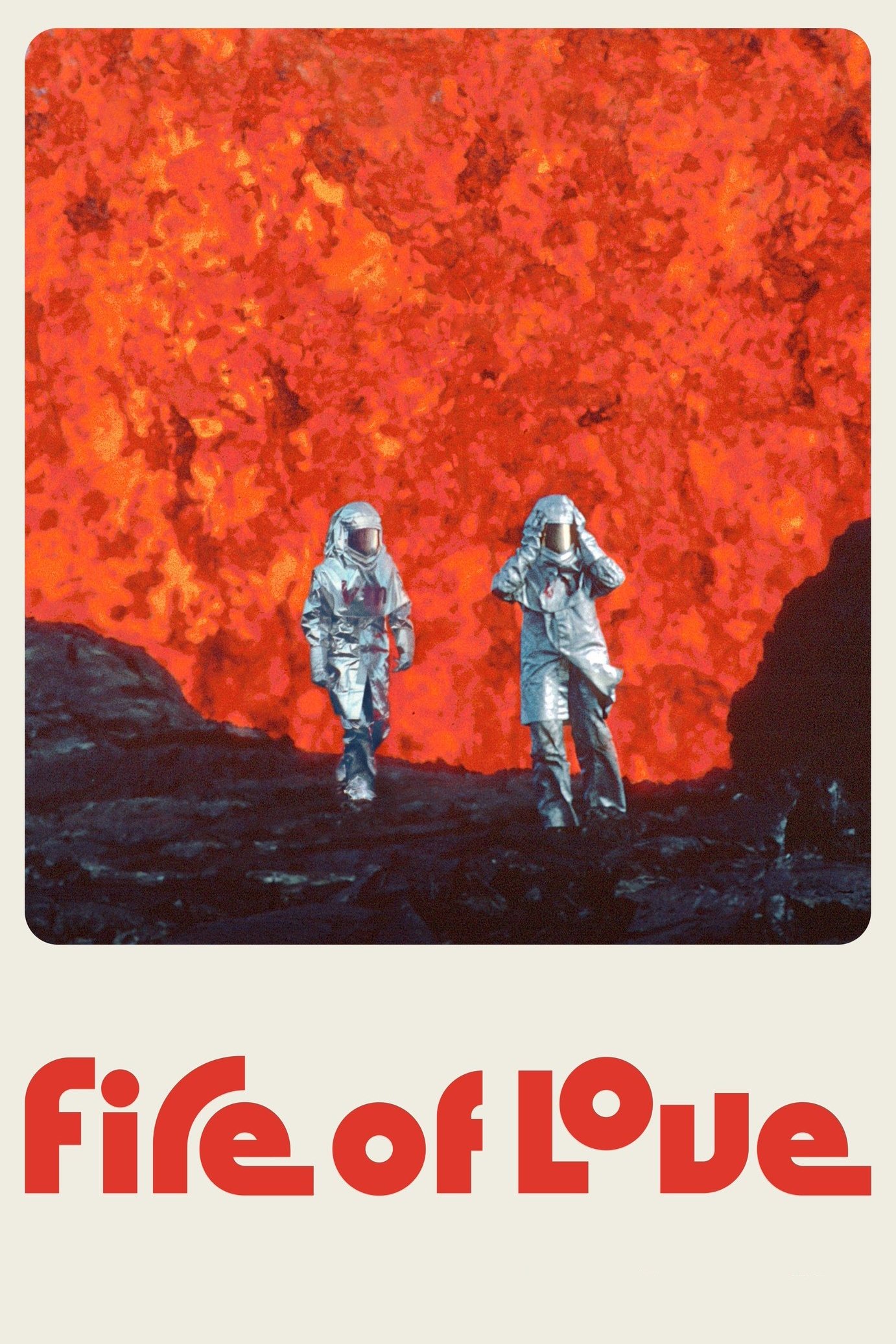
Two people in tinfoil clothing cook eggs on a rock beside a river of lava. The frame irises in, splits in two, jumps ahead; Nicolas Godin's analogue synthesizers hum warmly underneath. Then a voice arrives to tell us what we have just watched. That is Fire of Love (2022) in one sequence, and as far as we can tell it is Sara Dosa in one sequence too: a marvellous instinct for the image, and less trust in it than it deserves.
She came to filmmaking from anthropology, which explains a good deal. Her first feature, The Last Season (2014), followed two veterans hunting mushrooms in the Oregon woods. The Seer & The Unseen (2019) watched an Icelandic woman who talks to spirits while money circles the land she is trying to protect. Fire of Love turned to the archive, some 200 hours of it, shot by Katia and Maurice Krafft over twenty-five years of walking up to erupting volcanoes. Time and Water (2026) goes back to Iceland for the melting glaciers, approached through family history and old writings. Shane Boris has produced three of these. The pattern is plain: one person, or two, and a piece of the world that will outlast them.
What works is the shaping. With Erin Casper and Jocelyne Chaput, who edited Fire of Love and share its writing credit, Dosa sorted the Kraffts' footage as the Kraffts did, into red volcanoes that pour and grey ones that explode, and let the film's mood follow the colour. We had been grinning at the eggs and the tinfoil; when the film reached the Colombian town buried in mud in 1985, we stopped grinning, and we understood without being told why the couple had turned from looking to warning. That is good documentary construction and it is hers.
What does not work is the talking. Dosa has said that at the beginning "we didn't want narration at all" and hoped the archive would speak for itself, and that the love story needed "a narrative vehicle". She was right the first time. The narration in Fire of Love is less sure of itself than the cutting, and the film is at its best when it falls silent. She is also reluctant to press. Maurice says he would rather a short intense life than a long dull one, and the film takes him at his word; nobody asks what their families thought, whether the two of them argued about the risks, or whether all that filming was itself a kind of appetite. Dosa honours her subjects' account of themselves. That is a decent instinct and a limit.
We would happily watch anything she cuts. We would watch it more happily with the sound down. Glaciers do not give interviews, so Time and Water will tell us whether the voice-over has learned to earn its place.
Biography
Sara Dosa is an American documentary filmmaker, director, writer and producer. She directed, wrote and produced the 2022 film Fire of Love, which premiered at Sundance and received an Academy Award nomination for Best Documentary Feature, a BAFTA nomination and the Directors Guild of America Award for Outstanding Directing.
Her earlier directing credits include the 2014 documentary The Last Season, nominated for an Independent Spirit Truer Than Fiction Award, and The Seer & The Unseen (2019). In 2018 she co-directed an episode of the Netflix series ReMastered: Tricky Dick & The Man in Black. She holds degrees in sociology and anthropology from Wesleyan University and a joint master’s in anthropology and international development from the London School of Economics.