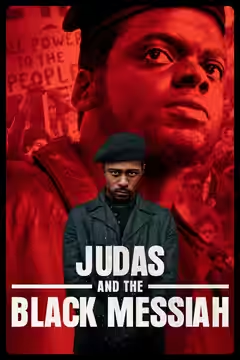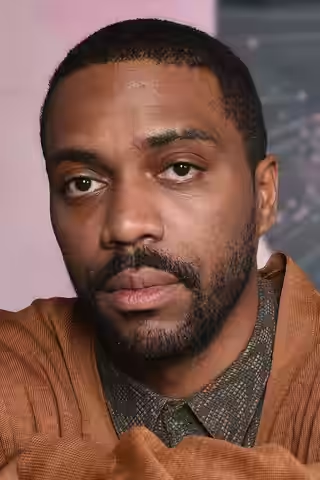
Shaka King puts political history inside thriller shapes, and Judas and the Black Messiah shows what the trick buys and what it costs: Hampton's speeches land, and the informant carrying the plot never comes into focus. Two features in, we rate the ambition.
Fi1m perspective
Fred Hampton is at a lectern. Daniel Kaluuya works the speech from the chest and drops to a rasp on the refrains, Sean Bobbitt shoots him low and close so the ceiling presses down, and at the edge of the frame Bill O'Neal stands doing what the Bureau pays him for. That shot is Shaka King's method in one image. The politics sit in the middle of the picture, the genre sits at the edges, and the audience only notices afterwards where it has been looking.
He took a long road to it. His NYU thesis became Newlyweeds (2013), a comedy-drama about a marijuana-using Brooklyn couple that premiered at Sundance, and then came years of television, episodes of High Maintenance, People of Earth and Shrill, and short films including LaZercism (2017), a satire in which white people suffer from racial glaucoma, with LaKeith Stanfield. He attached himself to the Hampton story in 2016 and spent four years researching and co-writing it, consulting Hampton's family and developing the material with Kenny and Keith Lucas. His own account of the plan was blunt: he called it a Trojan horse, a Fred Hampton biopic hidden inside an undercover crime drama.
The disguise is a real idea, not a sales line. It gets Hampton's speeches in front of people who came for a thriller, and it gives Stanfield and Jesse Plemons the film's best small scenes: a steak dinner, an agent's living room, a man talking about his baby while an envelope crosses the table. King is good at the transaction, at money and coats and the way Charlese Antoinette Jones's costumes keep score as the envelopes thicken. We are not easily moved by a man at a lectern, and we were moved twice; the second time we realised we had stopped watching Stanfield altogether, which is the film working exactly as built.
The cost is the man carrying the plot. O'Neal is written as someone with no politics who wants a car and his freedom, and the screenplay, by King and Will Berson, could not find him and settled on calling the blankness a mystery. A Trojan horse has to be hollow, and this one is. King's research served Hampton handsomely and could do little for O'Neal, who left almost nothing behind but a television interview, and King's respect for the record seems to have stopped him inventing an inner life the evidence would not support. That is fair to history and hard on drama, and 125 minutes is a long time to spend behind eyes that will not tell you what they see.
One feature we can judge with confidence, one we cannot, and eight years between them in a marketplace he found unwelcoming to the films he wanted to make. The research and the point of view are the strengths; the plotting is where the seams show. What we want from him next is a film where he trusts the man at the lectern enough not to need the getaway car.
Biography
Shaka King is an American film director, screenwriter and producer. Born on 7 March 1980 in New York City, he studied political science at Vassar College and film at New York University, where he was mentored by Spike Lee.
King directed the independent feature Newlyweeds (2013). He is best known for directing, co-writing the screenplay and story, and producing the biographical drama Judas and the Black Messiah (2021). The film received six Academy Award nominations, including Best Picture and Best Original Screenplay for King. He has also directed episodes of television series such as High Maintenance (2018).