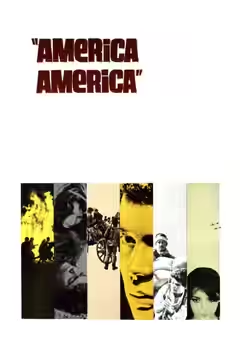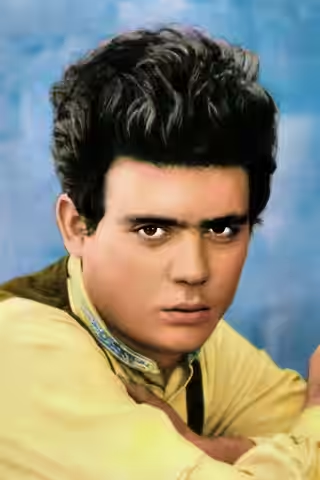
Stathis Giallelis made one film that matters, and in it he hardly acts. Kazan wanted a face the audience could not warm to, and the untrained boy he found in Athens gave him that. Stubbornness does the work skill would have done.
Fi1m perspective
Watch the eyes. For most of America America (1963) Stathis Giallelis looks a little past whoever is talking to him, mouth set, as if he has already decided something and does not intend to discuss it. It is not a technique. It is what a drama student with a few months of English does when a great director puts him in nearly every scene of a three-hour film and tells him not to smile. Kazan knew exactly what he was buying.
He found Giallelis at auditions in Athens in 1962 and coached him for the part, or had him coached, since by the actor's own account the direction stopped short of instruction: "He would say 'I want you to give me this emotion for the scene' but he would never show you how to get it." What came out is Stavros Topouzoglou, a boy who wants to get from Anatolia to New York and will let anyone pay for it. Giallelis is stiff in places, and there are scenes where a trained actor would have given us more. But a trained actor would have let us like Stavros, and the film does not want that. The blankness is the character's, and it is also the actor's, and Kazan lets the two sit on top of each other.
It works best on the road with Lou Antonio's Osman, the Turk who adopts him, feeds him, prays beside him and lifts his belongings one at a time while smiling. Giallelis does almost nothing across that stretch, and Haskell Wexler shoots it as reportage rather than staging, so there is nowhere for an actor to hide and nothing for him to embellish. We watched it with our jaw clenched, waiting for Stavros to see what we could see, and when he does the film refuses to make him the hero of the moment. A more accomplished performer would have taken that moment anyway. Giallelis could not, and the scene is better for it.
There was very little afterwards. A supporting part in Cast a Giant Shadow (1966), a role in the Greek political allegory Happy Day (1976), The Children of Sanchez (1978) opposite Anthony Quinn, then nothing after 1983. Kazan later said he never had the ambition to master English, and that the parts he was offered shrank to the ethnic and the incidental as a result. We have not seen enough of the later work to argue.
So the case rests on one film, and it holds. See America America for Kazan and Wexler, and stay for the face that will not give you what you want from it. Whether Giallelis could have done anything else we do not know. Nobody asked him to, and he did not ask.
Biography
Stathis Giallelis (Greek: Στάθης Γιαλέλλης) is a retired Greek actor. He was born on 21 January 1941 in Greece.
Giallelis came to international attention for his leading role as Stavros Topouzoglou in Elia Kazan's America America (1963). The performance earned him the Golden Globe Award for New Star of the Year – Actor and a nomination for Golden Globe Award for Best Actor – Motion Picture Drama. He also appeared in Cast a Giant Shadow (1966) as Ram Oren and later in Greek films including Happy Day (1976). His screen career spanned 1963 to 1983.