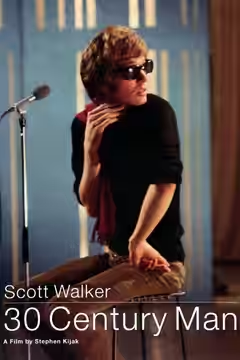
Stephen Kijak makes documentaries about musicians with the archive open and the studio door ajar, and the access is real. He is too polite to his subjects to ask them anything hard, and the films are smaller for it.
Fi1m perspective
Somewhere in the middle of Scott Walker: 30 Century Man (2007), a room full of serious professionals waits while the singer tries to describe a sound by listing everything it is not. Kijak holds on it. Then he plays us the record they made, with that voice over it, and the scene stops being funny. We laughed at the waiting and stopped laughing at the result, and the stopping is the point: he has put the method next to the music and let us hear the gap between them. It is the best thing Kijak does, and he does not do it often enough.
He did not start with music. Never Met Picasso (1996) was a narrative feature he wrote, directed and produced, and Cinemania (2002), made with Angela Christlieb, followed a handful of New Yorkers who go to the cinema the way other people go to work. The Walker film changed the direction. Since then he has mostly made films about musicians, several of them with the producer John Battsek and Passion Pictures: Stones in Exile (2010), on the making of Exile on Main St., Jaco (2015), We Are X (2016) and Sid & Judy (2019). Shoplifters of the World (2021) was a return to fiction, built around the songs of The Smiths. He tends to pick an album or a stretch of years rather than a whole life, which keeps the films from sprawling.
What works is the access and what he cuts around it. Walker plainly did not want a documentary and Kijak got one anyway, in the studio while a record was being made. The 1960s footage he sets against it, screaming girls and a Jacques Brel song sung with complete conviction to an audience that wanted something lighter, makes the case better than any of the admirers lined up to make it. He has called his music films mixtapes, and the good stretches move like one: the right clip under the right song, nobody talking.
The trouble is reverence. 30 Century Man tells us repeatedly that the late records are difficult and never shows us how to listen to one, and the queue of famous fans mostly tell us how much they admire him. Walker himself, shy and funny and precise, is on screen too little for a film that had him in the studio. Kijak is kind to the people he films, which is a fine quality in a person and a limit in a documentarian. The films stay on the work and leave the life alone, and the portraits come out flattering and partial.
He seems to know it. "The problem is, you do one of them very well and you're stuck for life," he said in 2015, adding that it was the Walker film that got him into it. We would not call him stuck. The archive is in order and the door is open; what the next one needs is a filmmaker prepared to make his subject uncomfortable for a minute.
Biography
Stephen Kijak is an American film director and producer. Born on 3 October 1969 in New Bedford, Massachusetts, he studied at Boston University’s College of Communication. His debut feature film, Never Met Picasso (1996), which he wrote, directed and produced, won awards at the 1997 Outfest film festival. He followed this with the documentary Cinemania (2003), co-directed with Angela Christlieb.
Kijak is known for documentaries about music and musicians. He directed and co-produced Scott Walker: 30 Century Man (2006), which had its world premiere at the London Film Festival; David Bowie served as executive producer. Subsequent films include Stones in Exile (2010), We Are X (2016), If I Leave Here Tomorrow (2018) and Sid & Judy (2019). He has also directed narrative features and television episodes.