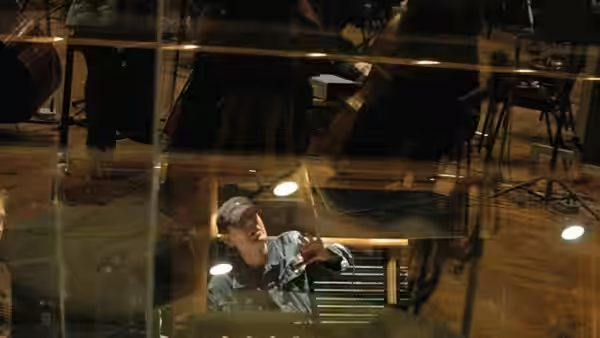
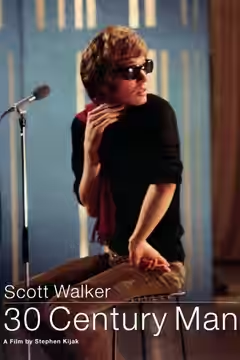
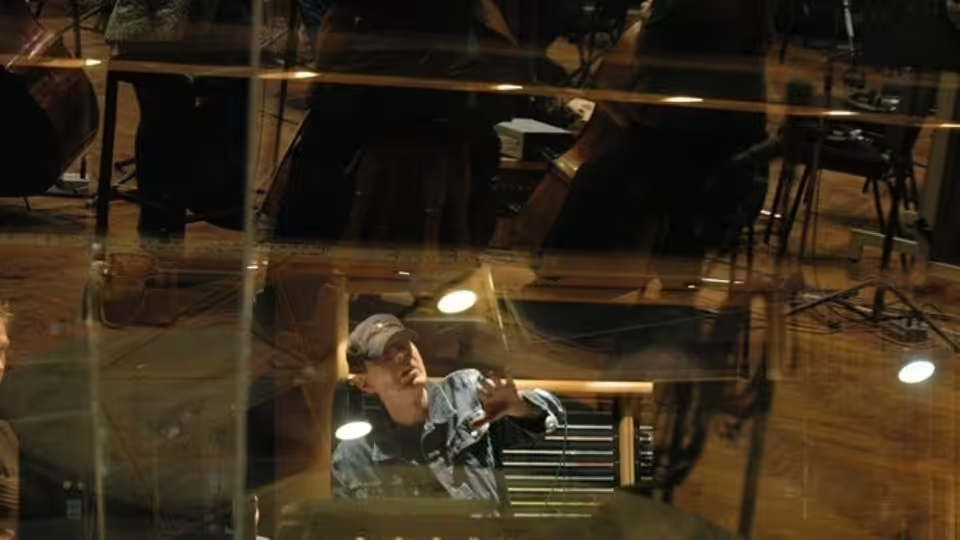
A man works at a recording console behind reflective studio glass
Film review

Scott Walker: 30 Century Man

2007 · Directed by Stephen Kijak · 1h 35m

In a sentenceEveryone in British pop queues up to say he is a genius, and he looks politely embarrassed throughout

London, the mid-2000s. Scott Walker, once one third of the Walker Brothers and a 1960s pop idol, is in a recording studio, steering session players towards sounds he can hear and cannot yet name. Stephen Kijak’s documentary cuts between that room and the career that led to it: black-and-white television of the Walker Brothers and the screaming crowds, archive footage of Jacques Brel and of Walker singing him, and the solo records that cost him his audience before he retreated from view. Admirers including David Bowie, Jarvis Cocker, Damon Albarn, Marc Almond and Johnny Marr talk about what the records did to them, and Walker himself, shy and courteous, tries to explain where he went.

Fi1m review

Stephen Kijak’s documentary has the access, the archive and a queue of famous admirers, and it uses the first two well. But it is too reverent to ask its subject anything difficult, and the admirers mostly tell us how admiring they are.

Stephen Kijak has made a documentary about a man who plainly did not want one. In the mid-1960s Scott Walker was one third of the Walker Brothers and one of the most photographed faces in Britain; by the end of the decade he was making solo records that grew odder and less popular with each release; and then, with a few interruptions, he more or less disappeared. 30 Century Man finds him in a London studio, courteous and quiet, and tries to work out what happened in between. It is careful, affectionate and well stocked, and it never once asks him a hard question. We would send a Walker admirer to it tonight and a sceptic to the records instead.

The structure is the ordinary one. The film runs in order, the pop years, the solo years, the silence, the return, with the present-day studio footage threaded through. Grant Gee and Mat Whitecross, who edit, keep the three kinds of material distinct: black-and-white television from the 1960s, interviews with Walker and his admirers today, and the studio, where a roomful of session players waits while Walker searches for a sound. The studio is where the film is best. Walker explains to a patient engineer the exact noise he has in his head, the players wait to be told what the noise is for, and nobody at this point says the word genius. They are too busy.

We laughed, a little, at that first studio scene, at the sight of serious professionals waiting on a man who can only describe what he wants by what it is not. Then Kijak plays us the result, with that voice over it, and we stopped laughing. That is the film doing its job: it puts the method next to the result and lets us hear the distance between them. The rest of the time it is talking.

The talking is the problem. David Bowie, Damon Albarn, Jarvis Cocker, Marc Almond, Sting, Johnny Marr and Dot Allison each take a turn, and a documentary with this many famous people in it quickly becomes a documentary about how many famous people are in it. Cocker is dry and useful. Almond comes closest to describing something specific about the voice and how it sits against the arrangements. Most of the others say that Walker is extraordinary and that they cannot explain why, which is pleasant to hear and tells us nothing. The sequence in which some of them are handed the records and listen on headphones, faces going slack, has been widely enjoyed, and it is agreeable, and what it mostly tells us about is their faces.

Kijak also commissions animated passages to run under some of the songs. They are decorative, and they sit where somebody might have explained what the lyrics were doing. The film tells us repeatedly that the later records are difficult and never shows us how to listen to one; it does not stay with any of the late songs long enough for us to hear its shape. Walker’s own music is on the soundtrack throughout, and it says more than anyone standing in front of it, which is awkward for a film that is 95 minutes of people standing in front of it.

The archive is another matter. There is black-and-white footage of Walker singing a Jacques Brel song: a beautiful young man in a suit performing to a television audience that has come for something lighter, and doing it with complete conviction. It explains more about where he went than any interviewee manages. The 1960s footage, screaming girls and all, makes the case the talking heads keep asserting, that this was a pop star and he walked away from it. Walker himself, when he is allowed to speak, is shy, funny and precise, and we wanted a great deal more of him. Kijak had the access; he seems to have been too grateful for it to use it.

As music documentaries go it is a solid middle entry, better supplied than most and less daring than its subject deserved. The reviews so far have been a little warmer than ours, and if you already own the records you will likely side with them. If you do not, watch the Brel clip, sit through the studio, and then go and find the records. It runs 95 minutes, and about twenty of them are the ones that matter.

Critical consensus AI synthesised

69
Positive
6
Mixed
1
Negative
2

Most critics like Scott Walker: 30 Century Man, and the praise clusters in the same places: the access Kijak gets to a famously private musician, the archival performances, and the sequences in which fellow musicians listen to Walker’s records and react with open astonishment. Several reviewers see it as an affectionate tribute that will please longtime fans and send newcomers to the albums, and the animated interpretations of the songs are picked out as the film’s most distinctive touch.

The spread is wide. Two reviews pull hard against the rest: The Guardian finds the film painfully reverent, with a rock-nerd feel its graphics cannot disguise, while The Hollywood Reporter struggles to take it seriously and suggests its treatment of Walker’s perfectionism tips into absurdity. Even one of the admirers has doubts about Walker’s later music and some of the film’s choices. The reviews lean positive, but the dissenters are not mild.

Time Out
24 April 2007 · ★★★★★ · Trevor Johnston
100

The review calls the film a definitive portrait of an elusive musician and says it has nearly everything one could want from a music documentary. It singles out the breadth of the film’s coverage as a strength.

Read the full review →
Empire
30 March 2007 · empire
85*

Empire calls the documentary captivating, especially for fans of Scott Walker or music more broadly. It praises the access to Walker and highlights a sequence where musicians listen to his albums in astonishment.

Read the full review →
Los Angeles Times
27 February 2009 · Mark Olsen
75*

Olsen presents the documentary as an engaging tribute to Scott Walker and his unconventional musical path. He particularly praises the musicians’ reactions to Walker’s recordings, which convey their surprise and delight.

Read the full review →
Slant Magazine
17 December 2008 · N.P. Thompson
75*

Thompson sees the documentary as an affecting tribute, despite criticizing Walker’s later music and some of the film’s choices. The review especially praises the archival performances and Kijak’s sensitive, evocative visual presentation.

Read the full review →
Variety
6 March 2007 · festival review · Eddie Cockrell
75*

Cockrell finds the documentary absorbing and expects it to delight Walker’s longtime fans while attracting new listeners. He singles out the animated interpretations of Walker’s songs as the film’s most interesting touch.

Read the full review →
Screen Daily
5 November 2006 · Jonathan Romney
64*

The page identifies this as a review, but its paywall prevents access to the critic’s verdict. The visible text does not reveal what the critic singled out for praise or complaint.

Read the full review →

Straight answers AI written, from our review

Is Scott Walker: 30 Century Man worth watching?
Scott Walker: 30 Century Man is worth watching if you already admire the records, and we scored it 67. The archive footage and the studio scenes, where Walker searches for a sound he cannot yet name, are the best of it. The famous admirers mostly tell us how admiring they are, and Kijak never asks his subject anything difficult.
How long is Scott Walker: 30 Century Man, and what is it rated?
Scott Walker: 30 Century Man runs 1h 35m. It is a documentary and music film.
Where can I watch Scott Walker: 30 Century Man in the US?
Scott Walker: 30 Century Man is streaming on Tubi, Amazon Prime Video and The Roku Channel in the US, and it is also available to rent from Apple TV and Amazon Prime Video from $3.99. Availability is checked daily; the links above go straight to each service.

Cast

If you liked this, try…

  1. The Devil and Daniel Johnston (2005) · not on Fi1m yetAnother difficult, revered songwriter, and a film braver about the cost of the gift.

  2. 20,000 Days on Earth (2014) · not on Fi1m yetNick Cave stages his own portrait, and the artifice says more than most candour.

  3. Don't Look Back (1967) · not on Fi1m yetDylan in London, 1965, filmed without reverence; the standard for pop-star documentaries.

  4. Searching for Sugar Man (2012) · not on Fi1m yetA vanished singer, a devoted following, and a far better story about disappearance.

  5. Nico, 1988 (2017) · not on Fi1m yetA drama about a 1960s icon’s late, uncompromising years, cold, specific and unsentimental.