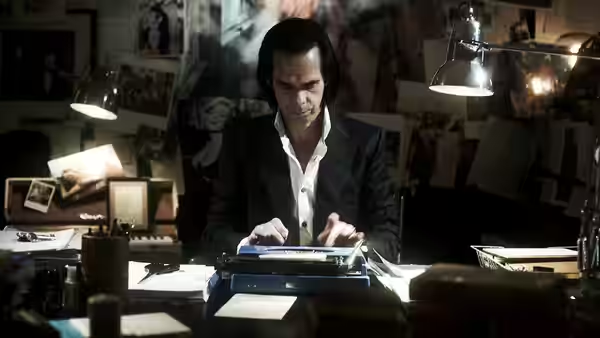
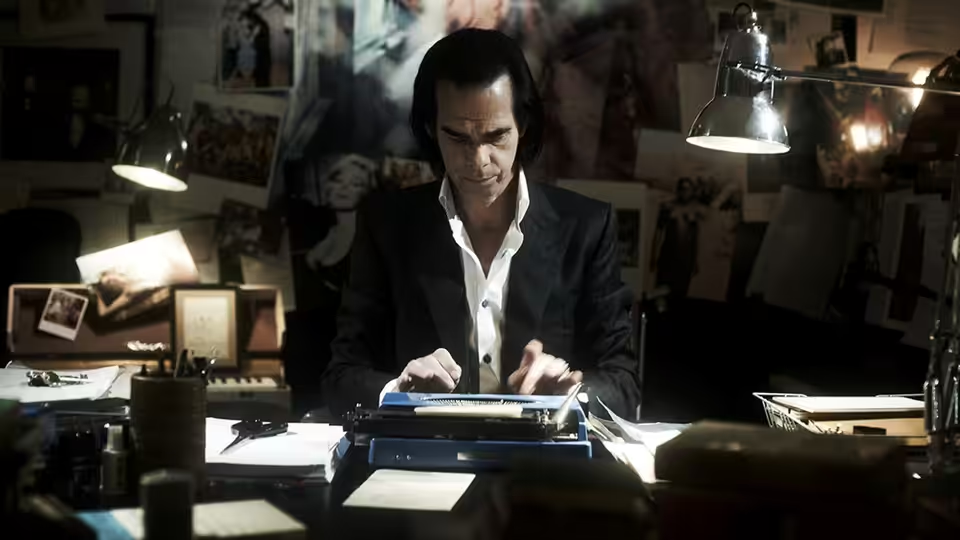
Nick Cave typing at a cluttered desk surrounded by photographs
Film review

20,000 Days on Earth

2014 · Directed by Iain Forsyth, Jane Pollard · 1h 37m · MPA NR

In a sentenceNick Cave spends a day explaining himself, and we would happily have stayed longer for dinner

Marking his 20,000th day alive, Nick Cave (as himself) moves through a partly staged day in Brighton. Notebooks and doodles supply material for songs, while conversations turn towards his memories and the way he works. Warren Ellis (as himself) and Blixa Bargeld (as himself) are among the people who share the portrait; a therapist and an archive offer other ways into his recollections. Nick Cave tries to describe how he turns ideas into music, while the public character he has constructed complicates the account. The day brings together the work of writing and the business of explaining himself.

Plays from YouTube when you press play; nothing loads from them until then.

Fi1m review

Iain Forsyth and Jane Pollard make an absorbing, often funny portrait of Nick Cave at work. Its carefully managed candour can be frustrating, but the songs and conversations make it rewarding even without prior devotion.

Iain Forsyth and Jane Pollard’s 20,000 Days on Earth is an absorbing film about making songs, with a frustrating reluctance to press the man making them. Nick Cave shares the writing credit with the directors, and his involvement helps explain how carefully he is presented. The partly staged day gives his memories and thoughts a shape without pretending that the camera has caught him unprepared. He is funny enough, and the work interesting enough, to make the arrangement worthwhile.

Erik Wilson’s shadow-heavy photography makes the staged encounters feel like parts of the same imagined day. The shadows suit a subject who takes his public image seriously, and the camera helps maintain that image even in apparently intimate company. It is an effective choice, though the solemnity can make an ordinary conversation seem more momentous than it is. The therapist and archive sequences keep the attention on recollection, giving his accounts of himself a structure beyond a series of anecdotes.

Jonathan Amos’s editing gives that day a clear rhythm, with the cross-cutting in the performance material providing a welcome increase in energy. Across 97 minutes, conversation and music have room to develop without the film feeling obliged to deliver a complete life story. The notebooks and doodles are especially useful. Seeing those scraps become songs turns a vague subject into a process we can begin to follow.

We felt unexpectedly fond of Nick Cave during his dinner conversation with Warren Ellis. The pleasure of talking to someone familiar makes his seriousness easier to live with, and the exchange has an ease that the formal framework does not quite allow elsewhere. Warren Ellis gives him someone to respond to, which is a relief after so much explanation. There is warmth in that familiarity, and it helps the film accommodate the more self-important stretches.

The music by Nick Cave and Warren Ellis gives all this discussion a purpose: we hear what the thinking and scribbling are for. The live performances have an urgency that justifies spending so long with the person who makes the songs. They also allow feeling into a film whose subject can be rather busy describing it. The attention to both unfinished work and performance means we can make our own judgements about how much the explanations tell us.

The limitation is the lack of pressure on the account we are given. The therapy framework suggests that uncomfortable questions might follow, but mostly supplies another occasion for the subject to speak on his own terms. His eloquence occasionally seems to satisfy the directors before it has satisfied us. Their willingness to let him control the conversation leaves some of the promised intimacy out of reach, however handsomely the encounters are filmed.

By music-documentary standards, the willingness to stage encounters is refreshing. It gives the directors a way to organise talk about memory and writing without turning every thought into a biographical lesson. Familiarity with the songs will help, but curiosity about writing and performance should be enough. We recommend making time for the company, with no expectation of a searching interrogation.
Critical consensus AI synthesised

77
Positive
18
Mixed
4
Negative
0

Most critics welcome 20,000 Days on Earth as an inventive, engaging portrait of Nick Cave, with praise clustering around its blend of staged encounters and documentary observation. The life-in-a-day structure, witty voiceover and glimpses of songs taking shape give the reviews plenty to admire beyond the performances. Critics also single out the cinematography, editing and sound, while several find that Cave’s humour and conversations with fellow artists make the carefully cultivated persona more approachable.

Reservations centre on self-indulgence and how much the film actually reveals. The responses range from enthusiastic to mixed, with none outright negative, but critics differ over its appeal beyond Cave’s following. Slant Magazine regards it as a meticulous but fans-only construction; IndieWire sees potential inspiration for anyone interested in creativity, while conceding that it barely explores his psyche. For some, the managed self-image is fascinating; for others, it limits the intimacy.

Radio Times
★★★★★ · Jamie Healy
100

The review is strongly positive about the documentary’s portrait of Nick Cave. It praises the filmmakers’ bravura style and the insight offered by Cave’s day in Brighton.

Read the full review →
Time Out
13 February 2014 · ★★★★★ · Dave Calhoun
100

The page identifies this as a review, but the review text is unavailable, so its verdict cannot be determined. The visible excerpt introduces Nick Cave marking his 20,000th day on Earth but does not reveal a specific point of praise or complaint.

Read the full review →
Evening Standard
18 September 2014 · Nick Roddick
85*

Roddick finds the documentary enthralling, provocative and surprisingly moving. He praises its exploration of Cave’s creative process and the transformation of his notebooks and doodles into songs.

Read the full review →
IndieWire
18 September 2014 · B+ · Cory Everett
83

Everett finds the film essential for Nick Cave fans and potentially inspiring to anyone interested in creativity. He praises its live performances and inventive, candid approach, while noting that it only skims the surface of Cave’s psyche.

Read the full review →
The AV Club
16 September 2014 · B+ · Jason Heller
83

Heller finds the documentary atmospheric and compelling, despite occasional self-indulgence. He praises its shadowy, verité-style approach and the counterpoint between Cave’s mythmaking and moments that puncture the myth.

Read the full review →
Empire
10 September 2014 · Guy Lodge
80*

The critic finds the film a shimmering, playfully elusive and seductive portrait of Nick Cave. They praise its cinematic sensibility and elegant life-in-a-day structure.

Read the full review →

Straight answers AI written, from our review

Is 20,000 Days on Earth worth watching?
20,000 Days on Earth is worth watching for its funny, absorbing account of Nick Cave making songs, and we score it 80. We find his carefully managed candour frustrating, but the conversations and performances reward curiosity about writing and music without requiring prior devotion to Cave.
How long is 20,000 Days on Earth, and what is it rated?
20,000 Days on Earth runs 1h 37m and is rated NR by the MPA in the US. It is a documentary and drama film.
Where can I watch 20,000 Days on Earth in the US?
20,000 Days on Earth is streaming on The Roku Channel and Tubi in the US, and it is also available to rent from Amazon Prime Video from $2.99. Availability is checked daily; the links above go straight to each service.
How violent or frightening is 20,000 Days on Earth, and is it suitable for children?
20,000 Days on Earth has a UK 15 certificate, making it unsuitable for children under 15. We describe a film centred on conversations, memories and musical performances, but cannot give a specific warning about violence or frightening material; the certificate remains the clearest guide to age suitability.

Cast

Awards

Sundance World Cinema Directing Award: Documentary, 2014

Won
Sundance World Cinema Directing Award: Documentary

Sundance World Cinema Documentary Editing Award, 2014

Won
Sundance World Cinema Documentary Editing Award

If you liked this, try…

  1. Stop Making Sense (1984) · not on Fi1m yetFor the pleasure of watching musical thought become precise, physical performance.

  2. The Beaches of Agnès (2008) · not on Fi1m yetAnother self-portrait that uses staged scenes to approach memory with warmth.

  3. The Quince Tree Sun (1992) · not on Fi1m yetStay with the daily work of an artist, including the stubborn delays.

  4. F for Fake (1973) · not on Fi1m yetA more mischievous companion for anyone intrigued by artists managing their reputations.

  5. Ryuichi Sakamoto: Coda (2017) · not on Fi1m yetA quieter study of musical creation, with close attention to listening.