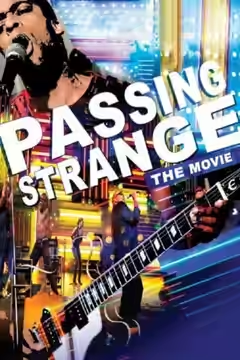
Stew has one screen credit and it is as himself: a big man with a guitar at the edge of Spike Lee's Passing Strange, telling the story of the boy he was and declining to let him off. Dry, patient and, on this evidence, worth an evening.
Fi1m perspective
He stands at the side of the stage in spectacles, guitar in hand, and talks to us about a boy from South Central Los Angeles called Youth who wanted to be an artist. The boy is Stew, some thirty years earlier, and he is played by Daniel Breaker. Stew never pretends otherwise, and the pleasure of watching him is in how little he flatters the boy. He waits, lets Breaker be pleased with himself, then gets a word in. Filmed at or below eye level by Matthew Libatique, his face does a great deal of the work while his hands do the rest on the strings.
The career behind that stance is a musician's. He formed The Negro Problem in Los Angeles in the early 1990s and made solo records from 2000. From 2004 he and Heidi Rodewald, his co-composer and bass player, built Passing Strange with the director Annie Dorsen; it opened at Berkeley Rep in 2006, moved to the Public Theater in 2007 and to Broadway in 2008, where Lee filmed its final performances for the 2009 release. He has called the result "autobiographical fiction", and the phrase is exact: he is himself on stage, telling a story he has tidied. Since then he has made further stage pieces, The Total Bent (2016) with Rodewald again and Notes of a Native Song (2018), neither of which has come to the screen.
What works is the double act. Lee's best decision is to put Stew and Breaker in the same frame and hold, and in those moments the film becomes an older man trying to correct a younger one who is not listening. We were moved more than we expected by how unforgiving that is: Stew writes his own youth as gangly, tiring and a little vain, and then stands three yards away watching him. Barry Alexander Brown cuts the songs hard on the beat and slows for the talk, so a line of Stew's is allowed to settle on the face of whoever it lands on. The lyrics are detailed and funny, and the band is part of the show rather than under it.
What does not work is the length and, now and then, the reach. At 135 minutes the film is a quarter of an hour longer than the show needs, and some of that is Stew's: a narrator who enjoys talking will talk. There are stretches where the material strains for a big statement about art and race and the cost of leaving home, when the small exchange between the two men has already made it. That is a writer's fault, not a performer's, and it comes with a piece this close to the writer's life.
One credit is not much to go on, and we would not pretend to know how he would fare in someone else's script. But the narrator's chair suits him, and so does the guitar. If he ever puts The Total Bent in front of a camera we will be in the queue. Until then there is one film, and it is a good one.
Biography
Stew, born Mark Stewart, is an American writer, composer, lyricist and performer. A longtime rock musician and frontman of the band The Negro Problem, he created the semi-autobiographical musical Passing Strange, writing the book and lyrics and co-writing the music with Heidi Rodewald. He performed as the Narrator in the original stage productions.
The show premiered at Berkeley Repertory Theatre in 2006, transferred to Off-Broadway and Broadway in 2007–2008, and was filmed by Spike Lee for a 2009 cinema release. Stew received the Tony Award for Best Book of a Musical and Drama Desk Awards for Outstanding Lyrics and Outstanding Music. He has continued to work in musical theatre and as a performer.