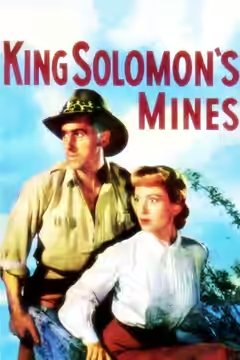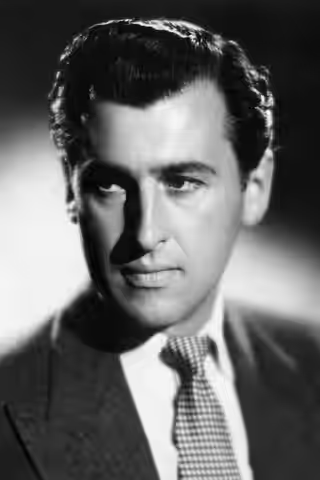
A leading man who looked born for the sword and the safari, Granger was at his best when he seemed slightly bored by both. Hollywood kept him in costume for a decade; the dry, reluctant hero of King Solomon's Mines suggests what else was there.
Fi1m perspective
The best thing Stewart Granger does in King Solomon's Mines (1950) is look as though he would rather be somewhere else. His Allan Quartermain has a son in England to pay for and no wish to die for a stranger's husband, and he delivers the film's sourest lines about the country and the men who come to shoot it as if he had said them many times before and stopped expecting anyone to listen. Most adventure heroes want the adventure. Granger's wants the fee.
That reluctance is the interesting part of him, and it is the part the studios used least. He came up through repertory and the West End in the 1930s and became a star in the Gainsborough melodramas from 1943, beginning with The Man in Grey, in which he played Rokeby. King Solomon's Mines took him to Hollywood and an MGM contract, and MGM knew exactly what it had bought: a tall man who could fence. Scaramouche (1952), The Prisoner of Zenda (1952) and Moonfleet (1955) followed, and the comparison to Errol Flynn was made so often it became a job description. Later there were European films and television.
The physical side was real. He moves well and he is convincing with a blade, and Scaramouche, where he plays André Moreau, is still the film people reach for when they want to show what the swashbuckler could be. The criticism, then and since, is that he was kept in the same costume for too long and asked for too little inside it, and we think that is fair. The dry, self-disliking man of the safari film is not a note MGM went back to.
We had gone into King Solomon's Mines for Robert L. Surtees's Technicolor and the stampede, and we got them, but what stayed with us was smaller: Granger mentioning the boy in England as a debt rather than a sentiment, and moving on before the line could turn soft. It is a professional's performance about a professional, and it is better than the film around it. The romance with Deborah Kerr, with whom he made two films, is a quarrel, a rescue and a kiss in that order, and only her cropped-hair scene earns its keep; he plays the rest with the good manners of a man who knows the script has scheduled him. He worked three times with Jean Simmons as well, though we have not yet reviewed those.
Start with the safari. Watch him while other people are talking, and count how often he looks like a man who has already done the sum.
Biography
Stewart Granger (born James Lablache Stewart) was a British actor. He was born on 6 May 1913 in Kensington, London, and died on 16 August 1993 in Santa Monica, California. He trained at the Webber-Douglas School of Dramatic Art and began his career on stage before appearing in British films from the early 1940s.
Granger rose to prominence in Gainsborough melodramas such as The Man in Grey (1943) and Fanny by Gaslight (1944). He moved to Hollywood in 1950 and starred as Allan Quatermain in King Solomon's Mines (1950). Subsequent leading roles included Scaramouche (1952), The Prisoner of Zenda (1952) and North to Alaska (1960).
He later appeared in television series including The Love Boat and Murder, She Wrote, and films such as The Wild Geese (1978). Granger became a United States citizen in 1956.