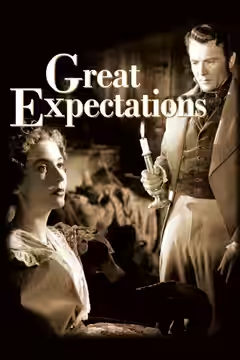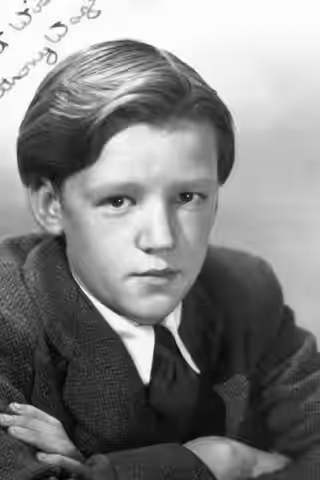
Tony Wager makes young Pip frightened without making him ingratiating. Our regard for him rests chiefly on Great Expectations, where his unforced distress gives David Lean's imposing Dickens adaptation a child we believe in.
Fi1m perspective
In the opening graveyard scene of Great Expectations (1946), Tony Wager makes Pip's fear look as though it has arrived before he knows how to disguise it. We were frightened because his distress seemed immediate, with no hint that he was asking us to admire his acting. Guy Green's black-and-white photography leaves the child exposed in a place where being able to see clearly offers little reassurance. Wager gives that cold, hostile setting someone we can worry about, and David Lean is right to keep the child's vulnerability so firmly in view.
That is the performance on which our regard for Wager rests, and it is a substantial achievement. The temptation in a part like young Pip is to make innocence conspicuous, giving every frightened response an extra nudge. Wager avoids that: the emotion is clear without being displayed for approval, and we never have to make allowances for a child performer. The adult romance is less persuasive, but the early scenes have already given us good reason to care about Pip.
Later credits are less helpful in judging what he could do. Wager continued in British films and television through the 1950s and 1960s, including small and uncredited parts. He was Fezziwig's Lad in Scrooge (1951) and a lookout aboard HMS Ajax in The Battle of the River Plate (1956), both uncredited appearances. From the late 1960s his work was mainly in Australian television, ending with The Boardroom (1988). We would be cautious about treating those smaller parts as a verdict on his abilities, or claiming too much for them on the strength of Pip.
There is a danger in praising a child performance as natural: it can make the actor's contribution sound like an accident. Lean and Green make the graveyard hostile, but Wager makes its effect on Pip believable. We should give him credit for that restraint, alongside the director's judgement in casting him. Watch Great Expectations for him, rather than merely waiting for Pip to grow up.
Biography
Anthony Wager, also credited as Tony Wager or Anthony Alexander Wager, was an English actor and television writer. He was born on 24 June 1932 in Willesden, London, and died on 23 December 1990 in Bali, Indonesia. He grew up in Mill Hill and Hendon, attended Christ's College, Finchley, and made his screen debut as Young Pip in David Lean's Great Expectations (1946).
Wager appeared in several British films during the 1940s and 1950s, including uncredited roles in Scrooge (1951) and The Battle of the River Plate (1956). He later moved to Sydney, Australia, where he worked in film and television and wrote for series such as Silent Number (1974). His final onscreen role was in the 1988 Australian television film The Boardroom. He received a Film Daily Critics Award for Best Performance for a Juvenile for his work in Great Expectations.