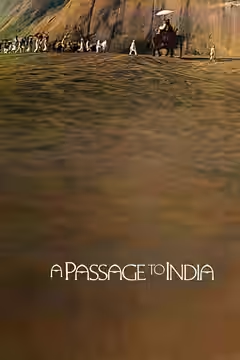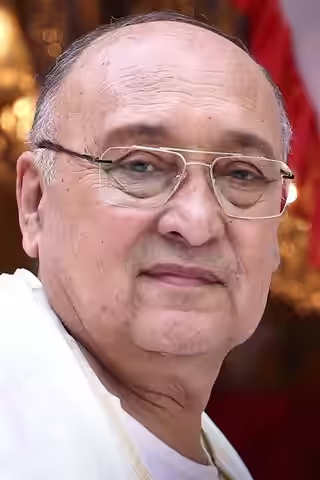
Victor Banerjee plays men who are quick to like people and slow to recover from a slight, and his tell is a laugh that arrives a beat too soon. In A Passage to India he is better than the film around him.
Fi1m perspective
Watch the mosque scene in A Passage to India (1984). Ernest Day has moonlight on the water outside, an old Englishwoman has wandered in with her shoes off, and Dr Aziz, who came to be alone, is talking to her before he has decided whether he should. Banerjee lets Aziz laugh a beat too soon, and then he lets us see the laugh cost him. It is a performance built on eagerness and on how much eagerness hurts when it is not returned. He gets a bungalow so small his friends sit on the bed, and he offers it as if it were a palace.
That was the year the West noticed him, though he had been working for Satyajit Ray since Shatranj Ke Khilari (1977), also known as The Chess Players, in which he played the Prime Minister. He made three films with Ray in all, including Ghare Baire (1984), another literary adaptation, as Nikhilesh Choudhury. Lean came the same year, Roman Polanski's Bitter Moon (1992) followed with Banerjee as Mr Singh, and there was work with James Ivory, Mrinal Sen and Shyam Benegal, in Hindi, Bengali, English and Assamese, and as late as High Life (2018). The pattern is clear enough: educated men, often in period dress, standing where two worlds meet and being asked to choose.
What he does well is play the wound without playing the victim. Aziz moves from host to injured party to a man in a rage, and Banerjee never asks for sympathy along the way; he simply shows us each stage and lets Peggy Ashcroft's tired, dry Mrs Moore be the one person who sees it. Their scenes are the heart of Lean's film. The moment that stayed with us is smaller: Aziz summoned to Major Callendar's house, kept waiting, and then watching Callendar's wife take his carriage without a word. Banerjee does almost nothing, and we felt the humiliation of it more sharply than anything in the trial that follows.
The trouble is that the trial does follow, and Lean's last hour slows to a procession while the man at the centre of it is left to wait. Banerjee is better than the film around him, which is a compliment to him and a limit on what he could do with the part. We have reviewed only this one of his films, so we can say with confidence what he does at his best and less about how often he has been allowed to do it.
He has described himself as selective, preferring quality to volume and keeping his distance from mainstream Bollywood. He also once said, "A film is like a one-night stand and theatre is a commitment." He has treated cinema accordingly, and cinema, on the evidence of Aziz, has lost by it.
Biography
Victor Banerjee is an Indian actor who has appeared in English, Hindi, Bengali and Assamese films. He trained at St Edmund's School in Shillong and graduated in English literature from St Xavier's College, Calcutta, later studying comparative literature at Jadavpur University.
Banerjee made his screen debut as the Prime Minister in Satyajit Ray's Shatranj Ke Khilari (1977). He gained international attention for his role as Dr Aziz H. Ahmed in David Lean's A Passage to India (1984), for which he received a BAFTA nomination and won the Evening Standard British Film Award and National Board of Review Award. His other credits include Bitter Moon (1992), Gunday (2014) and High Life (2018). He was awarded the Padma Bhushan in 2022.