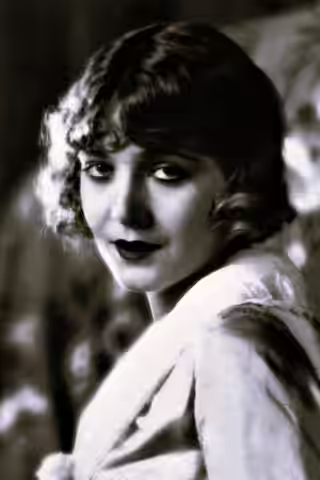
Vilma Bánky brings charm to silent romance, but The Eagle leaves us wanting more reason to care about the lovers. Her appeal is clear; the emotional force depends on how much the writing gives her.
Fi1m perspective
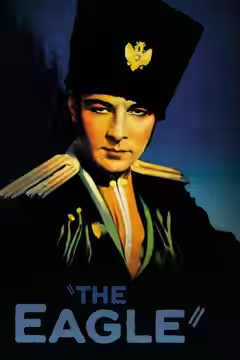
Beside Rudolph Valentino in The Eagle (1925), Vilma Bánky looks entirely at home in a romantic adventure. Her Mascha Troekouroff is appealing, and Clarence Brown's film has enough charm and comic life to make a worthwhile evening. We were disappointed when our interest in the lovers kept fading, because their romantic passages are less engaging than the comedy around them. Hanns Kräly's screenplay provides lightness rather than emotional depth, leaving the actors with too much to supply themselves.
Her Hollywood work quickly settled around such pairings after an early career in European films. The Dark Angel (1925), her American debut, put her opposite Ronald Colman, who became a frequent co-star. They were paired again in The Winning of Barbara Worth (1926) and The Night of Love (1927), while The Son of the Sheik (1926) was her second and final film with Valentino. Across those romantic vehicles, the attraction of the leading couple was central to what she was being asked to do.
Samuel Goldwyn's publicity stressed her beauty and charm, and much of the discussion of her acting followed suit. Charm matters in these films, and we would not dismiss it simply because it was easy to advertise. But The Eagle shows the limits of asking an attractive pairing to sustain scenes that need better writing. Louise Dresser's amused authority makes the comic passages more involving, and we wait for the romance to catch up.
The move to sound exposed a different difficulty in matching her to material. This Is Heaven (1929) drew criticism for attempts to Americanise her screen image, while her Hungarian accent troubled audiences and some reviewers in that film and A Lady to Love (1930). Her Hollywood feature career ended after 1930, with a final German film, The Rebel (1933), following. Those circumstances should not become a verdict on every silent performance. Start with The Eagle, provided a light adventure will do and a compelling love story is not essential.
Biography
Vilma Bánky was a Hungarian-born American actress. She began her career in Europe, appearing in films in Hungary, Austria, France and Germany from around 1920. In 1925 Samuel Goldwyn signed her to a Hollywood contract while she was in Budapest.
She was promoted as "The Hungarian Rhapsody". Her American films include The Dark Angel (1925), The Eagle (1925) in which she played Mascha Troekouroff opposite Rudolph Valentino, and The Son of the Sheik (1926), also with Valentino. She frequently co-starred with Ronald Colman. Bánky retired from films in the early 1930s after the advent of sound.
In 1927 she married actor Rod La Rocque; the couple remained together until his death in 1969 and had no children. Bánky died on 18 March 1991.