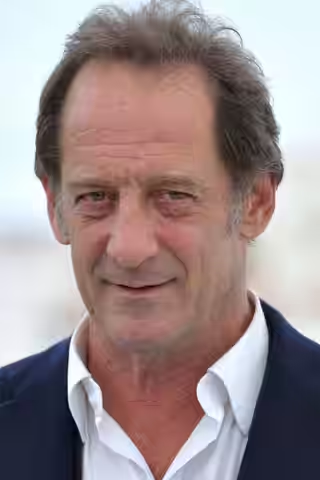
Vincent Lindon does less on screen than almost any leading man in French cinema and gets more back. Cast for four decades as ordinary men under pressure, he never pleads for sympathy, and in Titane the same stillness held up inside a horror film.
Fi1m perspective
There is a party at the fire station in Julia Ducournau's Titane (2021). The stranger Vincent has taken in as his missing son climbs onto the engine and dances the way she used to dance on car bonnets, and the men do not know where to look. Ducournau cuts to Lindon, and his face does the whole scene: a man deciding, in front of us, what he is prepared not to notice. That scene moved us more than we expected, and none of it was dialogue. This is what Lindon does. He stands still, he watches, and he lets us see a decision being taken.
He has been at it since the early 1980s, first in small parts (Betty Blue in 1986, a drunk in La Haine in 1995), then through the 1990s and 2000s with Claude Sautet, Bertrand Blier, Claude Lelouch and Pierre Jolivet, who used him five times. Coline Serreau cast him three times. The turn came with Stéphane Brizé, from Mademoiselle Chambon onward, and it is the Brizé films that most people now mean when they say his name: The Measure of a Man (2015), At War (2018), Another World (2021), five together in all. Brizé puts him among non-professional actors in stories about work and the lack of it, and lets the camera find out whether he can be told apart from them. Mostly he cannot, which is the point.
What critics keep noticing is restraint, and they are right, but restraint on its own is just a man not doing much. Lindon's trick is that the body keeps talking after the face has shut up. In Titane his fire captain injects steroids into his bruised backside every night to keep a body that is giving up on him, and Impens shoots the station in orange and near-dark so the men glow while Jim Williams's organ and low choir grind underneath. Lindon holds still in the middle of all that noise and is the most frightening thing in the frame. He has said that his one strength is "a lack of self-conscience", and that explaining his method would throw him off balance. We believe him.
The caveat is the obvious one. A style that depends on not being seen to act invites directors to ask for the same man again, and he has been cast, over and over, as the ordinary middle-aged fellow with the economy on his back. Titane and Quentin Dupieux's The Second Act (2024) suggest he knows this and has started saying yes to stranger offers; The Quiet Son (2024) puts him back in a father's shoes. Start with Titane, where the method is under a different kind of pressure, then go to Brizé, where it lives. He is in his sixties now and the men he plays are ageing with him, which suits the work. A man who does so little on screen has never needed youth to do it.
Biography
Vincent Lindon is a French actor and filmmaker. He trained at the Cours Florent in Paris and made his screen debut in the early 1980s.
He is known for roles in La Haine (1995), The Measure of a Man (2015), Titane (2021) and The Second Act (2024). For his performance in The Measure of a Man, he received the Best Actor award at the 2015 Cannes Film Festival and the César Award for Best Actor. In 2022 he served as president of the jury for the main competition at the Cannes Film Festival. He won the Volpi Cup for Best Actor at the 2024 Venice International Film Festival for The Quiet Son.