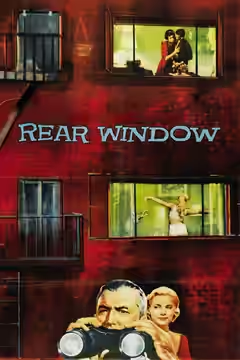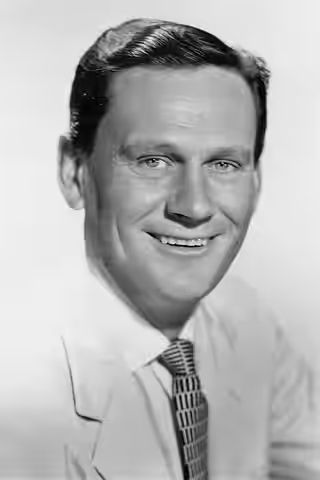
Wendell Corey makes sober authority worth watching by allowing a little cynicism into it. We value his understated support, especially in Rear Window, where a sceptical detective gives the excitement something useful to contend with.
Fi1m perspective
In Rear Window (1954), Wendell Corey gives doubt a gruff voice. His Thomas Doyle is the sceptical detective, and Alfred Hitchcock makes good use of an actor who seems unlikely to be hurried into agreement. We enjoyed Corey's sobriety here: in a film that makes watching so enticing, his resistance to suspicion gives us something to argue with. He does not need to make Doyle more colourful to make him worth watching.
That sober manner was useful beyond detectives and doctors, the authority figures he often played. His film debut, Desert Fury (1947), came under producer Hal Wallis; by The File on Thelma Jordon (1950), he was co-starring opposite Barbara Stanwyck. He also appeared with her in the western The Furies (1950). The early opportunities to lead gave way to an emphasis on supporting work through the 1950s, where his understatement could help a star without demanding equal attention.
Corey's strength is that solidity need not mean simple reassurance. The piercing eyes and gruff delivery suit men whose job is to assess a situation, while the cynicism leaves open the possibility that they have already had enough of everybody involved. We would be cautious about praising dependability as if it were sufficient in itself. An actor who supplies sober authority needs a film that makes that authority interesting, and Doyle's scepticism has a clear use in a story built around looking and suspecting.
Our enthusiasm for Rear Window is not a claim that Corey carries it. James Stewart and Grace Kelly supply its warmth, and Hitchcock's courtyard thriller has humour and unease that reach well beyond this supporting performance. What Corey offers is the useful resistance of a man who will not simply share the excitement because the film invites it. Start there, and give the detective some attention even when it is more tempting to agree with somebody else.
Biography
Wendell Reid Corey was an American actor and politician. He began his career on the stage, appearing in summer stock productions before making his Broadway debut in Comes the Revelation (1942). He achieved success as a cynical newspaperman in Elmer Rice's Dream Girl (1945).
Producer Hal Wallis signed him to a Paramount contract, and Corey made his film debut in Desert Fury (1947). He became known for supporting roles in films including Sorry, Wrong Number (1948), The Search (1948), The Furies (1950) and Rear Window (1954), in which he played Lt. Thomas Doyle. On television he appeared in series such as Alfred Hitchcock Presents (1955), Perry Mason (1957) and The Wild Wild West (1965), and had regular roles in Harbor Command (1957–1958) and The Eleventh Hour (1962–1963).
Corey served as president of the Academy of Motion Picture Arts and Sciences from 1961 to 1963 and as a board member of the Screen Actors Guild. A Republican, he was elected to the Santa Monica City Council in 1965 and stood unsuccessfully for the US Congress in 1966.