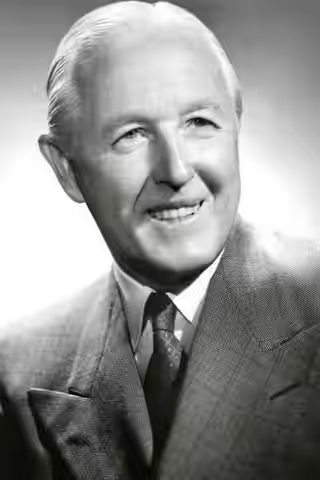
William Keighley was the Warner Bros. house director who finished on time and got out of the actors' way. That made him useful for twenty years and, on the one film everyone remembers, not quite enough.
Fi1m perspective
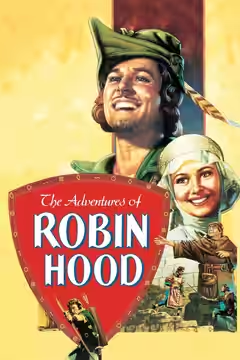
The credits of The Adventures of Robin Hood (1938) carry two directors' names, and the story of the second one is the story of William Keighley's career. He shot the location work, the footage out among the trees, and the studio then took him off the picture and handed it to Michael Curtiz because it wanted more pace and more fighting. We gave the finished film 90 and would send a stranger to see it, and we cannot honestly say how much of what we love in it is his. That is not a slight. It is how the studio worked.
He came to films from the stage, an actor and then a Broadway director, and joined Warner Bros. around 1930 as sound arrived, working as a dialogue director before his first solo features in 1934. What followed was the studio's bread and butter, gangster pictures and comedies, made quickly. 'G' Men (1935) put James Cagney on the right side of the law as a federal agent and was the film that made Keighley's name. Bullets or Ballots (1936) had Edward G. Robinson and Humphrey Bogart in an undercover crime story. Each Dawn I Die (1939) was Cagney again, in prison. They made five films together, and the best of them sit among the actor's stronger work.
The comedies came from Broadway, where he had started, and The Man Who Came to Dinner (1942), from the Kaufman and Hart play, is the one still spoken of well: a large cast talking fast in one house, which is a thing he knew how to run. The war took him to supervise the Army Air Forces' film unit, and afterwards the work thinned. The Street with No Name (1948) is a late crime thriller with a decent reputation. He stopped after The Master of Ballantrae (1953), his third film with Errol Flynn.
The case against him has always been the same one, and it is fair. He had no signature. Put a Keighley film next to a Curtiz film and you can tell which is which, and it is not Keighley's that catches the eye; The Prince and the Pauper (1937) is the example usually reached for. The case for him is the one the studio made every time it handed him a schedule: he would bring it in, it would move, and the stars would look like themselves. In the 1930s that was worth a good deal.
Watching Robin Hood again, we were as happy as we ever are in a cinema, and it surprised us that a film with so straight a moral line could still land so hard. Some of that happiness is in the forest, which was his. The rest belongs to Flynn and to the man who replaced him. A director whose most famous credit is the one he was taken off is a working man, not a tragic one, and the factory did well enough by him.
Biography
William Keighley was an American film director and former stage actor. Born in Philadelphia in 1889, he trained at the Ludlum School of Dramatic Art and began acting on stage at the age of 23. He worked as an actor and director on Broadway in the 1910s and 1920s before moving to Hollywood with the arrival of sound films.
Keighley signed with Warner Bros., where he directed a range of genres including crime dramas and comedies. He began directing The Adventures of Robin Hood (1938) but was replaced by Michael Curtiz after several weeks of shooting; the two share credit. Other notable films include 'G' Men (1935), Bullets or Ballots (1936), The Prince and the Pauper (1937), Each Dawn I Die (1939) and The Man Who Came to Dinner (1941). During the Second World War he supervised the US Army Air Forces' First Motion Picture Unit.
He retired from film-making in 1953 and later lived in Paris with his wife, the actress Genevieve Tobin. Keighley died in New York City in 1984.