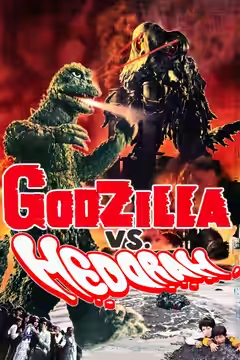
Yoshimitsu Banno directed one Godzilla film and was never given another. Godzilla vs. Hedorah (1971) is a sincere, grubby, frightening picture about industrial filth, stitched to a children's monster fight, and it remains the strangest thing the series has produced.
Fi1m perspective
A kitten on a beach, coated to the eyes in oil. Brown water in the bay, a dead fish drifting past a dead crab. A man falls into a pool of sludge and comes out as bone. These are the images Yoshimitsu Banno chose to put in front of an audience of children in 1971, in a series that had spent the previous decade turning its monster into a mascot, and they are the reason Godzilla vs. Hedorah is still argued over.
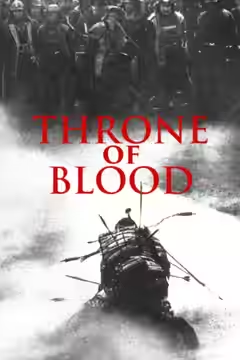
He came to it late and from a distance. Banno had joined Toho in 1955 and spent years as an assistant director, four of them on films for Akira Kurosawa, among them Throne of Blood (1957). His first credit as director was not a feature at all but an audiovisual show for the Mitsubishi pavilion at Expo '70, Birth of the Japanese Islands. On the strength of it, producer Tomoyuki Tanaka handed him the eleventh Godzilla. Banno later recalled the pitch: 'I asked Tanaka, "What about a pollution monster?" He agreed.' What Tanaka got was a heap of living sludge that drinks factory smoke and grows, and a director who meant every frame of it.
What works is the smallness. Banno and his cinematographer Yôichi Manoda keep the horror to a hand, a face, a drainpipe before the thing stands up, and those minutes frighten far more than the fights that follow, which are Teruyoshi Nakano's two suits pushing at each other in mud. We were horrified by that kitten, and had not expected to be; it is a real animal in real filth and the camera does not look away. What does not work is nearly everything else Banno tries: a nightclub singer whose dancers' faces turn to fish heads for a few frames, split screens, negative images, a cartoon Hedorah eating a cartoon factory, a cheerful theme song he wrote the words to, real belching chimneys cut straight into the story. Some of it lands. Much of it is a first-time director spending every idea he has saved up, and the film never decides whether it is a warning for adults or an afternoon out for their children.
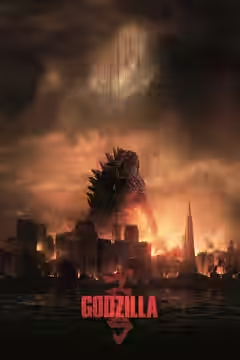
Toho did not ask him back. He took a smaller job as associate director on Prophecies of Nostradamus (1974), another disaster picture, then spent the decades that followed on documentaries, animated features and large-format projection systems, and from the 2000s on a 3D Godzilla that was never made but contributed to his executive producer credit on Legendary's Godzilla (2014). It is an odd shape for a career: one feature, then forty years in its shadow. But that one feature is closer in spirit to Ishirō Honda's 1954 original than anything made in the fifteen years between them, and it took a man with no track record to remember what the monster had been for. Start with the first half hour. Stay for the rest because, whatever else it is, none of it is dull.
Biography
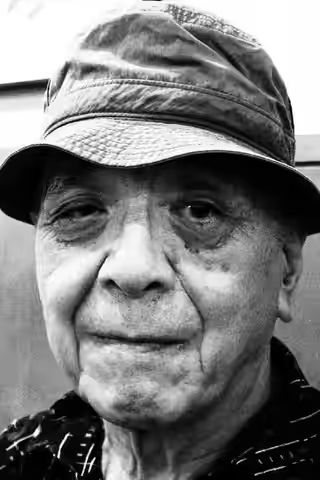
Yoshimitsu Banno was a Japanese film director, writer and producer. He joined Toho in 1955 and worked as an assistant director on several Akira Kurosawa films, including Throne of Blood (1957), The Hidden Fortress (1958) and The Bad Sleep Well (1960).
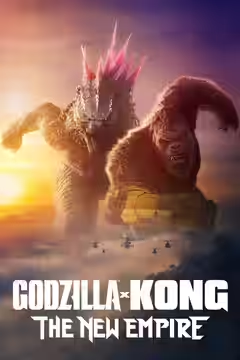
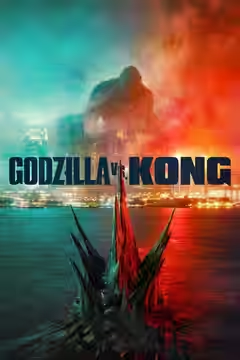
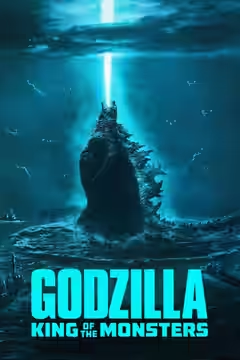
Banno directed and co-wrote Godzilla vs. Hedorah (1971), his feature debut, which featured an environmental theme. He later served as executive producer on Legendary Pictures' Godzilla (2014). Following his death, he received posthumous executive producer credits on Godzilla: King of the Monsters (2019), Godzilla vs. Kong (2021), Monarch: Legacy of Monsters (2023) and Godzilla x Kong: The New Empire (2024).