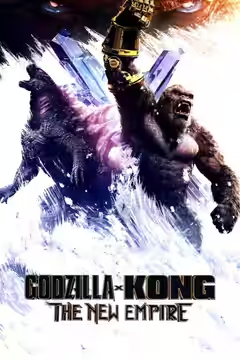
Adam Wingard’s second monster team-up is bright, loud and daft, and it is at its best when the humans stop talking, which is not often enough. Left alone with the apes, it is close to good fun; the rest is people reading out the plot.
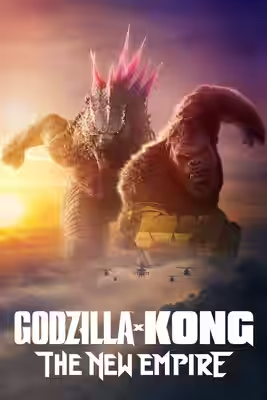
Adam Wingard’s follow-up to Godzilla vs. Kong (2021) is the fifth film in the Legendary MonsterVerse, and it has half learned the lesson the others refused to: nobody came for the people. Kong gets long stretches of the film to himself, without a line of dialogue, and they are the best stretches. Then the humans return to explain what we have just watched, and the film sags every time. It is loud, bright and daft, and for about a third of its 115 minutes it is good fun.
The setup is simple enough. Kong lives below in Hollow Earth, Godzilla patrols the surface, and a signal from the deep sends Ilene Andrews (Rebecca Hall), her adopted daughter Jia (Kaylee Hottle), the podcaster Bernie Hayes (Brian Tyree Henry) and a veterinarian called Trapper (Dan Stevens) down to see what is calling. What they find includes a hidden tribe of Iwi, a queen (Fala Chen) and a tyrant ape called the Skar King. The plot beyond that is a list of reasons for large things to arrive in the same place.
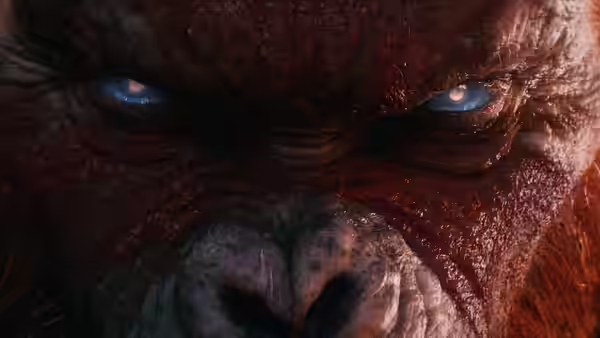
The ape is the film. Kong’s early scenes, hunting and bathing and sulking with a sore tooth, are played entirely on his face, and the animators give him a wariness and a short temper that no human in the cast is allowed. When he picks up a smaller ape and uses it to hit other apes we laughed out loud, and the pleasure was uncomplicated, the pleasure of a child knocking over a tower of blocks. It is the one place the film knows exactly what it is.
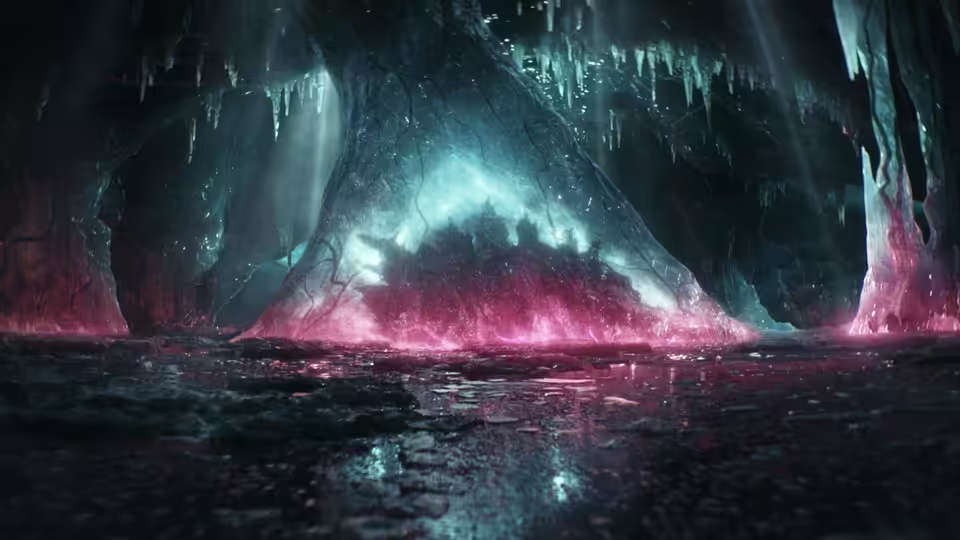
Ben Seresin shoots Hollow Earth in saturated pinks, greens and violets, so it looks like a screensaver, and the surface in flat grey daylight, so the monsters look as if they have been dropped into news footage. Tom Hammock builds the Iwi city as carved stone lit from within, and it is the one set we wanted to look at for longer than the cut allowed. Tom Holkenborg and Antonio Di Iorio’s score pulses along in synth and hits hard when the fights start. Emily Seresin puts Stevens in shirts of a loudness that becomes a running joke, and he wears them with the ease of a man who has stopped reading his own scenes.
The humans are the problem, and the script by Simon Barrett, Jeremy Slater and Terry Rossio does not help them. Henry’s Bernie talks constantly and says most things twice. Hall is a fine, watchful actress given readouts to frown at. Hottle, who has the film’s one real feeling to carry, a girl who does not know where she belongs, is handed a lost-tribe subplot that resolves itself in a montage. Josh Schaeffer cuts away from the people as soon as he decently can, which tells you how the editor felt about them, and the film keeps going back anyway.
Somewhere past the hour we realised we had stopped listening to anyone with a mouth and were simply waiting for the next growl. That is fine in a monster film for a while. It is less fine when the climax arrives, and landmarks come down in several countries, and the sound is mixed so high that we came out of the cinema tired. The film has no interest in whether anybody was inside those buildings, and after a point neither did we, which is not a thing we like noticing about ourselves.
Ishirō Honda’s Godzilla (1954) was about a bomb. Godzilla Minus One (2023) was about a man who could not forgive himself, and it made its monster frightening with a fraction of the resources. The New Empire is about an ape with a club, and it knows it. Godzilla vs. Kong was tidier, one fight promised and one fight delivered; this has more monsters and less shape.
At home you can turn the sound down and skip nothing, since the plot survives in the pictures. It runs 115 minutes and carries a 12A, and the certificate is right: nothing in it will frighten anybody. See it if you are about nine, or have one with you.