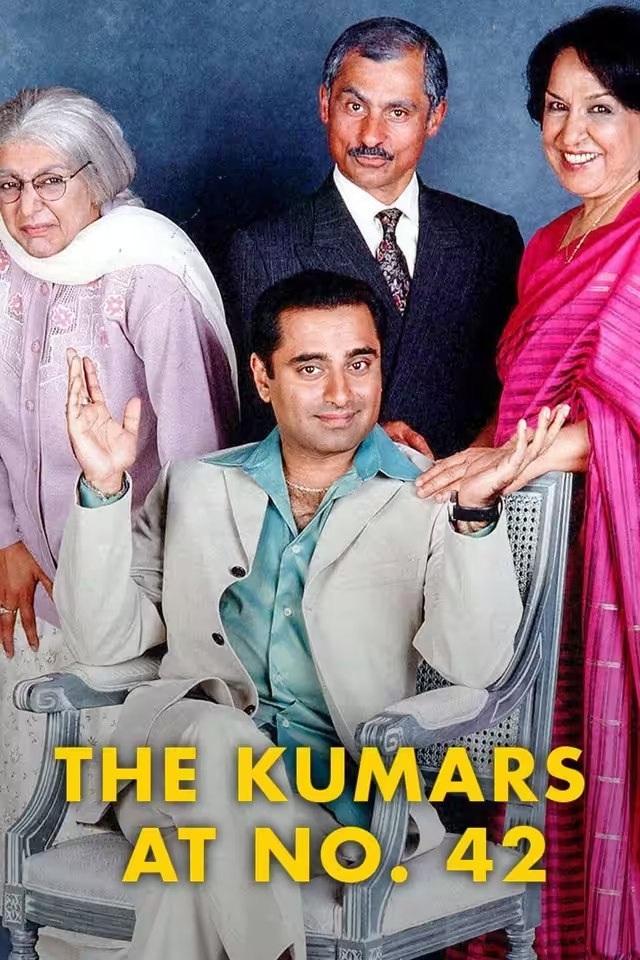
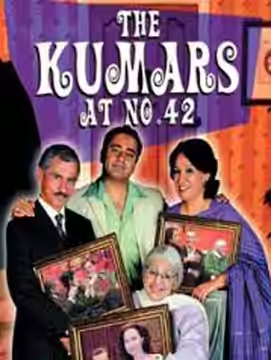
Sanjeev Bhaskar and Sharat Sardana hide a chat show inside a sitcom and let a fictional family loose on real celebrities. The idea is slight and repeats itself across seven series, but Meera Syal’s grandmother is a comic creation we would put beside anyone’s.
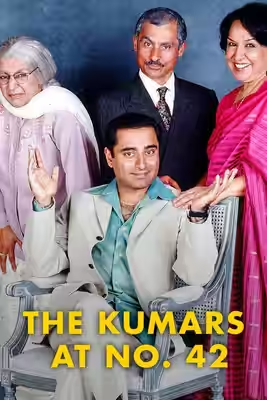
Sanjeev Bhaskar plays the son of the house, who wants to host a chat show, and whose parents have built him a studio on the back of their semi-detached so that he can. That is the whole of the idea. A real celebrity arrives each week, is kept in the living room for a few minutes to be fed, interrogated and propositioned by the family, and is then taken through to the studio for an interview that the host loses control of inside a minute. The family are fictional. The guest is not, and has not been given the script. It is a thin idea, and for its first few series it was done so well that the thinness did not matter.
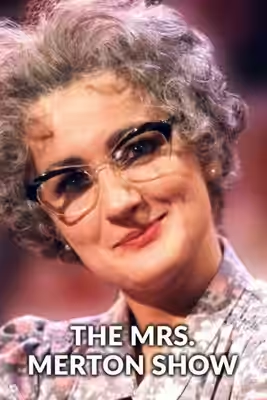
Meera Syal’s Ummi is the reason it works. Syal, well under half the age of the character, plays the grandmother in cardigan and spectacles as a woman who has stopped caring what anybody thinks of her and has noticed that this is a kind of power. She wants to know whether the guest is married, what they are paid and whether they would like to see upstairs. We laughed, out loud and more than once, at the way Syal lets a question sit until the guest starts to answer it, and then asks a worse one. The skill is that she never breaks. The guest is the only person on the sofa who is allowed to, and sooner or later most of them do.
Indira Joshi and Vincent Ebrahim have the quieter jobs and do them well. Joshi’s Madhuri is all food and worry, pressing plates on people who have come to promote a book. Ebrahim’s Ashwin is interested in money, his own importance and nothing else, and asks the questions about mortgages that a professional interviewer has been trained out of. Bhaskar gives himself the least grateful part: his host has booked the guest, wants badly to be their friend, and is humiliated by his own family before the titles have finished. He plays the panic straight, which is right.
Lissa Evans directs it as a studio sitcom, several cameras and an audience, and Sharat Sardana and Bhaskar’s scripts give the family a handful of lines each and then step back and let the guest react. Anil Gupta produces. The join between the written part and the unwritten part is visible, and the show is honest about it; the fun is watching a professional decide, in real time, how much of the game to play. The guests range from Helena Bonham Carter to Carol Vorderman to Robson Green, and the format is at its best when they do not try to compete.
The caveat is that it is one joke. The show ran for seven series and 51 episodes, from 12 November 2001 to 2006, and the joke did not grow. By the later runs the family’s lines had hardened into catchphrases, and the guests arrived already knowing that the grandmother would make a pass at them, which takes the surprise out of the pass. There is almost no sitcom underneath; nothing happens to the Kumars between guests, and nobody in the house changes. A half-hour also lives or dies by the booking. A guest who will not be embarrassed leaves Syal with nowhere to go, and there are episodes where you can see her looking.
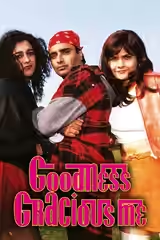
Set against Goodness Gracious Me, the sketch show Bhaskar and Syal came out of, this is narrower and more relaxed; it has one target instead of forty and hits it more often. The one review we have read puts it a little higher than we do, largely because its American adaptation made the original look better by comparison. We do not need the comparison. The show is funny on its own terms and wears out on its own terms too.
Watch the first two series, one episode at a time, with someone old enough to remember who the guests were. Watch any more than that in a sitting and you will start to see the hand on the knee coming.