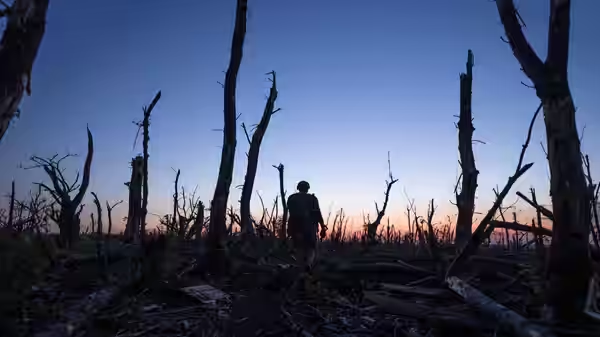
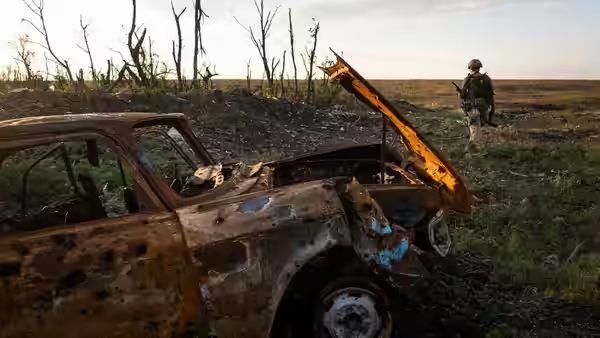
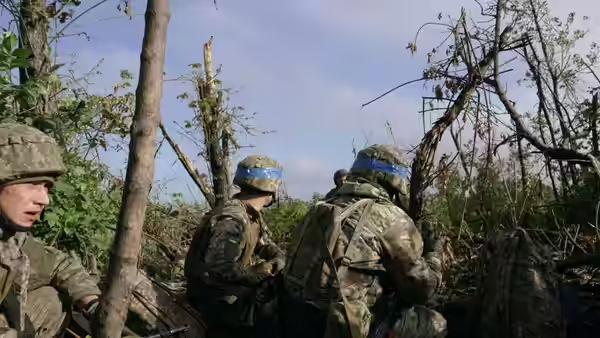
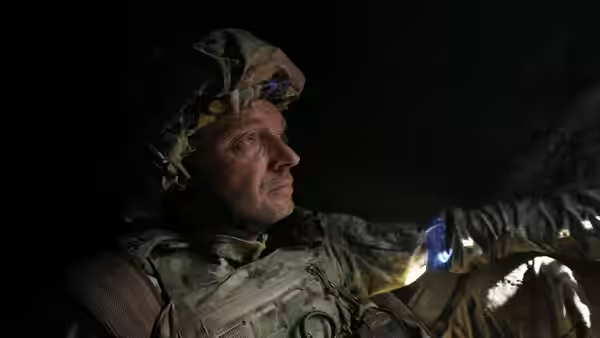
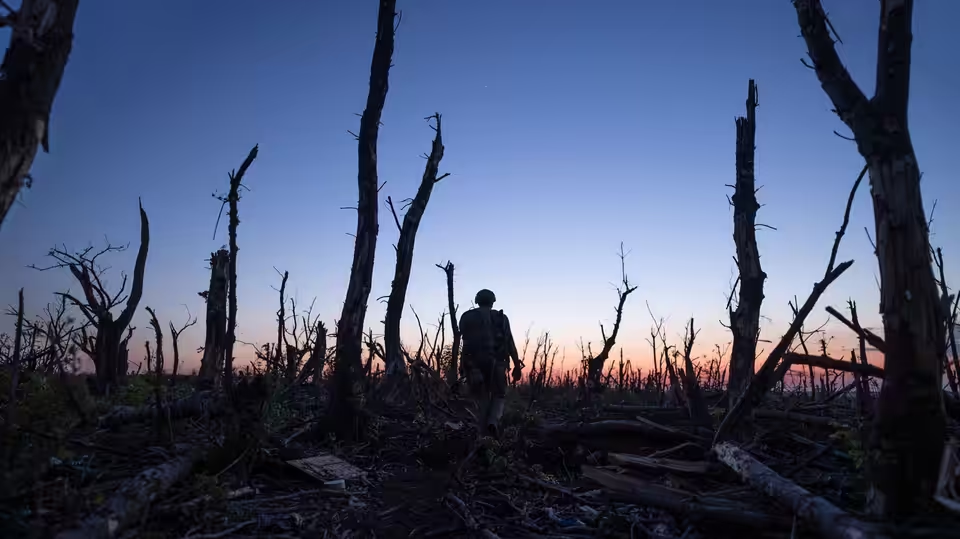
A lone soldier walks among shattered trees at dusk
Film review

2000 Meters to Andriivka

2025 · Directed by Mstyslav Chernov · 1h 48m

In a sentenceThe soldiers’ conversations are the scenes we kept wishing would last longer

Andriivka, a village in Ukraine, is the objective of a counteroffensive recorded from the soldiers’ positions on the ground and by drones overhead. Director and cinematographer Mstyslav Chernov appears as himself, accompanying men whose body cameras record the fighting from their own positions. They need to reach the village, but each advance exposes them to more fighting. Between engagements, the men wait and talk. Editor Michelle Mizner brings together these conversations, combat footage and drone images, with music by Sam Slater. The film follows the immediate demands of the advance and the people carrying it out.

Plays from YouTube when you press play; nothing loads from them until then.

Fi1m review

Mstyslav Chernov brings us close enough to the fighting for every pause to feel precious. This is a harrowing, humane documentary whose combat footage is stronger than the narration laid over it.

Mstyslav Chernov’s 2000 Meters to Andriivka is a harrowing, humane documentary that we recommend despite some unnecessary explanation. It follows Ukrainian soldiers fighting towards the village, making the advance intelligible through combat, waiting and conversations with the men involved. Chernov is concerned with what it takes to keep going when progress means more fighting. The film’s strength is the time it spends with people who must do that work, and the attention it pays when they are not fighting.

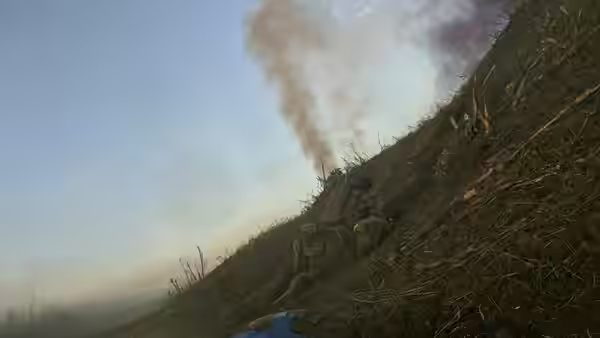
Chernov’s cinematography and the soldiers’ body-camera footage bring us close without making combat reassuringly legible. The body cameras are especially difficult to watch, because the view belongs to someone who has to keep moving through the danger. We were frightened by that dependence on the person carrying the camera. The images are sharp enough to prevent the men becoming distant figures in a war report, yet the film does not pretend that seeing this gives us anything approaching their experience.

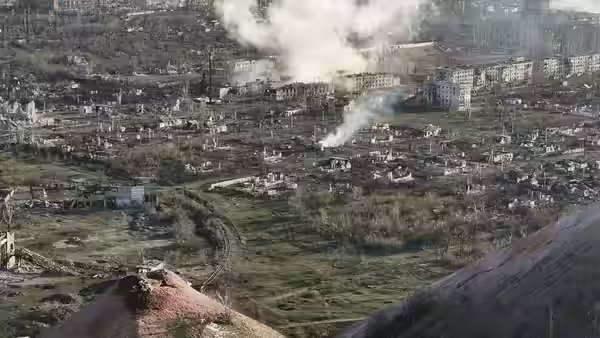
Chernov’s use of drone imagery is more complicated. The view from above can be beautiful, and the distance allows us to look at a battlefield without the bodily alarm of the ground-level footage. But drones also serve the fighting, so this change of perspective cannot be treated as harmless visual relief. The film makes us consider who is looking, what they can see and what they might do with that information.

Michelle Mizner’s editing gives the conversations and stretches of waiting enough space to matter. The men are allowed to occupy the screen without having to supply action, and their company changes how the fighting feels. In a less patient documentary, such passages might be reduced to brief introductions before the next burst of combat; here, they are part of what we have come to watch. That patience helps Chernov keep the soldiers recognisable as people, with lives that cannot be adequately described by their role in an advance.

The reservation is the narration, which is sober but sometimes tells us what the images and conversations have already established. The broader explanations can interrupt the close attention the film otherwise asks of us. Sam Slater’s music poses a related problem when it softens the fighting, offering an emotional cue where the footage has already supplied more than enough. Neither choice undoes the force of the material, but both suggest a needless anxiety about leaving us to respond for ourselves.

At 108 minutes, this asks for sustained attention to people under sustained pressure. War films sometimes encourage us to admire endurance without thinking much about what it costs, and Chernov makes that difficult. His attention to the men during the waits is crucial: they do not exist only for the moments when they are in danger. Choose it when there is time afterwards to sit quietly, without another film already queued up.

Critical consensus AI synthesised

81
Positive
11
Mixed
1
Negative
0

Most critics respond strongly to 2000 Meters to Andriivka, praising its close, harrowing account of Ukrainian soldiers in combat. Praise centres on the body-camera and frontline footage, which makes the fighting immediate without romanticising it. The quieter conversations also draw consistent approval: the reviews value the soldiers’ humour, vulnerability and humanity during stretches of waiting, giving the violence an emotional weight beyond the force of the images alone.

The differences are largely matters of degree, with enthusiasm ranging from emphatic praise to more qualified approval rather than outright rejection. The AV Club finds the broader narration unnecessary beside the vivid soldier-level footage, while Eye for Film notes that the score can soften the reality of the fighting. These reservations concern how the material is presented; across the reviews, there is broad agreement about the power of the footage and the importance of the intimate portraits.

Evening Standard
30 July 2025 · ★★★★★ · Nick Howells
100

Howells calls the documentary an essential, exceptionally powerful film that confronts viewers with the reality of the war. He singles out the soldiers’ body-camera footage for its immediate, riveting depiction of the fighting and its human cost.

Read the full review →
Time Out
22 July 2025 · ★★★★★ · Phil de Semlyen
100

The review calls the documentary devastating and extraordinary. It singles out its jaw-dropping portrayal of the Ukraine war.

Read the full review →
The Guardian
30 July 2025 · Peter Bradshaw
88*

Bradshaw finds the documentary even more visceral than Chernov’s previous film, portraying the counteroffensive as a waking nightmare. He praises its pin-sharp footage and unflinching conviction, especially in the accounts of soldiers later killed.

Read the full review →
The Hollywood Reporter
24 January 2025 · festival review · Daniel Fienberg
85*

Fienberg finds the documentary an immediate, contemplative and haunting account of modern warfare. He praises its intimate soldier conversations and the drone imagery’s dual role as visual art and an instrument of war.

Read the full review →
IndieWire
23 January 2025 · B+ · Christian Blauvelt
83

Blauvelt calls the documentary both pro-war and anti-war, praising its empathetic, visceral immersion in combat while emphasizing the numbing futility of fighting. He singles out the soldiers’ body-camera footage for putting viewers directly in their perspective.

Read the full review →
Los Angeles Times
1 August 2025 · Robert Abele
75*

A harrowing, deeply immersive account of Ukraine’s fight for Andriivka, the review finds the film both intimate and gutting. It particularly praises the frontline footage and the humanizing conversations with soldiers during stretches of waiting.

Read the full review →

Straight answers AI written, from our review

Is 2000 Meters to Andriivka worth watching?
2000 Meters to Andriivka is worth watching for its frightening proximity to combat and patient attention to Ukrainian soldiers between engagements; we score it 85 out of 100. We recommend it to viewers prepared for a harrowing documentary, with the reservation that its narration sometimes explains what the footage already makes clear.
How long is 2000 Meters to Andriivka, and what is it rated?
2000 Meters to Andriivka runs 1h 48m. It is a documentary and war film.
Where can I watch 2000 Meters to Andriivka in Türkiye?
2000 Meters to Andriivka is not on any streaming or rental service in Türkiye at the moment. It is available in 8 other countries; change your country at the top of the page to see where. Availability is checked daily.
How violent or frightening is 2000 Meters to Andriivka, and is it suitable for children?
2000 Meters to Andriivka has a UK 15 certificate and contains frightening, close-range combat footage, making it unsuitable for children under 15. We found the soldiers’ body-camera images particularly difficult to watch because every movement depends on someone exposed to danger; older teenagers and adults sensitive to real warfare should approach with care.
How does 2000 Meters to Andriivka compare to The Battle of Algiers?
2000 Meters to Andriivka documents soldiers fighting towards a Ukrainian village, while The Battle of Algiers reconstructs an urban revolt with civilians never safely out of view. We find Chernov’s film stronger at giving individual soldiers time to talk and wait; Pontecorvo’s is the better choice for a lucid account of a campaign, though it allows less time with the people caught in it.
What should I watch after 2000 Meters to Andriivka?
After 2000 Meters to Andriivka, try The Battle of Algiers (1966, Fi1m 93): An unsentimental account of urban conflict, with civilians never safely out of view. Then The Ascent (1977, Fi1m 88): A war film that gives moral choices the same weight as physical danger; and Waltz with Bashir (2008, Fi1m 83): Animation makes room for damaged memories that straightforward combat footage cannot explain.

Cast

Awards

News and Documentary Emmy Awards, 2026

Won
News and Documentary Emmy Awards

If you liked this, try…

  1. Restrepo (2010) · not reviewed yetAnother soldier-level documentary, attentive to the long waits as well as combat.

  2. The Battle of Algiers (1966, Fi1m 93)An unsentimental account of urban conflict, with civilians never safely out of view.

  3. The Ascent (1977, Fi1m 88)A war film that gives moral choices the same weight as physical danger.

  4. Waltz with Bashir (2008, Fi1m 83)Animation makes room for damaged memories that straightforward combat footage cannot explain.

  5. A Private War (2018) · not reviewed yetFor a closer look at the compulsion and cost of reporting war.