Chris Kelly spent years with the people fighting the sale of a Phnom Penh lake, and the footage he brought back is remarkable. The film he cut from it is long, crowded and often hard to follow, and the anger survives anyway.
Chris Kelly went to Cambodia to film the fight over one lake and came back with something closer to a history of a country’s opposition. Boeung Kak, in the centre of Phnom Penh, was leased to a developer and pumped full of sand, and the families living around it were offered a little money and told to go. Kelly directed, wrote, produced, shot and co-edited what followed. The result is 127 minutes that are often remarkable and seldom tidy, a film we were glad to have seen and kept losing the thread of, sometimes inside the same ten minutes.
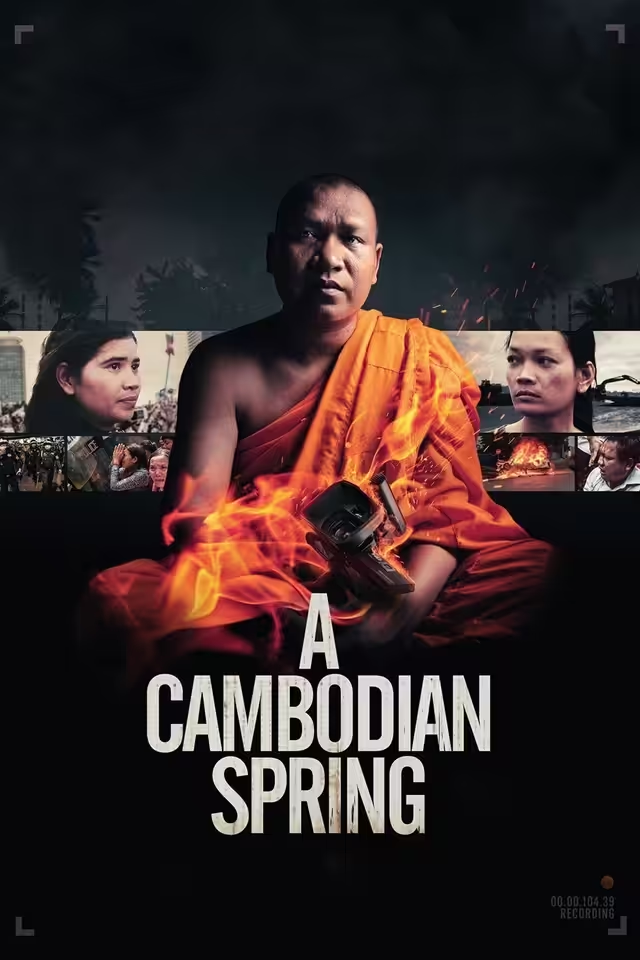
His three subjects are well chosen. Two mothers from the lakeside discover, more or less on camera, that they are good at this: at marshalling neighbours, at standing their ground in front of a line of helmets, at saying the thing the officials do not want said. A Buddhist monk films evictions and beatings on a small camera and hands the footage on, which earns him the attention of the police and the displeasure of the men who run his order. Kelly stays close to all three. When the crowd surges the camera is in it, and when a door is shut in the monk’s face we are standing beside him.
The lake is the film’s best image, and Kelly, who shot it himself, knows it. A pipe spews grey slurry into clear water. Stilt houses that stood over a lake stand, a few months on, over a plain of wet sand, and then over nothing, because the bulldozers have arrived. Kelly returns to the same vantage points so that we watch the water retreat the way a timelapse would show it, only slower and with people in it. James Holden’s score sits under these passages as a low electronic hum that never tells us how to feel, which this sort of film rarely allows.
We were angry, and the film earned it plainly. There is a stretch in which the women of Boeung Kak are met at a demonstration by police who simply pick them up and carry them off, and the camera goes down with one of them, and for a few seconds we are looking at tarmac and boots. There is no music. Nobody explains it. It is the most direct thing in the film and we have not shaken it.
The trouble is the shape. Kelly cut the film with Ryan Mullins and Pawel Stec, and three editors have not settled how much to tell us. Title cards arrive dense with the names of parties, ministers and land laws, and they are gone before we have finished reading them. Characters vanish for twenty minutes while the film widens out to national politics, and when they return we have to remember who was in prison and who was out. The people doing the taking, the developer, the officials, the ruling party, stay off screen throughout. We understand why Kelly could not get to them; we wish he had found a way to show their absence rather than simply carrying on without them.
The second half takes a turn among the three of them that we will not describe. We will say it is the most human thing in the film, and that the film gives it less room than it gives the title cards.
Documentaries made from inside a movement usually have this weakness. The closer the camera is, the less of the map you can see, and A Cambodian Spring has chosen closeness and paid for it. A tidier film, with experts in chairs and a voice from London telling us what the government had done that week, would have been easier to follow and would not have had the lake, or the women, or the monk holding his camera above the crowd.
Give it the whole evening and do not expect to follow all of it. It will not make you an expert on Cambodia. It will make you remember the sound of sand hitting water.