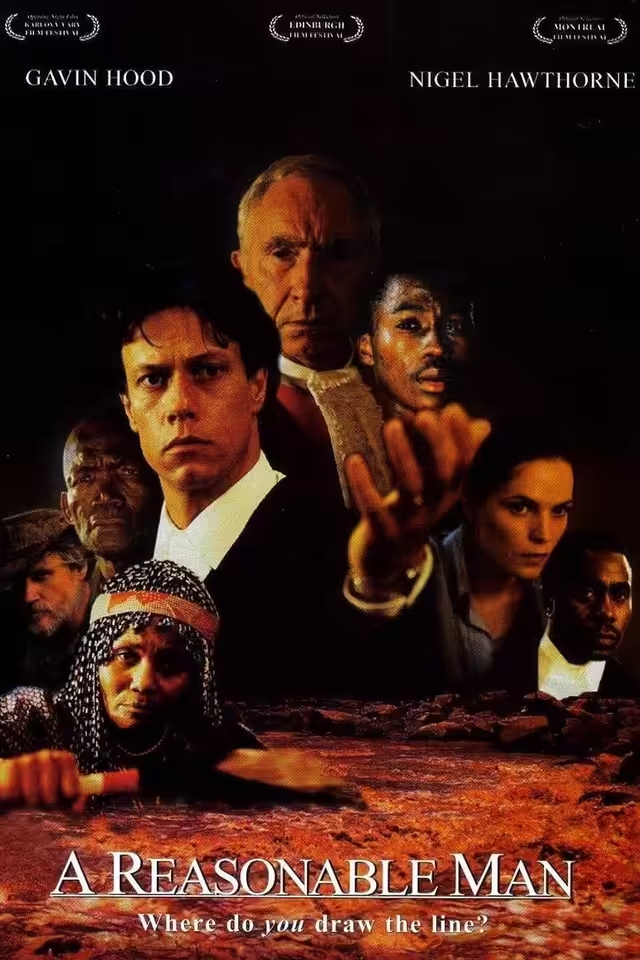
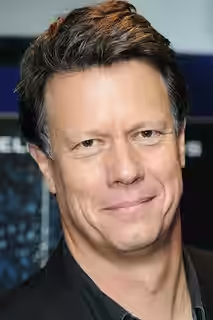
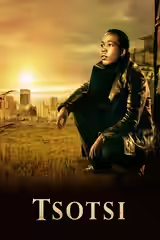
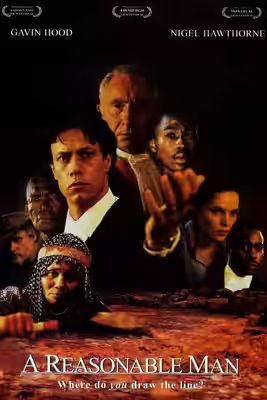
Gavin Hood writes, directs and stars in a courtroom drama that asks a hard question about law and belief and sticks with it for 103 minutes. It is modestly made and sometimes stiffly played, and it is still worth the evening.
The film is built on a single legal question. South African law judges an act by what a reasonable man would have done, and Gavin Hood, writing and directing and casting himself as the defence lawyer Sean Raine, wants to know which man that is. A Zulu herd boy, Sipho Mbombela, kills a baby he believes to be a tikoloshe, an evil spirit, and the court has to decide whether a belief shared by his whole village counts as reason or madness. Hood does not pretend the question is easy, and for 103 minutes he does not let it go. That alone puts the film ahead of most courtroom dramas, which usually know the answer before the first witness is sworn.
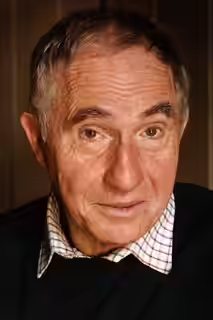
Nigel Hawthorne is the reason to see it. As Judge Wendon he sits above the argument with a patience that is not quite indulgence, and he lets us see a man who has spent a career applying one culture’s law to another culture’s people and knows exactly what that has cost. He does almost nothing: a glance over the glasses, a pause before a ruling, a dry question that cuts a lawyer’s speech in half. Every time the film threatens to become a lecture, he turns it back into a trial. Vusi Kunene, as Prosecutor Linde, gives him a worthy opponent, a black prosecutor who has no time for the idea that his people should be judged by a softer standard, and the film is honest enough to let him win several exchanges.
Hood the actor is the weaker link in Hood the film. He plays Sean as a decent man with something on his mind, and he carries it mostly in his jaw. Janine Eser, as his wife Jennifer, is left to ask whether he is all right and to be told that he is. The film is more interested in Sipho than in either of them, and Loyiso Gxwala repays that interest with a performance of frightened stillness that does not ask for pity.
The witnesses are where the writing comes alive. Nandi Nyembe plays the sangoma Rachel Ndlovu without a trace of the mystic, a working woman explaining her trade to people who have decided in advance not to understand it. Graham Hopkins, as the anthropologist Professor MacKenzie, delivers the academic case for cultural relativism and is made to look slightly foolish for it, which we took as Hood’s point. Ken Gampu’s Headman speaks for the village in two scenes and says more about the gap between the court and the kraal than any of the lawyers manage.
Buster Reynolds shoots the countryside in flat, hard daylight, dust and dry grass and a sky with nothing in it, and the courtroom in brown wood and the glare of high windows, so that the two worlds never look like the same country. Avril Beukes cuts the trial cleanly and lets the longer speeches run, which is right. Neill Solomon’s score keeps to drums and voices and mostly stays out of the way until the end, when it does not.
We will not describe how the trial resolves. We can say that Sean’s closing address, which the whole film has been building towards, held us completely, and that what held us was not the eloquence but the admission inside it. A lawyer stands up in a court he does not trust and tells it something about himself that he has told nobody else, and Hood, who cannot always act, can plainly write. We had been half-bored by the man for an hour; we were not bored then.
Against the genre’s own standards this is a small film that does something the large ones rarely attempt, which is to let the legal question be the drama rather than a frame around it. The reviews so far have been kind, and we are inclined to agree with them, with the caveat that the production is plain, the hero is stiff and the first half asks you to wait. Wait. The trial is worth it, and Hawthorne is worth it twice.