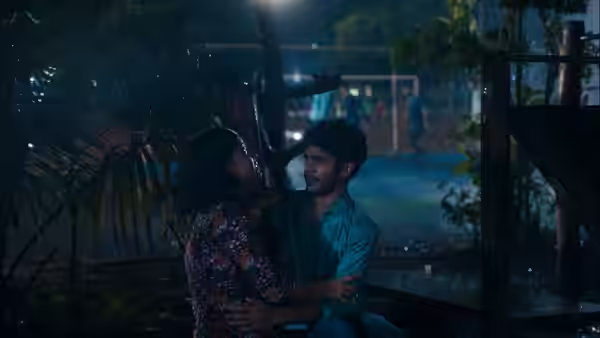
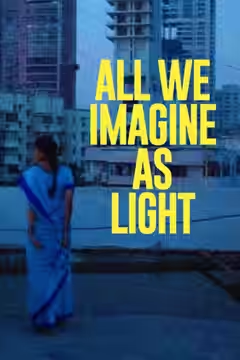
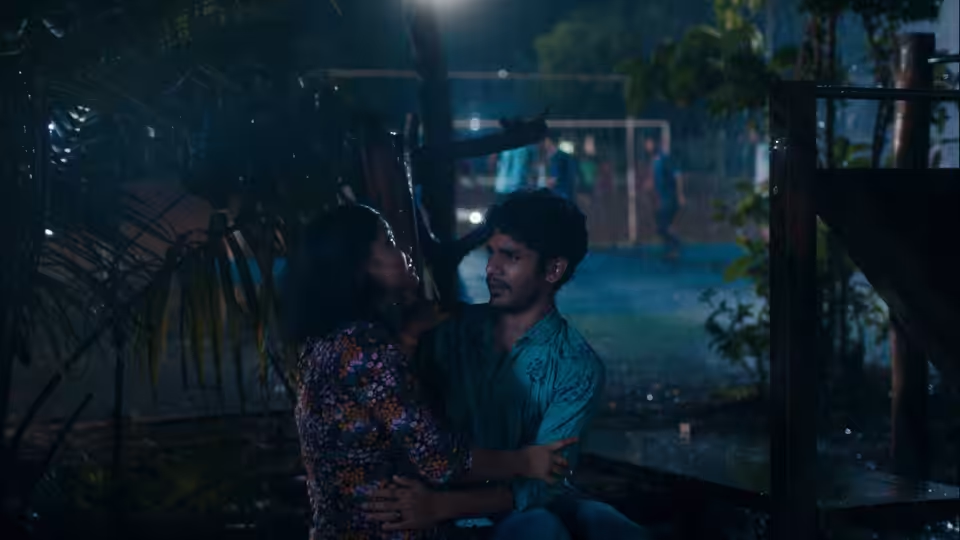
Anu (Divya Prabha) embraces Shiaz (Hridhu Haroon) beneath a shelter in the rain
Film review

All We Imagine as Light

2024 · Directed by Payal Kapadia · 1h 58m

In a sentenceA rice cooker arrives from Germany without a note, and it is the most eloquent thing a husband says all film

Mumbai, in the monsoon. Prabha (Kani Kusruti) is a senior nurse at a city hospital, a woman from Kerala whose husband left for a job in Germany soon after their arranged marriage and has stopped calling. She shares a one-room flat with Anu (Divya Prabha), a younger nurse who is secretly seeing Shiaz (Hridhu Haroon), a Muslim boy, while her parents send her photographs of suitable grooms. Parvaty (Chhaya Kadam), the hospital cook, is being pushed out of the flat she has lived in for years by developers, because she has no papers to prove her late husband’s tenancy. A rice cooker arrives from Germany with no note. Dr Manoj (Azees Nedumangad), a colleague, writes poems and wants Prabha to read them. The rain keeps falling and the trains keep running.

Plays from YouTube when you press play; nothing loads from them until then.

Fi1m review

Payal Kapadia’s film follows two nurses and a hospital cook through a Mumbai shot almost entirely after dark, and it is patient, tender and quietly angry. The second half leaves the city and asks for some faith, which it mostly repays.

All We Imagine as Light opens with voices. Over pictures of Mumbai after dark, markets being unloaded, a train, wet tarpaulin, people we never see tell us how long they have lived here and where they came from, and none of them says the word home. Payal Kapadia, who wrote and directed, spends a few minutes on this before she gives us a face, and by then we know what her film is about: a city full of people who arrived from somewhere else and have not quite decided to stay. It is a lovely film, tender and slow and cross underneath, and we recommend it with one caveat about its second half.

The face, when it comes, is Prabha’s. Kani Kusruti plays her as a senior nurse at a Mumbai hospital, a woman from Kerala whose husband went to Germany for work after an arranged marriage and has stopped ringing. She shares a small flat with Anu (Divya Prabha), a younger nurse who is seeing a Muslim boy called Shiaz (Hridhu Haroon) and hiding him from parents who are lining up a groom. The third woman is Parvaty (Chhaya Kadam), the hospital cook, whose building has been bought by developers who want her out and who has no paper to say her late husband ever lived there. Dr Manoj (Azees Nedumangad) writes poems and would like Prabha to read them.

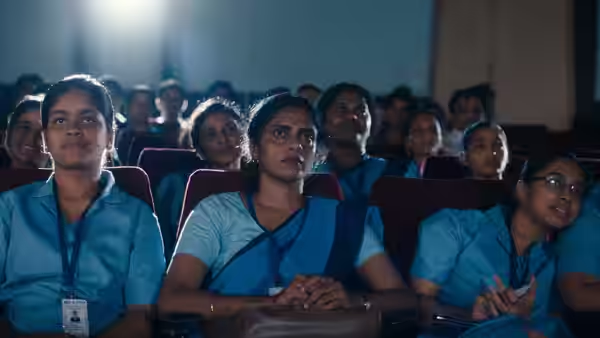
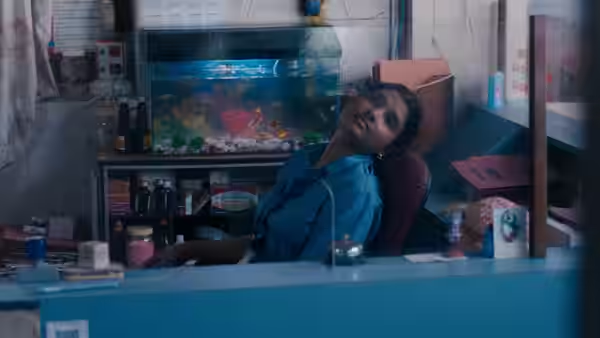
Ranabir Das shoots nearly all of the Mumbai half at night, and he lights it with what is there: sodium lamps, shop signs, the blue-white of a phone held under a blanket, rain on the window of a moving train. The flat, put together by production designers Piyusha Chalke, Shamim Khan and Yashasvi Sabharwal, is one room and a kitchen with a curtain doing the work of a wall, and the camera does not treat it as a trap. People cook in it and sleep in it and the cat comes and goes. Maxima Basu puts the nurses in the same pale uniform at work and then lets Anu go out in colour while Prabha stays in what she came home in. You could tell the two women’s ages from the washing line.

Early on, a parcel arrives from Germany. It is a rice cooker, red, expensive, and there is no note. Prabha unpacks it, looks at it, and later that night, alone in the kitchen, she picks it up and holds it against herself. We were moved more than we expected to be by a woman embracing a kitchen appliance, and it is Kusruti’s stillness that does it. She does not cry. She presses the cold metal to her chest and waits, as though it might warm up. Kapadia does not add a word.

The scene most critics single out, in which Manoj gives Prabha a poem and she reads it by her open window, is as good as they say, though we liked Nedumangad more in the corridors, hovering, trying to find a reason to be where she is. Anu’s strand is thinner. Divya Prabha is lively and exact, and her scenes with Kusruti, teasing, borrowing money, being told off, are the warmest in the film. But Shiaz for a long stretch is a voice on a phone and a boy on a scooter, and the film cares more about what stands between the pair than about who they are together. That is partly the point. It still leaves one of the three stories waiting for its turn.

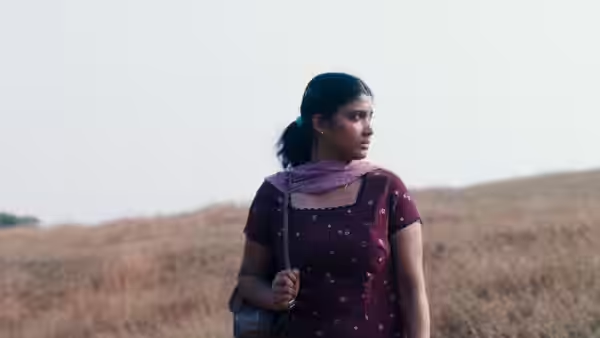
Then the film leaves the city, and takes a turn we will not describe. What we can say is that Das swaps neon for sunlight, that Dhritiman Das’s music, which has stayed out of the Mumbai scenes almost entirely, is allowed in, and that Clément Pinteaux, who has been cutting between ward and flat with unhurried regularity, starts holding shots longer than we expected. It took us a quarter of an hour to settle into the new pace, and we suspect some viewers will not. We did, in the end, and Anu’s story gets its best scene there.

Chhaya Kadam is the film’s ballast. Parvaty smokes, drinks and has no illusions about who the city is for, and Kadam plays her without a shred of self-pity. Kapadia’s anger about Mumbai’s developers and its papers-or-nothing bureaucracy is real, and she lets Kadam carry it rather than a speech.

At 118 minutes it never hurries, and its 15 certificate is for very little. Watch it late, with the lights off and the window open if the weather allows; it is a night film for most of its length.

Critical consensus AI synthesised

83
Positive
23
Mixed
1
Negative
0

Almost every critic is won over. Of twenty-four reviews, twenty-three are positive and one is mixed, which is as close to unanimity as the reviews get. The praise settles first on how Kapadia films Mumbai: the rain, the neon, the crowded trains, and the way the light shifts from the harsh city to the calmer coast. The performances of Kani Kusruti and Divya Prabha come next, with several reviews noting that the two women find harmony rather than friction. Many also single out the mix of documentary observation and something close to dreaming.

Where critics hesitate, it is nearly always over the move to the countryside late on. The AV Club finds that stretch less tethered to reality, and Collider calls the film slow and dour before a hopeful last act rewards patience. Deadline takes the opposite view and holds the hallucinatory third act up as the film’s strongest passage. Vulture notes that sadness lingers under the ending. The spread is narrow, from approving to rapturous, and nobody dismisses it.

Little White Lies
28 November 2024 · 4/5/5 · Jenna Mahale
100

Mahale calls the film a gorgeous romance that captures Mumbai’s particular romantic chaos. She praises its transportive visuals and subtle, powerful details of desi girlhood.

Read the full review →
IndieWire
13 November 2024 · A · Sophie Monks Kaufman
95

Kaufman calls the film a sensual triumph, praising its intimate and hypnotic portrait of two nurses’ lives in Mumbai. She especially singles out the richly composed cinematography and the performances of Kani Kusruti and Divya Prabha.

Read the full review →
The New Yorker
14 November 2024 · Justin Chang
95*

Chang calls the film one of the year’s great movies, praising its radiant, atmospheric portrait of Mumbai and women’s solidarity. He especially singles out the lead performances, whose contrasting characters find harmony rather than conflict.

Read the full review →
Los Angeles Times
15 November 2024 · Joshua Rothkopf
90*

Rothkopf praises the film as subtle, assured and politically resonant, finding its portrait of women’s solidarity deeply moving. He singles out the shift into near-fantastical realms as the film’s transformative strength.

Read the full review →
The Guardian
23 May 2024 · Peter Bradshaw
90*

Bradshaw finds the film a glorious, absorbing triumph, rich in humanity and emotional clarity. He singles out its dreamlike storytelling and the revelation that brings Prabha closer to understanding her life.

Read the full review →
Slant Magazine
26 May 2024 · ★★★½/4 · Ryan Coleman
88

The critic calls the film an exceptional, generous portrait of Mumbai and its people. They praise Kapadia’s fluid camerawork for contrasting the women’s confinement with the city’s openness.

Read the full review →

Straight answers AI written, from our review

Is All We Imagine as Light worth watching?
All We Imagine as Light is worth watching for anyone with patience for a slow, tender film about lonely people in a big city, and we scored it 84. Payal Kapadia's story of two nurses and a hospital cook in a night-time Mumbai is quietly angry as well as gentle. Our one caveat is the second half, which leaves the city and takes a quarter of an hour to settle.
How long is All We Imagine as Light, and what is it rated?
All We Imagine as Light runs 1h 58m. It is a drama and romance film.
Where can I watch All We Imagine as Light in Hungary?
All We Imagine as Light is not on any streaming or rental service in Hungary at the moment. It is available in 12 other countries; change your country at the top of the page to see where. Availability is checked daily.
How violent or frightening is All We Imagine as Light, and is it suitable for children?
All We Imagine as Light is neither violent nor frightening; its UK 15 certificate is for very little, and our review says as much. It is a quiet adult drama about loneliness, an absent husband, a secret romance across a religious divide and a woman being pushed out of her home, with some smoking and drinking. Nothing in it would alarm a squeamish viewer, but young children would find it slow.
How does All We Imagine as Light compare to Chungking Express?
All We Imagine as Light and Chungking Express both spend most of their length in a rain-soaked city after dark, with people who nearly connect and often do not, but they move at different speeds. Wong Kar-Wai's film is funny, restless and driven by music and colour; Kapadia's is slower, sadder and more angry about who her city is for. Pick the Hong Kong film for energy, the Mumbai one for stillness.
What should I watch after All We Imagine as Light?
After All We Imagine as Light, try Chungking Express (1994, Fi1m 85): Hong Kong after dark, neon and rain, and people who nearly meet but do not. Then Certain Women (2016, Fi1m 84): Three women, small towns, and a director who trusts a held face over a speech; and Cléo from 5 to 7 (1962, Fi1m 88): A woman walks a city for two hours and the city tells her who she is.

Cast

Awards

APRECI Award for Best International Premiere, 2024

Won
APRECI Award for Best International Premiere

Cannes Film Festival, 2024

Won
Cannes Film Festival Grand Prix

If you liked this, try…

  1. The Lunchbox (2013) · not on Fi1m yetAnother Mumbai loneliness, carried by notes in a tiffin box rather than a rice cooker.

  2. Chungking Express (1994, Fi1m 85)Hong Kong after dark, neon and rain, and people who nearly meet but do not.

  3. Certain Women (2016, Fi1m 84)Three women, small towns, and a director who trusts a held face over a speech.

  4. Cléo from 5 to 7 (1962, Fi1m 88)A woman walks a city for two hours and the city tells her who she is.

  5. Sir (2018) · not on Fi1m yetA Mumbai flat, a domestic worker and an employer, and a love nobody around them will allow.