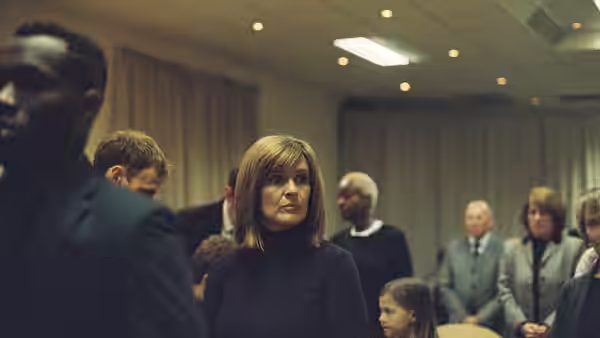
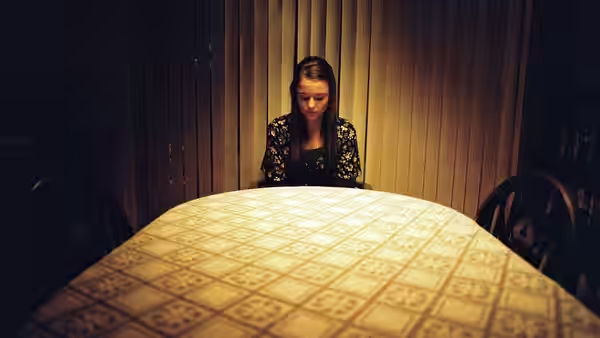
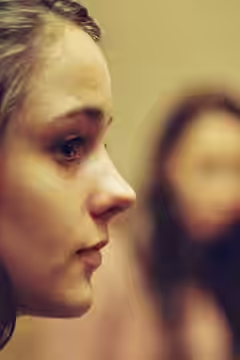
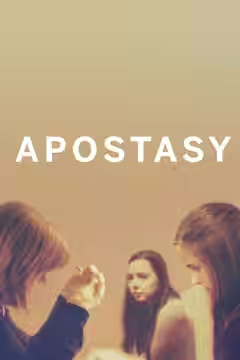
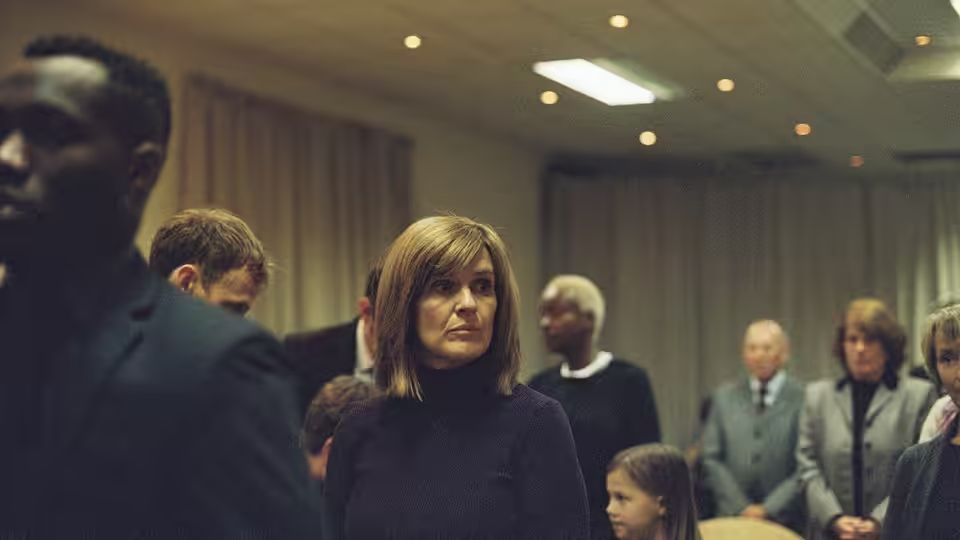
Ivanna (Siobhan Finneran) stands among congregation members in a meeting hall
Film review

Apostasy

2017 · Directed by Daniel Kokotajlo · 1h 34m

In a sentenceNobody shouts, nobody slams a door, and the doors stay shut anyway

Oldham, the present day. Ivanna (Siobhan Finneran) is a Jehovah’s Witness raising two grown daughters in the faith. Alex (Molly Wright), eighteen and anaemic, is told by hospital doctors that a blood transfusion would help her; she will not have one, and the congregation treats the refusal made on her behalf as a baby as a mark in her favour. She practises Urdu so she can preach to the families on the next street and prays in a whispered voiceover to Jehovah. Her older sister Luisa (Sacha Parkinson) is at college and has a boyfriend outside the faith. When Luisa falls pregnant, Elder Brian (James Quinn) and Elder Alan (James Foster) convene a meeting, and Ivanna must decide how much of her daughter she is still permitted to speak to.

Plays from YouTube when you press play; nothing loads from them until then.

Fi1m review

Daniel Kokotajlo’s first film watches a Jehovah’s Witness household in Oldham from the inside and declines to argue with it, which is what makes it hurt. Siobhan Finneran and Molly Wright are exact. The second half is bolder than it is tidy.

A mother and two daughters live in a small house in Oldham and go to the Kingdom Hall. The younger daughter, Alex (Molly Wright), has anaemia, and the doctors keep raising the matter of a transfusion; she keeps declining, because blood is forbidden and because the congregation has told her, since she was a baby, that she is a kind of example. The older daughter, Luisa (Sacha Parkinson), has started college and come home with ideas and a boyfriend. Their mother, Ivanna (Siobhan Finneran), believes all of it. Daniel Kokotajlo, writing and directing his first film, grew up in this faith, and Apostasy is the rare film about a closed religion that never once steps outside to explain it to us.

We recommend it, and we recommend it to people who think they have seen this film before. The usual version has a sceptic in it, someone to ask the questions the audience is asking. Kokotajlo leaves that person out. Nobody argues with the doctrine. The camera simply watches people live by it, and John Ellis’s production design does a great deal of the work: magnolia walls, stackable chairs, a hall that could be a dentist’s waiting room, a front room where the Bible sits beside the remote control. Lance Milligan dresses the women in long skirts and cardigans and the brothers in suits a size too careful, so that the faith is visible in every frame without anyone having to mention it.

The first act turns on Luisa’s pregnancy. The elders, Brian (James Quinn) and Alan (James Foster), hold a meeting, and the result is announced to the congregation in a sentence. The rules say the family must cut her off, and the film shows what that means at a kitchen table, in a parked car, on a doorstep. The announcement scene moved us more than anything else in the film, and it was Finneran who did it. She does not cry. She sits upright in her chair with her bag on her lap and lets her mouth go slightly slack, and we understood she had already chosen, and that the choice had cost her something she would never admit to.

Molly Wright plays Alex as a believer, not a victim. She practises Urdu phrases at the bus stop so she can preach to the neighbours, prays in whispered voiceover with the plainness of someone leaving a message, and when Steven (Robert Emms), a young elder, begins courting her under the congregation’s eye, she is pleased in a way that is painful to watch. Emms makes Steven sincere and faintly ridiculous at once, a man who has learned to speak in paragraphs from a leaflet. The scenes between the two of them are the film’s gentlest and among its most unsettling.

Adam Scarth shoots in low grey northern light, almost all of it indoors, and keeps the frame tight, so that rooms feel smaller than they are and faces are rarely allowed to look away from each other. Napoleon Stratogiannakis cuts slowly and holds shots a beat past comfort. Matthew Wilcock’s music is barely there, a low tone under certain scenes and silence under the rest, and the silence is the right call. There is a great deal of speech in this film and almost none of it is loud.

Then, around the midpoint, the film does something we will not describe, and the second half is a different film. We think the decision is brave. We also think it costs something. After the turn the elders harden from two particular men into a single instrument, Steven’s part of the story resolves too neatly, and the scenes with the wider family, Cousin Michelle (Jessica Baglow), Cousin Barry (Christian Foster), Aunty Linda (Clare McGlinn), begin to feel like illustrations of a point already made. One critic has suggested the material might have worked better as a documentary. We disagree, because the point of the film is Finneran’s face and Wright’s, but we understand the complaint: the structure shows its bones.

Films about faith usually want a renunciation scene, a door kicked open, a speech. Kokotajlo refuses to give us one, and at 94 minutes he does not pad the refusal. It is a PG certificate, which seems about right. Nothing in it would frighten a child except the adults.
Critical consensus AI synthesised

79
Positive
8
Mixed
1
Negative
0

Most critics like Apostasy, and the reviews cluster closely. They describe Kokotajlo’s debut as an intelligent, assured drama about a Jehovah’s Witness family, and nearly all of them note that it declines to sneer at the faith it examines. The praise settles on the three lead performances, and on Molly Wright above all, whose playing of Alex is called tender and emotionally precise. Siobhan Finneran’s subtler turmoil is also singled out, as is the close, claustrophobic cinematography.

The reservations are few and mild. The one mixed review, from Little White Lies, calls the film well made and noble in intent but wonders whether the material would have worked better as a documentary, a worry no other critic shares. Beyond that, the spread runs from warm to warmer: the festival notices from autumn 2017 are the most enthusiastic, while the reviews around its 2018 release settle on solid four-star approval. Nobody calls it a failure.

The Hollywood Reporter
9 October 2017 · festival review · Neil Young
90*

The critic calls the film one of the year’s strongest British works and praises its sensitive, intelligent treatment of faith and individual freedom. He especially highlights the nuanced performances of its three leads.

Read the full review →
Variety
6 October 2017 · festival review · Guy Lodge
90*

Lodge finds the film fascinating, devastating, and quietly forceful in its examination of faith and institutional obligation. He especially praises the superb performances of the three lead actors, singling out Molly Wright’s emotionally precise portrayal of Alex.

Read the full review →
Empire
26 July 2018 · Nev Pierce
85*

Pierce calls it a thoughtful, assured and compelling exploration of faith and fundamentalism. He particularly praises Molly Wright’s radiant performance and the film’s poised, nonjudgmental treatment of authoritarian religion.

Read the full review →
Radio Times
★★★★ · Jeremy Aspinall
80

The critic finds the drama low-key but potent. They praise how it tests the boundary between religious devotion and family love.

Read the full review →
Sight and Sound
25 July 2018 · Nikki Baughan
80*

Baughan praises the film as a sensitive, assured drama that balances humanity with a clear warning about indoctrination. She singles out the nuanced performances and claustrophobic cinematography for praise.

Read the full review →
The Guardian
9 October 2017 · ★★★★ · Peter Bradshaw
80

Bradshaw finds the film an intelligent, gripping drama with emotional power. He praises the restrained performances, especially Molly Wright’s tender portrayal and Siobhan Finneran’s subtle turmoil.

Read the full review →

Straight answers AI written, from our review

Is Apostasy worth watching?
Apostasy is worth watching, and we scored it 81. It is a quiet, close study of a Jehovah's Witness family in Oldham that never steps outside the faith to explain it, and Siobhan Finneran and Molly Wright are exact in it. The second half takes a turn that is braver than it is tidy, so expect a film that shows its bones rather than one that resolves neatly.
How long is Apostasy, and what is it rated?
Apostasy runs 1h 34m. It is a drama film.
Where can I watch Apostasy in Serbia?
Apostasy is not on any streaming or rental service in Serbia at the moment. It is available in 4 other countries; change your country at the top of the page to see where. Availability is checked daily.
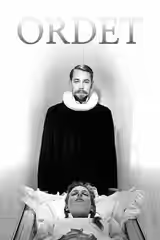
How does Apostasy compare to Ordet?
Apostasy and Ordet are both films about belief watched in small rooms, but Dreyer's farmhouse argues its faith out loud and Kokotajlo's Oldham house never argues at all. Ordet is the greater film, slow and formal and finally overwhelming; Apostasy is the smaller and plainer one, closer to a kitchen table than a sermon. Start with Apostasy if long speeches test your patience, with Ordet if you can give them the evening.
What should I watch after Apostasy?
After Apostasy, try Ordet (1955, Fi1m 86): Dreyer’s Danish farmhouse, where belief is argued over and then simply happens. Then Breaking the Waves (1996, Fi1m 82): A Scottish island congregation and a woman whose devotion they cannot contain.

Cast

If you liked this, try…

  1. Stations of the Cross (2014) · not reviewed yetA German teenager’s faith taken to its end in fourteen fixed shots; stricter and colder.

  2. Ordet (1955, Fi1m 86)Dreyer’s Danish farmhouse, where belief is argued over and then simply happens.

  3. Breaking the Waves (1996, Fi1m 82)A Scottish island congregation and a woman whose devotion they cannot contain.

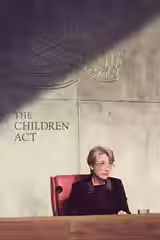
  4. The Children Act (2017) · not reviewed yetA judge rules on a Witness boy’s transfusion; the other side of Alex’s hospital door.

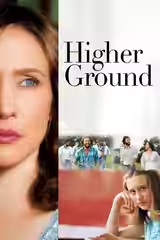
  5. Higher Ground (2011) · not reviewed yetVera Farmiga directs herself as a believer slowly losing the thread, without contempt.