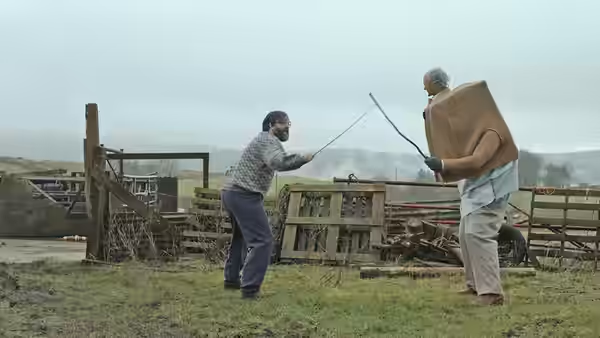
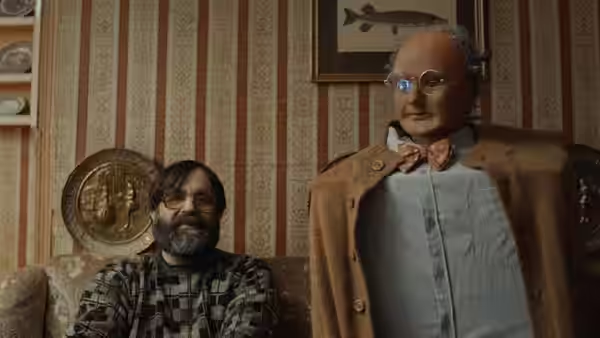
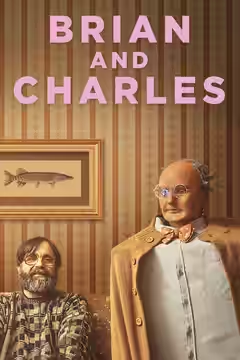
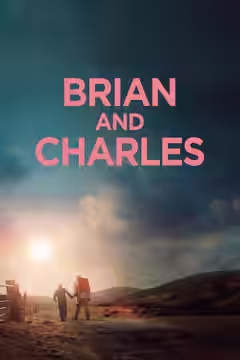
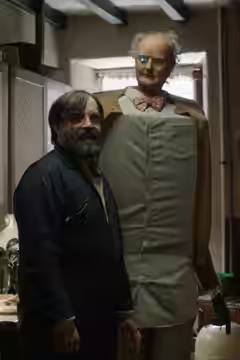
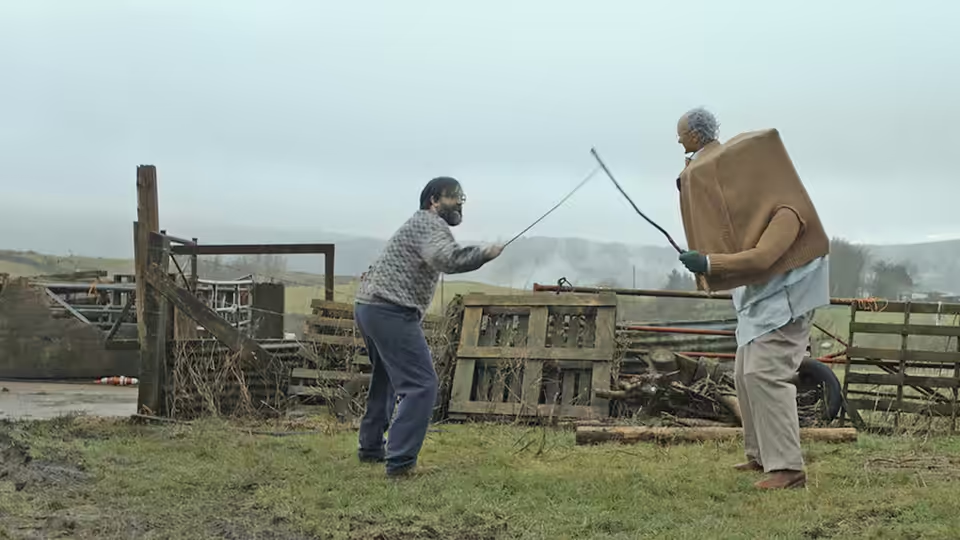
Brian (David Earl) and Charles (Chris Hayward) spar with sticks in a farmyard
Film review

Brian and Charles

2022 · Directed by Jim Archer · 1h 31m

In a sentenceA man builds himself a robot companion and discovers he has manufactured an argumentative teenager

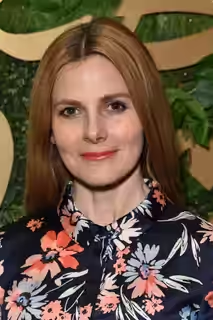
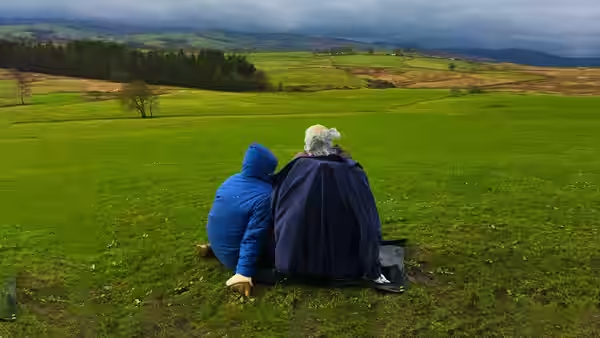
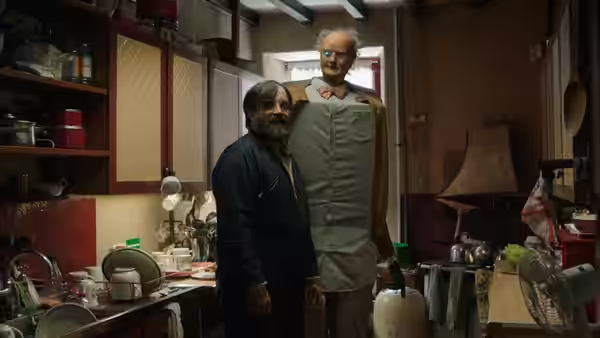
On a farm, Brian (David Earl) builds himself a robot companion called Charles (Chris Hayward). Brian wants relief from loneliness, but his invention has a curiosity that requires more attention than he expects. Charles speaks in a synthesised voice, develops a taste for cabbage and starts learning about the world from his maker. Hazel (Louise Brealey) offers Brian the possibility of a tentative romance, alongside the company he has made for himself. As Charles becomes more inquisitive, Brian has to make room in his solitary life for someone with questions and preferences of his own.

Plays from YouTube when you press play; nothing loads from them until then.

Fi1m review

David Earl and Chris Hayward give this gentle robot comedy enough warmth and deadpan friction to overcome a thin supporting story. It is worth an evening, provided repeated bouts of eccentricity do not test the patience.

Brian and Charles is a funny, kindly comedy whose central friendship is much better developed than the story around it. Jim Archer treats the notion of a lonely man building himself a robot companion with enough seriousness to make the silliness matter. The question is how much company Brian can bear once his invention starts behaving like somebody else. That is a sound basis for a small comedy, and David Earl and Chris Hayward, who also write the screenplay, give it an affectionate, argumentative life.

David Earl’s Brian needs companionship without quite knowing what to do with it. The performance catches the embarrassment of wanting a friend while having little practice at being one, and it does not ask us to regard him as a case study. His awkwardness is funny because David Earl allows it to be awkward, rather than repeatedly signalling that we should find it lovable. When the film concentrates on his dealings with Charles, the writing notices how much two people can find to disagree about without either having particularly good grounds for complaint.

Chris Hayward makes Charles expressive through movement and a voice that seems poorly equipped for expressing anything. The deadpan delivery gives the robot’s curiosity an edge: he wants to know things, and he is not necessarily impressed by the answers. We laughed at his synthesised backchat, particularly the adolescent certainty that Brian is being unreasonable. It is a good joke about parenthood, made better by the fact that the parent has built the person now answering him back.

Murren Tullet’s cinematography suits the homemade feel, though the mockumentary conceit remains loosely applied. The camera’s supposed presence never becomes particularly interesting in itself. Hannah Purdy Foggin’s production design helps the improbable robot belong in the farm setting, without competing with him for attention. Jo Walker’s editing gives the exchanges room to find their comic rhythm, but cannot disguise how often the film returns to the same joke. At 91 minutes, it is short enough to forgive that repetition, though we still notice it.

The trouble is what happens around the central pair. Louise Brealey gives Hazel a welcome delicacy, and the tentative romance is appealing when allowed to remain tentative. But Hazel is too thinly written to command the same interest as Brian and Charles, while the broader conflict has the dutiful feel of something added because a feature needs a plot. We keep waiting for the film to return to the two performances that make its familiar material worth watching.

Daniel Pemberton’s music is sympathetic to the film’s gentleness, although the sweetness can become insistent. Jim Archer is strongest when he trusts an odd voice, an ungainly movement or a slightly uncomfortable pause to carry the feeling. As science fiction, the film has little interest in technological grandeur, and that modesty is a virtue. Its robot is interesting because living with him takes some adjustment, and the comedy understands how affection can survive a considerable amount of irritation.

Choose it for a quiet evening, with some tolerance for repetition and an affection for people who struggle to talk to one another. There is no need to be particularly interested in robots. Enjoy the conversations, and forgive the rather obvious attempts to interrupt them.

Critical consensus AI synthesised

69
Positive
15
Mixed
6
Negative
2

Most critics find Brian and Charles a warm, funny comedy whose central friendship makes its modest story worth following. Praise centres on David Earl and Chris Hayward’s rapport, with Hayward’s physical performance and Charles’s deadpan digital voice drawing particular affection. The robot’s curiosity and growing cheekiness supply much of the humour, while Brian’s loneliness gives the companionship an emotional weight that several reviews find quietly touching.

The reservations concern how far that relationship can carry a feature. Even favourable reviews note thin plotting, familiar conflicts and an inconsistent mockumentary format; others find the sentimentality harder to accept. The spread is fairly wide, though positive responses predominate. Slant Magazine argues that the supporting characters and wider story become generic filler, while the Los Angeles Times finds that the appealing premise cannot overcome meandering storytelling and an uncertain emotional tone.

The Guardian
6 July 2022 · Peter Bradshaw
85*

Bradshaw finds the film an emotionally engaging comedy that successfully shifts between irony, menace and a sweet-natured ending. He singles out Charles’s comic appearance and voice, which prompt one of the review’s most amused reactions.

Read the full review →
The Hollywood Reporter
17 June 2022 · Sheri Linden
85*

The critic finds the film inventive, disarming, and warmly suitable for all ages. She praises the sincere performances and the gentle, underplayed magic of Brian and Charles’s friendship.

Read the full review →
Evening Standard
7 July 2022 · ★★★★ · Charlotte O'Sullivan
80

O'Sullivan finds the film a treat despite its lack of finesse. She praises the sharp dialogue for making its fantastical parenthood story feel hilariously real, while criticizing the threadbare plot and loose mockumentary conceit.

Read the full review →
Time Out
4 July 2022 · ★★★★ · Phil de Semlyen
80

The critic calls it a funny, touching, bittersweet surprise. The review singles out the robot buddy comedy’s unusual charm.

Read the full review →
Empire
13 July 2022 · John Nugent
78*

The critic finds it an immediately likeable, charmingly homespun comic fable about loneliness and friendship. They particularly praise Chris Hayward’s physical performance, which makes the deadpan robot Charles an endearing comic character.

Read the full review →
Variety
15 June 2022 · Tomris Laffly
75*

Laffly finds the film a sweetly optimistic charmer, though its quirks and limited conflict grow repetitive. She especially praises its compassionate portrayal of Brian’s loneliness and his heartwarming bond with Charles.

Read the full review →

Straight answers AI written, from our review

Is Brian and Charles worth watching?
Brian and Charles is worth watching for its warm, argumentative friendship between a lonely inventor and his robot companion; we score it 74. David Earl and Chris Hayward make the deadpan exchanges funny enough to forgive a thin supporting story, provided repeated eccentricity does not test the patience. We recommend it for a quiet evening rather than for science-fiction spectacle.
How long is Brian and Charles, and what is it rated?
Brian and Charles runs 1h 31m. It is a comedy and drama film.
Where can I watch Brian and Charles in Estonia?
Brian and Charles is available to rent from Apple TV from €3.99. Availability is checked daily; the links above go straight to each service.
How does Brian and Charles compare to Local Hero?
Brian and Charles shares Local Hero’s gentle pace and affection for awkward encounters, but its pleasures depend more narrowly on its central pair. We recommend Local Hero for the broader appeal of its performances, scenery and property-deal comedy; Brian and Charles suits an appetite for domestic bickering and homemade science fiction, though its supporting story is thin.
What should I watch after Brian and Charles?
After Brian and Charles, try Local Hero (1983, Fi1m 86): Another gentle comedy that gives awkward encounters time to become friendships. Then The Iron Giant (1999, Fi1m 88): A robot friendship with greater danger, but comparable affection for its unlikely companions; and My Life as a Courgette (2016, Fi1m 84): Small-scale animation that treats loneliness seriously without forgetting the need for jokes.

Cast

If you liked this, try…

  1. Local Hero (1983, Fi1m 86)Another gentle comedy that gives awkward encounters time to become friendships.

  2. The Iron Giant (1999, Fi1m 88)A robot friendship with greater danger, but comparable affection for its unlikely companions.

  3. The Man Without a Past (2002) · not reviewed yetDry Finnish humour and practical kindness for another man learning to belong.

  4. Robot & Frank (2012) · not reviewed yetAn equally awkward human and robot partnership, with rather more criminal initiative.

  5. My Life as a Courgette (2016, Fi1m 84)Small-scale animation that treats loneliness seriously without forgetting the need for jokes.