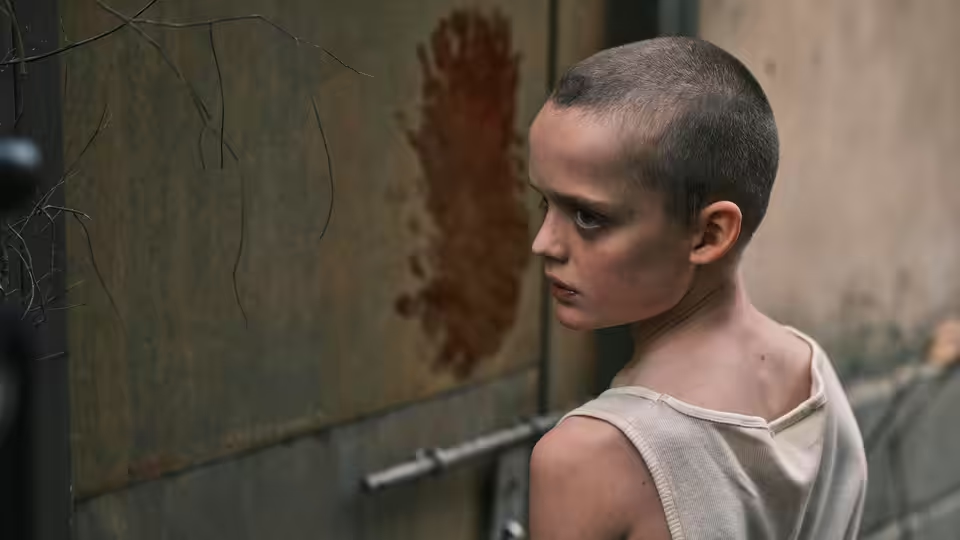
Sally Hawkins plays a foster mother who is kind, funny and attentive, and she is the most frightening thing in the film. The Philippou brothers’ second feature is grimmer and better built than their first, and it explains itself more than it needs to.
Danny and Michael Philippou’s first film, Talk to Me, was about teenagers passing an embalmed hand round a party, and it was frightening in the way a dare is frightening. Bring Her Back, their second, has no party and no dare. It has a foster home, two grieving children and a woman who has decided what she wants. It is the better-made film of the two and by some distance the harder to sit through, and it would be better still if it trusted us to work out what Laura is doing without showing us the instruction manual. It runs 104 minutes and feels longer, which is partly a compliment.
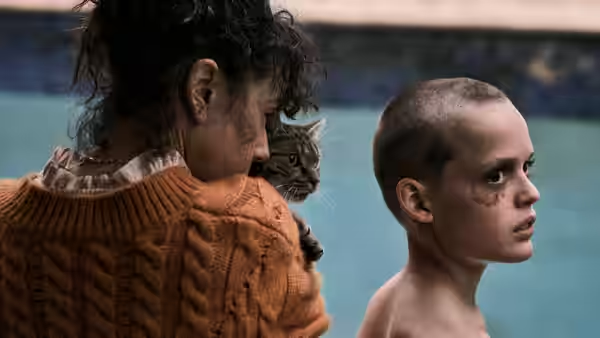
Andy (Billy Barratt) and his partially sighted step-sister Piper (Sora Wong) lose their father in the opening minutes, and the film does not soften it. Andy finds him. Barratt plays the aftermath as a boy trying to be the grown-up and getting it slightly wrong every time, which is exactly right. They are sent to Laura (Sally Hawkins), who lives in a cluttered house with an empty swimming pool in the garden, and who lost her daughter, Cathy, in it. She greets Piper like a returning relative. She greets Andy like a lodger.
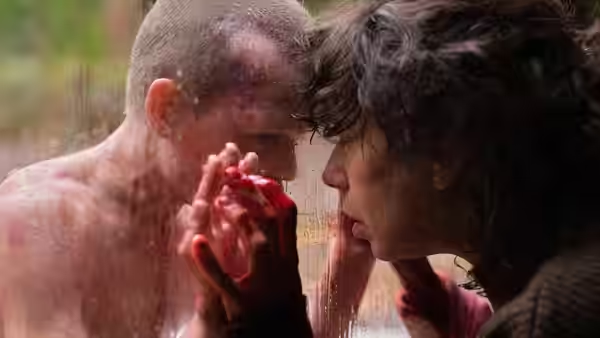
Hawkins is the reason to see it. Laura talks constantly, laughs at her own jokes, offers tea and hugs and a drink to children who should not be drinking, and never for one moment stops watching. The performance works because Hawkins does not signal. There is no cold flicker behind the eyes, no line delivered a beat too slow; she is warm all the way down, and the warmth is what makes her so frightening. When she starts to separate Andy from his sister, she does it with concern in her voice, and we found ourselves half-believing her while knowing exactly what she was doing. We have not seen that done better in a horror film for some years.
The house is built for her. Vanessa Cerne’s production design fills it with blankets, mismatched crockery and a dead child’s drawings that nobody has taken down, so it looks like somewhere a bereaved woman has stopped tidying rather than a haunted house. Aaron McLisky shoots it close and low-lit, the camera often at a child’s height, and lets the corners of rooms go dark so we are never sure how big the place is. Cornel Wilczek’s score is low and sustained and knows when to stop. The sound is the best of the craft: chewing, breathing, bare feet on tile, mixed so close that we flinched at things the camera had not shown us yet.
Then there is Oliver. Jonah Wren Phillips plays him as a small, silent boy with a stare, and for the first half hour he is simply odd. Then he is not. There is a stretch around the midpoint that we watched through our fingers, and we do not, as a rule, watch things through our fingers. We were horrified, and then a little ashamed of how much we admired the practical effects, because admiring anything felt like the wrong response. The Philippous have a gift for the body doing what a body should not, and here they use it on a child, which is the point, and also the reason some people will leave.
What holds it back is the explaining. Laura keeps a collection of old videotapes, and Geoff Lamb cuts to them in bursts throughout, grainy footage of people doing things in rooms. By the third burst we understood the mechanism; by the fifth we were being told again. The script, by Danny Philippou and Bill Hinzman, makes the mistake a good deal of grief horror makes: the meaning is clear from the premise, and the film keeps underlining it. The last twenty minutes, which we will not describe, are also so unrelenting that the sadness underneath, which is real, has to fight to be heard.
Several critics have set this beside Hereditary and Pet Sematary, and the debts are there: the dead child, the parent who cannot leave it alone. Neither of those films had Sora Wong, who plays Piper without a trace of pathos and whose partial sight the film uses cleverly, letting her hear the house before she sees it.
See it in a cinema if you can bear to, because the sound is mixed for big speakers and a dark hall. Do not see it on a full stomach, and do not see it the week after a funeral.