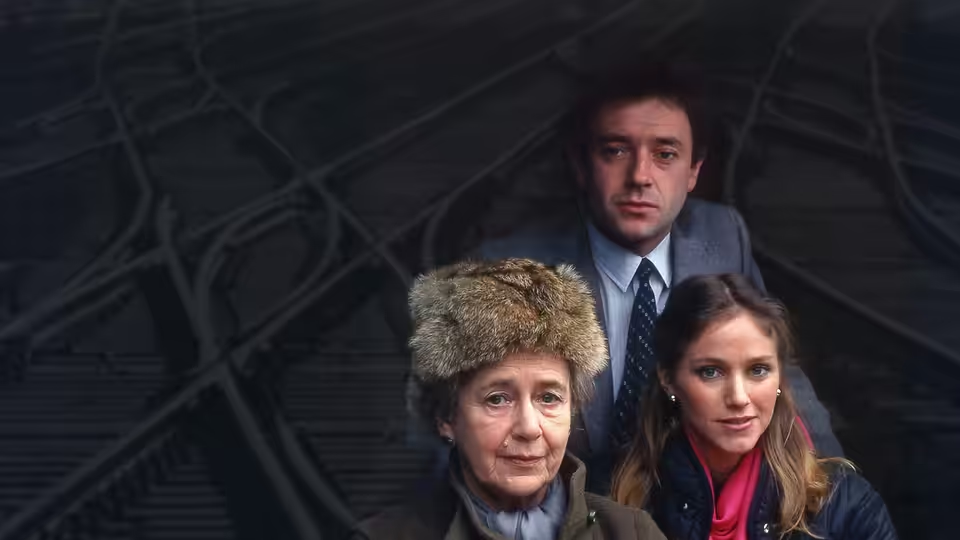
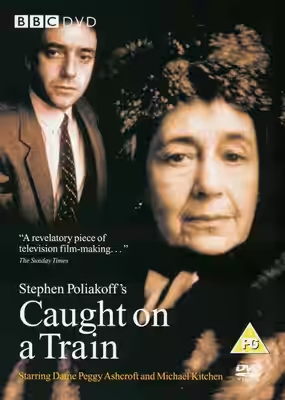
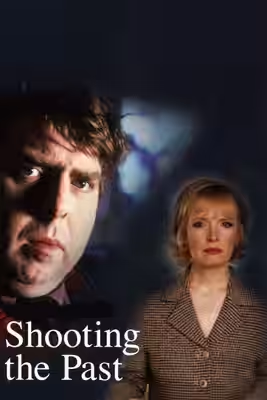
Stephen Poliakoff shuts a hollow young Englishman in a sleeper compartment with a Viennese woman who will not be refused, and Peggy Ashcroft and Michael Kitchen make 80 minutes of it feel like the whole night. Small, sharp and, at the last, unexpectedly kind.
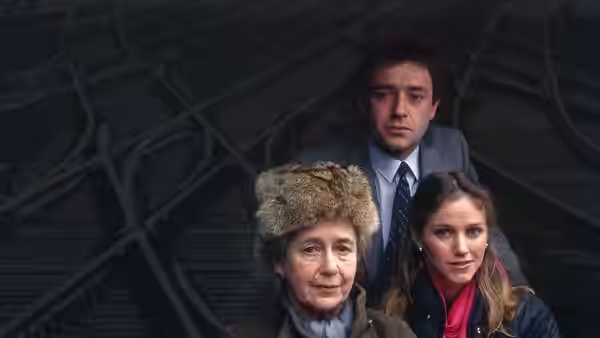
Stephen Poliakoff’s script puts two strangers in a sleeper compartment on the night train from Ostend to Vienna and keeps them there for 80 minutes. Peter (Michael Kitchen) is a young Englishman in publishing who wants a quiet night and, if it can be managed, the American girl in the corridor. Frau Messner (Peggy Ashcroft) is an elderly Viennese woman who wants his seat, his help with her luggage, his attention and, by Frankfurt, something harder to name. Peter Duffell directs it as the chamber piece it is. The result is small, sharp, often unkind and, at the end, more generous than it has any right to be, and Ashcroft is the reason to see it.
She plays Messner as a woman who has never once in her life been refused and has not noticed that this is unusual. The voice is soft and musical, the requests are tiny, and each one lands on the last like another suitcase on the rack. Could he move. Could he fetch the guard. Could he not smoke. Could he come with her to the buffet while the train waits, and the train does not wait long. Ashcroft never raises her voice and never lets Peter finish a sentence, and she makes the two things look like the same trick. There is a scene in the dining car, with Ingo Mogendorf as the waiter she decides to break, that we watched with our shoulders somewhere near our ears.
Kitchen is just as good in the harder part. Peter is pleasant, well dressed and well spoken, and Kitchen shows us within ten minutes that there is nothing behind the pleasantness at all. He smiles with his mouth, says yes when he means no, lies to Lorraine (Wendy Raebeck) about small things for no reason, and loses his temper only when it is safe to. The film’s case, as far as it makes one, is that this is what a certain kind of Englishman is made of, and Kitchen does not plead for him. He lets us watch Peter being found out, one favour at a time.
Duffell keeps the camera in the compartment and the corridor, under the thin yellow of the overhead lamps, with the dark going past the window and the odd station sliding in white and empty. The glass of the compartment door is used again and again: Peter looking out at Lorraine, Messner looking in at Peter. Michael Sheard’s Preston, a fellow Englishman who tuts from the corner, and the young Germans played by Louis Sheldon Williams and Michael Kingsbury turn up when the script needs the outside world to intrude, and go when it does not.
Here is what we felt. For the first hour we were on Peter’s side and uncomfortable about it, wincing at each new demand and wishing he would just say no, and then, somewhere around the Frankfurt platform, we realised we had crossed over and were waiting for Messner to win. The last twenty minutes, which we will not describe, go somewhere we had not expected, and one speech of Ashcroft’s, delivered sitting down and barely above a murmur, moved us a good deal more than an 80-minute train journey has any business doing.
Not all of it holds. The Frankfurt stop asks us to believe a train will wait on one old woman’s whim, and the film knows it and hurries past. The young Germans are there to make a point about the new Europe and the old, and they make it and leave. Raebeck is given one note, bright and then puzzled, and plays it well, but Lorraine exists to show us Peter’s vanity and is given no night of her own. And Poliakoff lets Messner explain herself once too often; the speech we cannot forget would be stronger without the two that prepare for it.
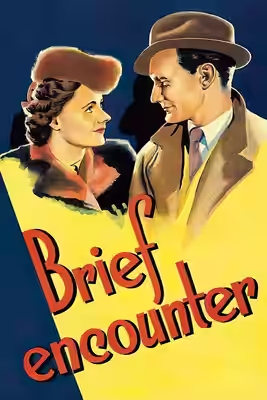
Set against the train films it will remind you of, The Lady Vanishes (1938) with its mystery and Brief Encounter (1945) with its longing, this is the stingy one. Nothing goes missing and nobody falls in love. Two people are stuck together for a night and one of them learns something, and whether it is the one who needed to is the question the film leaves on the platform. See it with someone who has sat next to the wrong stranger on a long journey. They will recognise everyone.