Earth Mama is a patient, moving drama carried by Tia Nomore’s restrained performance. Savanah Leaf gives Gia room to be uncertain, though the film’s insistence on maternal instinct sometimes narrows its sympathy.
Earth Mama is a compassionate drama that earns our concern for Gia without requiring us to approve of everything she does. Savanah Leaf, who writes and directs, approaches motherhood and the welfare system through a woman whose inner life deserves as much attention as her circumstances. The risk is that Gia might become a means of explaining foster care, with every scene arranged to prove a point. The director largely avoids that, giving Tia Nomore time to make her uncertainty felt.
The performance is the main reason to see it. We were moved by the close-ups of Gia’s face, because Tia Nomore makes her distress feel like something she is still working out how to express. There is vulnerability here, but also the ordinary difficulty of knowing what to say when a clear answer is expected. Staying with her gives us time to consider Gia without forcing a judgement, and the performance rewards that attention.
The film’s warmth comes partly from the solidarity among its Black women. The director does not make support look as simple as a kind word followed by a solved problem. The pressures remain, and the tenderness has value even when it cannot remove them. That helps keep the welfare-system material from becoming an exhausting procession of examples, each more hopeless than the last.
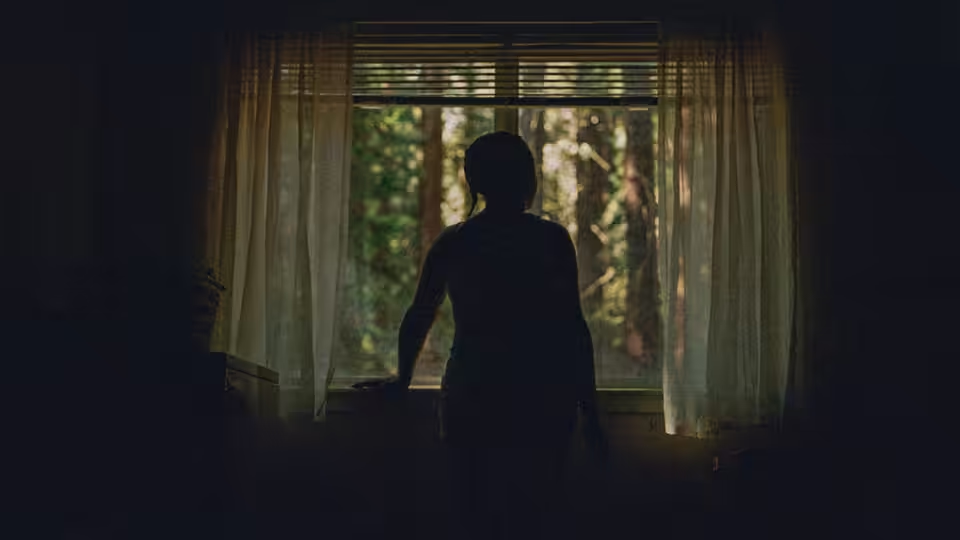
Jody Lee Lipes’s cinematography gives the natural surroundings a beauty that does not make Gia’s situation seem easier. The close-ups matter more: attention to a face can tell us something that another explanation of the system would not. Juliana Barreto Barreto’s production design keeps the surroundings from competing with the performance, which is the right priority here. The visual restraint allows us to spend time looking at Gia without feeling that every image has arrived with a lesson attached.
George Cragg’s editing accepts the risks of this unhurried approach. At 101 minutes, the film has room to linger, and we do not always feel that the extra space brings us closer to Gia. Kelsey Lu’s music works within the film’s gentleness, leaving the performance to carry its difficult feelings. There are passages where that collective restraint creates a little too much distance, although Tia Nomore usually gives us a reason to keep looking.
The larger reservation concerns the way motherhood is linked to the natural world. At times the film seems too sure that maternal longing is instinctive, and the images begin to tell us how a woman ought to feel. That is a narrow account of motherhood for a drama otherwise so willing to allow uncertainty. The performance keeps drawing us back to Gia’s particular difficulties, where the writing is more convincing.
These reservations do not undo the care in the writing or the force of Tia Nomore’s performance. Earth Mama belongs to the kind of social drama in which listening and looking are allowed to take time, and that patience mostly pays off. We recommend it with the warning that its quietness can occasionally feel like distance. Give it an evening when a small change in a face will have your full attention.