Lee Cronin moves the series into a condemned Los Angeles block of flats and gets a fierce performance from Alyssa Sutherland as a mother who comes back wrong. It is lean, loud and horribly efficient, and rather less fun than it thinks.
Sam Raimi’s Evil Dead films kept their horrors in a cabin in the woods, and the woods did half the work. Lee Cronin, writing and directing, moves the book into a city. Beth (Lily Sullivan), a guitar technician, turns up at the Los Angeles flat of her sister Ellie (Alyssa Sutherland), a tattoo artist raising three children in a building that has been condemned and is emptying out floor by floor. That night an earthquake opens the car park, Danny (Morgan Davies) finds a vault with a book and some old records in it, and he does what teenagers in these films do. Evil Dead Rise is lean, loud and frightening in bursts, and it is a good deal less alive than the films it descends from. If horror is your evening, it will do the job.
Sutherland is the reason to watch. Ellie comes back wrong before the first act is out, and Cronin has the sense to keep her mostly on the other side of a door, talking to her children in a voice that is nearly her own. Sutherland plays the possessed woman as a mother who remembers all the words and none of the feeling: the head tilts, the smile arrives a beat late, the lullaby is in tune. It is a physical performance done under a great deal of make-up, and she never lets the make-up do the acting for her. Sullivan, as Beth, is capable and dry and has less to work with; the script gives her a piece of news of her own in the first scene and then forgets about it for an hour.
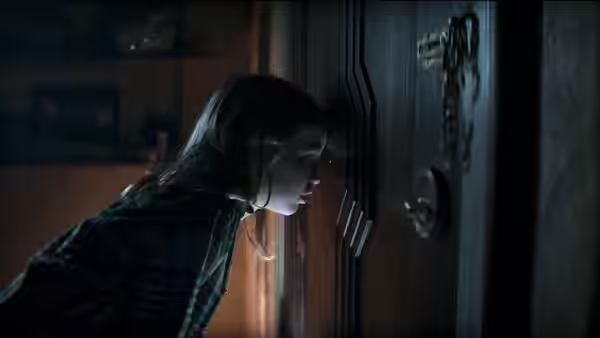
The building is well chosen and well built. Nick Bassett’s production design gives it water-stained corridors, a lift with a cage door that takes an age to close, and a car park that looks like a grave before the ground has even opened. Dave Garbett shoots the corridor from inside the flat, through the peephole, so the lens bends the walls and whoever is walking towards the door seems to be coming from a long way off. That shot frightened us properly, and it did so with a woman walking slowly and nothing else. Bryan Shaw cuts hard and short; at 96 minutes the film never sits down, which is a virtue for most of the way and a limit near the end.
The gore is what most people will come for, and Cronin supplies it in quantity. Stephen McKeon’s score rumbles under the floor and comes up to a shriek for the jumps, which is the job, and every impact lands with a wet, heavy thud. We flinched at the scene with the cheese grater, and we are not squeamish. Then, some way into the second half, we noticed that flinching had become the only thing the film was asking of us, and that we had stopped minding which of the children got out.
That is the trouble. The 1981 film was funny because the camera misbehaved, hurtling through the woods and knocking over the furniture. Cronin keeps his camera steady and grim, and the jokes that are left are lines rather than pictures. The three children are drawn with a thick pen: Danny makes the mistake, Bridget (Gabrielle Echols) blames him for it, Kassie (Nell Fisher) carries a home-made doll on a stick. The neighbours, Mr Fonda (Mark Mitchinson), Gabriel (Jayden Daniels) and Scott (Tai Wano), exist to be counted down. Sarah Voon’s costumes, worn flannel and band T-shirts, tell us more about these people than the dialogue does.
Cronin’s previous film, The Hole in the Ground, was also about a mother whose child comes back changed, and he plainly means this one to be about a family as much as about blood. Fede Álvarez’s 2013 Evil Dead went the same route, grim and straight-faced, and this sits closer to it than to Raimi; the cold open at a lakeside cabin is a nod to the originals rather than a promise to behave like them. The early films looked as if they might fall apart at any moment, and that was part of the fright. This one is bolted together and does not creak.
See it in a cinema if you can, with the sound up; the noise is half the film. At home, with a lamp on, it shrinks to a well-made possession picture with one remarkable performance in it.