Luc Besson’s script gives Kiefer Sutherland a collar and a gun and little else. Sutherland plays it dead straight, which is the film’s best joke and its only real idea; around him the violence is loud, the humour flat and the picture oddly cheap.
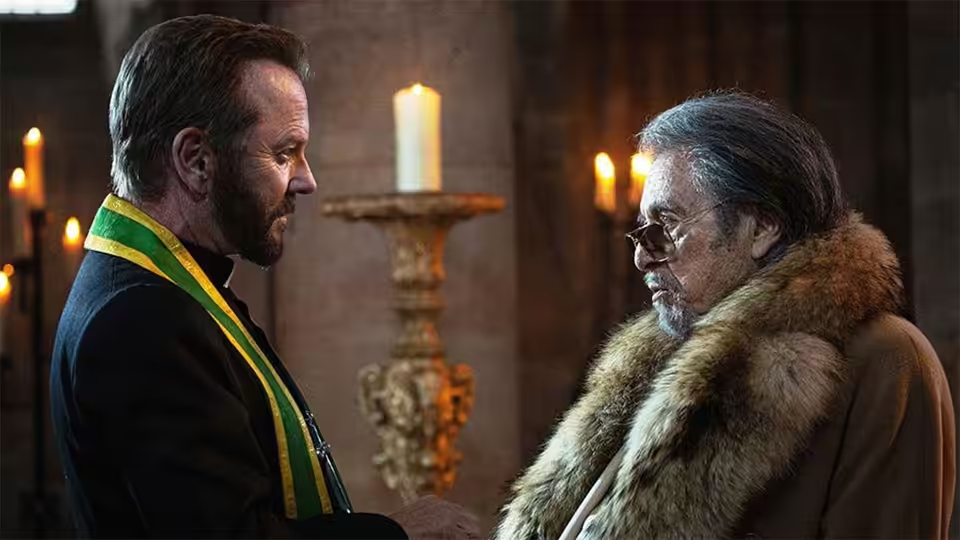
Luc Besson has written a film in which a priest kills gangsters, and has handed it to Barthélémy Grossmann to direct and Kiefer Sutherland to carry. That is the whole pitch, and the film knows it, and for a while knowing it is enough. Father Joe is a throwback to the kind of hired-gun picture Besson was making and producing thirty years ago, loud, bloody and pleased with itself, and it has one thing those films did not, which is Sutherland refusing on principle to smile.
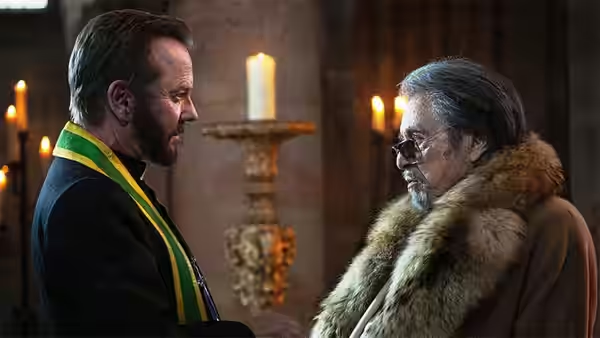
The refusal is the performance. Sutherland plays Joe as a man who takes both halves of his life with equal seriousness: the collar is not a disguise and the gun is not a lapse. He does not wink. He does not pause after the absurd lines to let us know he heard them. Whatever Besson meant the character to be, Sutherland has decided he is a believer, and the film is better whenever the camera stays on him long enough for that decision to register.
We laughed properly perhaps twice, and both times it was his face rather than the script that did it: the flat, unamused stare of a man who has just done something appalling in a cassock and is waiting for the next thing. The lines around him are broad and mostly land with a thud. Besson writes gangsters the way he always has, as furniture with accents, and the film’s humour is the kind that announces itself and then stands there.
Around Sutherland is a cast list built for a mob picture. Sebastián sierra plays Lorenzo, Esteban Dager plays Luca, Victor von Schirach plays Andrea, and Miglen Mirtchev turns up as Igor Rochenko; Avant Strangel is Detective Peter, the police presence. Michael Rispoli, Fred Melamed, Chris Tardio and Erik Palladino fill out the rooms. Al Pacino takes second billing and is used exactly as a film like this would use him, for the name and the voice. Ever Anderson is the other name of note, third on the bill.
The picture itself is the disappointment. Grossmann shoots the action without much sense of where anyone is standing, so the gunfights are loud and hard to follow, and the frame is oddly plain for a film with this much blood in it. Hugues Tissandier’s production design and Corinne Bruand’s costumes do the one job the film asks of them, which is to keep the collar visible in every fight and a church recognisable behind it. Matteo Locasciulli’s score does the pushing the camera does not, and it pushes hard.
There is a stranger thing in it too, which is that the film is generous about religion. Joe’s faith is not a costume for the film to mock, and nobody else’s is mocked either; for a picture this crude, that is an unexpected courtesy, and it gives the quieter scenes a warmth the loud ones never earn. It is also the closest the film comes to an idea. By the last half hour the gunfire had stopped registering as anything at all.
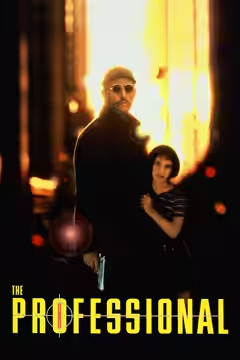
Besson wrote Léon (1994), which made a hitman and a child into something close to tender. Father Joe has the hitman and none of the tenderness. Sutherland deserved a better film and may well know it, since he also produced this one. It runs 116 minutes, which is twenty more than the joke has in it.