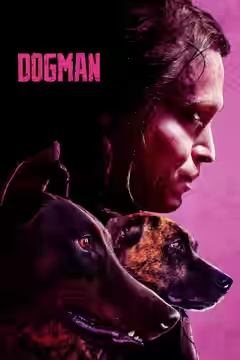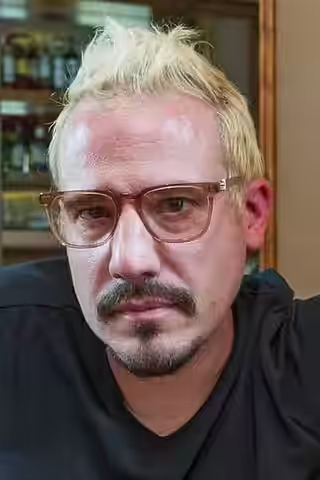
A director who began by shutting himself in a small room and making a thriller that got him noticed, then spent the years since working larger and for other people. On the evidence so far, four walls suited him better than the shooting gallery.
Fi1m perspective
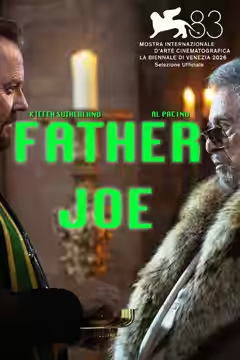
In Father Joe (2026) the fights happen in and around a church, which ought to be the easiest kind of space to stage: pews, aisle, altar, everybody knows where the walls are. Grossmann shoots it so that we do not. The cuts come before the eye has found anyone, the frame sits at an ordinary height and an ordinary distance, and the excitement is left to Matteo Locasciulli's score, which does the pushing the camera has declined to do. We spent the gunfights squinting, trying to work out who was behind which pillar, and before long we had stopped trying, which is a bad sign in a film whose entire pitch is a priest killing gangsters.
It is a strange place for this director to have ended up, because he started at the opposite scale. 13 m² (2007) he wrote, directed, produced and acted in, on his own money, and it is a huis clos: a handful of people in a space the title measures for you. The notice it drew was for tautness, for a young filmmaker who knew what to do with four walls. Then came a long spell in French television, No Limit (2013), Lascars (2014), Exposed (2017), and when he returned to features it was under Luc Besson, first with Arthur, malédiction (2022), a spin-off from Besson's Arthur films, then with English-language thrillers Besson wrote and produced, Father Joe among them. That is three films with Besson now. Colin Wandersman has shot two of his.
Grossmann has said of Besson: "J'ai énormément appris à ses côtés. Et quand il te donne un conseil, ce n'est pas une histoire d'ego, c'est quelque chose qui rend réellement le plan meilleur." He learned a great deal from him; the advice makes the shot better. We do not doubt he means it. But the Besson films are where the work has gone slack. Arthur, malédiction was criticised for thin plotting and for never getting past the slasher conventions it borrowed, and Father Joe has the same problem in a different genre: a script that hands over a premise and stops, and a director who fills the gap with volume rather than geography.
What survives is a feeling for what an actor can carry. Kiefer Sutherland's refusal to smile is the one real idea in Father Joe, and someone let him keep it for the whole film. Hugues Tissandier's design and Corinne Bruand's costumes keep the collar visible in every fight and a church recognisable behind it. The pieces are all present. They are not arranged.
We would like to see what he does with a small room and a script of his own again. The Besson years have shown us a director who can get a large, loud film made and finished, and not yet one who can make us see it.
Biography
Barthélémy Grossmann is a Swiss actor, director, screenwriter and producer. Born in Geneva on 30 October 1981, he began his career as an actor in short films and television series before moving into directing with his debut feature 13 m² (2007), which he also wrote, produced and appeared in.
He has directed television series including episodes of No Limit (2013) and the full second season of Lascars (2014), as well as the series American Dream (2015) and Exposed (2017). His later feature films as director include Arthur, malédiction (2022) and Father Joe (2026), the latter written and produced by Luc Besson and premiered out of competition at the Venice Film Festival.