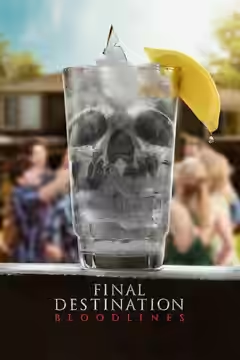
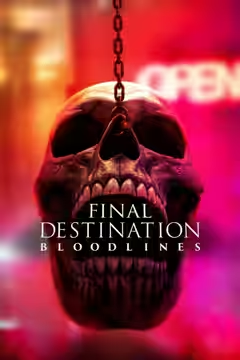
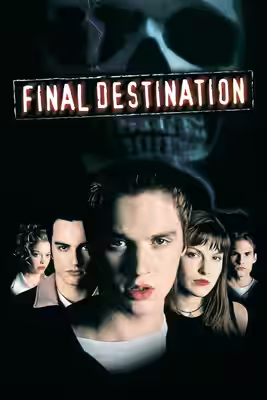
The sixth Final Destination film opens with the best twenty minutes the series has managed and then spends ninety more trying to match them. It cannot, quite, but the deaths are inventive, the jokes land and Gabrielle Rose gives it a heart.
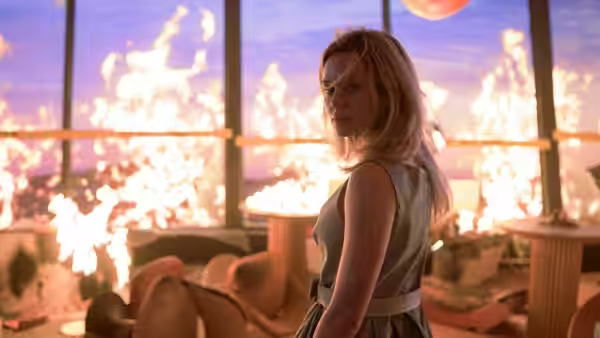
Stefani Reyes (Kaitlyn Santa Juana) is a student who has stopped sleeping. Every night she dreams the same thing: 1968, a party in a restaurant at the top of a new tower, a glass dance floor, and a young woman called Iris (Brec Bassinger) who sees the whole building come down before it does. Stefani’s grades are going, so she drives home to ask her family who Iris is. The answer is her grandmother, now old, alone and played by Gabrielle Rose, and the reason Stefani is dreaming about her is in the film’s title. This is the sixth Final Destination film and the first in fourteen years, and it is the best-made of them. It is also a film that spends its first twenty minutes at a level the remaining ninety cannot reach.
Those twenty minutes are the reason to buy a ticket. Rachel O’Toole’s production design gives the tower restaurant chrome rails, a glass floor and a band in matching jackets, Michelle Hunter dresses the guests in the sort of stiff pastel that photographs well and burns fast, and Christian Sebaldt shoots it all in warm, saturated colour so the place looks like a postcard from a holiday nobody came back from. Then the film starts pointing at things. A dropped coin. A hairline crack in the glass. A tray of drinks. Sabrina Pitre’s cutting turns the restaurant into a game of spot-the-weapon, and Tim Wynn’s score winds up underneath like a spring. We laughed, then found ourselves lifting our feet off the cinema floor, and we are not proud of either reaction. That is the film working as intended.
The rule of the series, since the first film in 2000, is that somebody cheats Death, and Death, who is patient and keeps a list, works through the survivors one freak accident at a time. Lori Evans Taylor and Guy Busick’s script has one good new idea: because Iris cheated, everyone descended from her is on the list too. So the film gathers a family barbecue and lets us count. Stefani’s mother Darlene (Rya Kihlstedt), her brother Charlie (Teo Briones), Uncle Howard (Alex Zahara) and Aunt Brenda (April Telek), and the cousins Erik (Richard Harmon), Bobby (Owen Patrick Joyner) and Julia (Anna Lore). Harmon, as the cousin who takes none of it seriously until he has to, gets most of the laughs and earns them.
Where it sags is where these films always sag: in the talking. Stefani and Darlene have an estrangement to work through, and the script writes it out in full, twice, while the audience waits for the next garden tool to become relevant. Santa Juana is fine when she is running and less sure when she is asked to cry at her mother, and directors Adam Stein and Zach Lipovsky let those scenes run long. There is a stretch in the middle where we checked the time, which in a film about waiting for something to fall on someone is a poor sign.
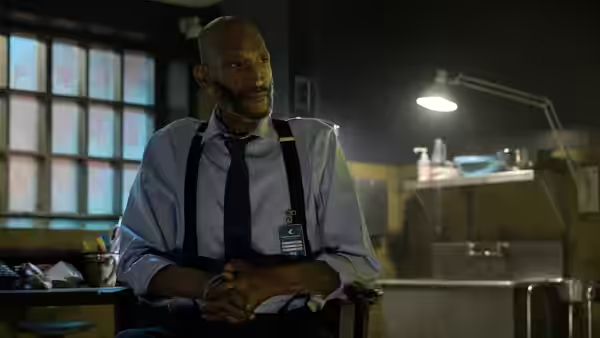
Two performances carry the second half. Gabrielle Rose plays the older Iris as a woman who has spent fifty years booby-trapping her own house against fate and has stopped expecting to be believed; she is funny and frightened at the same time, and the film is better whenever she is in it. And Tony Todd returns as Bludworth, the mortician who has been explaining the rules in these films since the first one. This is his last appearance, and the film knows it. The scene is quieter than anything around it, shot close, with hardly any music, and Todd plays it straight rather than sinister. We were more moved than a film with a logging truck in it has any right to make us, and it was because nobody winked.
Set against the rest of the series, this is the one with the most craft and the fewest scares. The deaths are jokes with long set-ups and wet punchlines, and after the opener we were never frightened, only delighted or appalled. The callbacks, the logging truck among them, are for the faithful, and the faithful will enjoy them. It runs 110 minutes and carries a 15 certificate, and most of those minutes eventually get a splat.
See it in a cinema with a crowd that likes to shout at the screen; at home it becomes a well-made film about a family arguing, with interruptions. And check the ceiling fan when you get in.