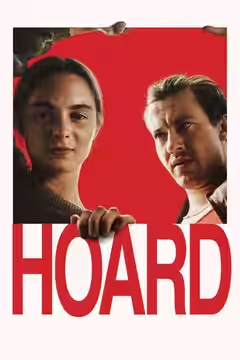
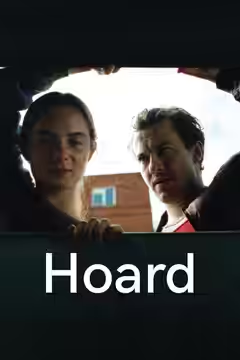
A young woman and man lean over an open container, looking inside
Film review

Hoard

2024 · Directed by Luna Carmoon · 2h 06m

In a sentenceAll that clutter, and the difficult part is how much these people love each other

Maria (Saura Lightfoot-Leon) and her mother, Cynthia (Hayley Squires), share a bond in which affection and hoarding are closely entangled. Maria’s childhood is also part of the story, with Lily-Beau Leach playing Young Maria. Michael (Joseph Quinn) enters a drama shaped by the things people keep and the feelings attached to them. Love makes these relationships difficult to dismiss, even when the behaviour within them causes distress. Maria’s experience brings romance and fantasy into a story of attachment, mental turmoil and the lingering force of a mother-daughter relationship.

Plays from YouTube when you press play; nothing loads from them until then.

Fi1m review

Luna Carmoon’s Hoard makes love and hoarding painfully difficult to separate. Saura Lightfoot-Leon holds this abrasive drama together, though repeated shocks and a wandering pace sometimes make its 126 minutes feel longer.

Luna Carmoon’s Hoard is a good, abrasive drama whose sympathy for its characters survives some unnecessary tests of our patience. Hoarding is bound up with affection here, which makes it difficult to regard the mess as something that could simply be cleared away. The film asks us to stay close to people whose behaviour can be distressing, without first making them agreeable company. That is a worthwhile demand, though the repeated provocations sometimes make it harder to answer.

Saura Lightfoot-Leon gives Maria enough force to hold our attention through the changes of tone. The performance is uninhibited, but its boldness never makes the character seem expendable: we still care what happens to her. Lily-Beau Leach, as Young Maria, is important to that sympathy too. Having two performers carry Maria could leave us attending to the join; instead, both make her worth following even when the film itself begins to wander.

We were moved more than we expected by the tenderness between Maria and Cynthia. Hayley Squires plays Cynthia, and the affection in their relationship makes the hoarding harder to watch: we cannot dismiss these lives as merely unpleasant. The film allows tenderness to exist alongside distress without suggesting that love is enough to resolve it. That feels honest, and it gives the discomfort a purpose beyond testing how much an audience will tolerate.

Bobbie Cousins’s production design makes the hoarding feel physically oppressive, with accumulated detail that is hard to take in at a glance. That matters because a merely picturesque mess would let us enjoy the strangeness and move on. Nanu Segal’s cinematography is similarly effective: the images have a beauty that does little to ease their discomfort. Together, these contributions give the performances surroundings that seem capable of wearing a person down.

The length is a more substantial problem. Rachel Durance’s editing does not always give the shifts in tone enough momentum, and at 126 minutes the film spends too long sustaining feelings it has already made clear. Jim Williams supplies the music, though we found the oppressive production design more effective at sustaining unease. A firmer rhythm would help: there are passages where we remain aware of the distress without learning anything further about the person experiencing it.

Luna Carmoon’s writing is least persuasive when a fresh provocation seems to be doing work that a developing relationship should do. We do not need Maria explained into submission, and we would not trade the strangeness for a convenient diagnosis. We do need a sense that spending more time with her is changing what we understand. The film achieves that often enough to remain absorbing, but its less disciplined stretches leave the actors doing too much.

As a drama about mental distress, Hoard makes a strong case for staying with people whose behaviour is hard to bear. Its willingness to let affection remain complicated is welcome in a genre often tempted to explain every hurt. It also trusts its performers to make us care without requiring us to approve of everything their characters do. Save it for an evening when being made uncomfortable is part of the attraction.


Critical consensus AI synthesised

71
Positive
7
Mixed
4
Negative
1

Most critics respond positively to Hoard, with praise centring on Luna Carmoon’s unsettling, physically tangible direction and Saura Lightfoot-Leon’s uninhibited performance. The reviews repeatedly describe a film whose accumulated detail makes its characters’ surroundings feel almost touchable. Several find tenderness and emotional complexity beneath the abrasive scenes, particularly in the portrayal of Maria and Cynthia’s bond. Even some of the more reserved responses admire its strangeness and willingness to make viewers uncomfortable.

The spread is wide, however, and the main disagreement concerns whether the provocations serve the characters. Little White Lies finds them emotionally purposeful and free of cliché; The i Paper argues that the escalating shocks fail to make a meaningful point. Elsewhere, reservations cluster around an excessive runtime, meandering pace and elements that do not quite cohere. The consensus favours Carmoon’s distinctive approach, but there is considerably less agreement about her control of the story.

Little White Lies
14 May 2024 · 4/5/5 · David Jenkins
100

Jenkins calls the film a distinctive, emotionally complex and deeply moving debut. He praises Carmoon’s avoidance of cliché and her ability to make provocative scenes serve character and mood.

Read the full review →
Time Out
17 September 2023 · ★★★★ · Sophie Monks Kaufman
80

The review warmly welcomes the film as the arrival of a brilliantly strange new visionary. It singles out the visceral treatment of love and hoarding in this British debut.

Read the full review →
Sight and Sound
16 May 2024
78*

The critic finds Hoard audacious, unsettling and pleasingly original, though not every element gels. Saura Lightfoot Leon’s mesmerising performance is singled out as the key to the film’s slippery, captivating world.

Read the full review →
IndieWire
2 September 2023 · B · Josh Slater-Williams
77

The critic calls the film an audacious, unsettling debut that announces a singular directing talent. They especially praise Saura Lightfoot Leon’s magnetic, fearless performance for anchoring the film’s warped beauty and volatile shifts in tone.

Read the full review →
Empire
13 May 2024 · Iana Murray
65*

Murray finds the film audacious and abrasive, though its provocations and overlong, meandering pace sometimes undermine it. She particularly praises Saura Lightfoot-Leon’s uninhibited performance and the film’s visceral, richly detailed production design.

Read the full review →
Screen Daily
2 September 2023 · festival review · Wendy Ide
64*

The accessible page identifies this as an unconventional mother-daughter drama but does not reveal the critic’s verdict. The paywall also hides what the critic singles out for praise or complaint.

Read the full review →

Straight answers AI written, from our review

Is Hoard worth watching?
Hoard is worth watching if abrasive, emotionally demanding drama appeals to you; we score it 75 out of 100. Saura Lightfoot-Leon’s performance and the tenderness between Maria and her mother give the discomfort a purpose, though repeated provocations and wandering pacing make its 126 minutes feel longer.
How long is Hoard, and what is it rated?
Hoard runs 2h 06m. It is a drama and romance film.
Where can I watch Hoard in Greece?
Hoard is not on any streaming or rental service in Greece at the moment. It is available in 3 other countries; change your country at the top of the page to see where. Availability is checked daily.
How violent or frightening is Hoard, and is it suitable for children?
Hoard has a UK 18 certificate and is an adult drama, unsuitable for children or younger teenagers. Its oppressive depiction of hoarding, distressing behaviour and mental turmoil makes it an uncomfortable watch. We would approach it cautiously if those subjects are difficult for you, rather than expect a gentle treatment of its mother-daughter relationship.
How does Hoard compare to Morvern Callar?
Hoard is the more abrasive choice beside Morvern Callar, though both make a young woman’s distress tangible through a distinctive visual approach. We favour Morvern Callar for quieter unease, with Samantha Morton’s guarded performance and music drawing us close; Hoard offers more openly expressed tenderness amid oppressive clutter. Both test our patience with their pacing.
What should I watch after Hoard?
After Hoard, try Morvern Callar (2002, Fi1m 82): Another young woman’s distress made tangible through a stubbornly personal visual language. Then The Piano Teacher (2001, Fi1m 82): For another uneasy encounter with desire, control and a suffocating maternal bond; and The Spirit of the Beehive (1973, Fi1m 87): Childhood imagination makes ordinary surroundings strange, with tenderness beneath the unease.

Cast

If you liked this, try…

  1. Morvern Callar (2002, Fi1m 82)Another young woman’s distress made tangible through a stubbornly personal visual language.

  2. The Piano Teacher (2001, Fi1m 82)For another uneasy encounter with desire, control and a suffocating maternal bond.

  3. The Fits (2015) · not reviewed yetA girl’s unsettled inner life finds expression through bodies and movement.

  4. The Spirit of the Beehive (1973, Fi1m 87)Childhood imagination makes ordinary surroundings strange, with tenderness beneath the unease.

  5. Safe (1995) · not reviewed yetAn exacting companion piece about distress that refuses a comfortable explanation.