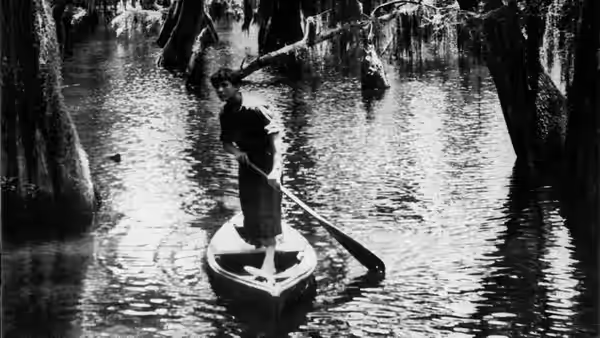
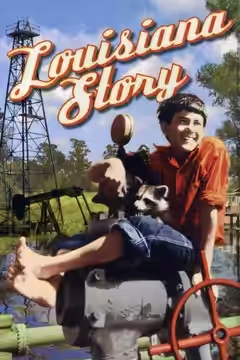
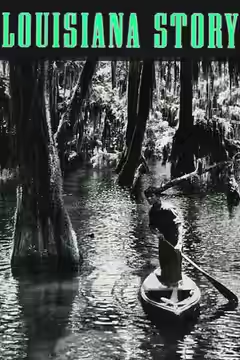
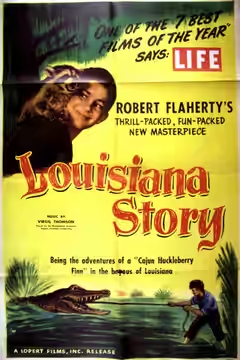
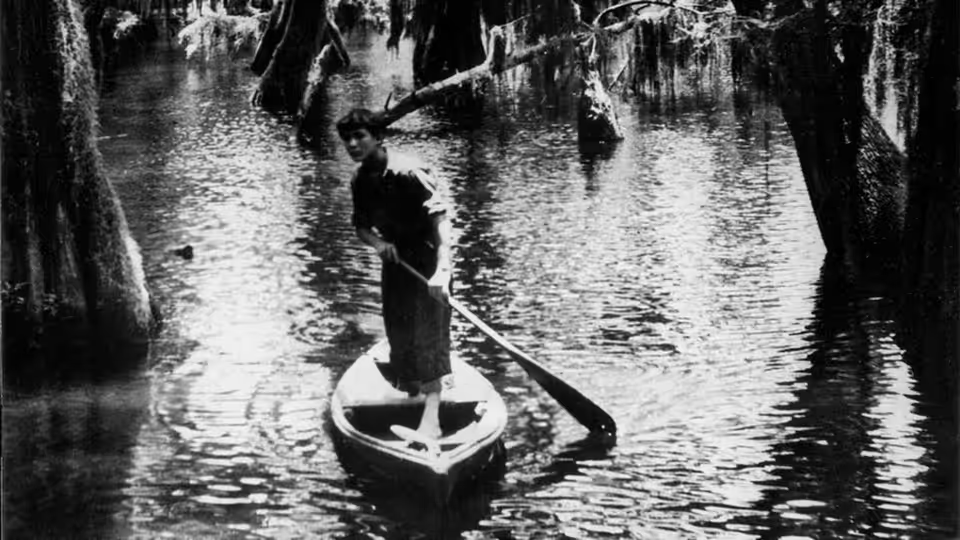
A boy stands in a small boat, poling through a cypress swamp
Film review

Louisiana Story

1948 · Directed by Robert J. Flaherty · 1h 18m

In a sentenceThe oil drillers receive a warmer welcome than we were prepared to offer

In the Louisiana bayou, The Boy (Joseph Boudreaux) explores the waterways by canoe while oil drillers work in the landscape around him. At home are His Father (Lionel Le Blanc) and His Mother (E. Bienvenu); among the workers are The Driller (Frank Hardy) and His Boilerman (C.P. Guedry). The opening canoe journey follows the boy through the bayou, introducing the surroundings he knows before bringing him into contact with the drilling operation. With little dialogue, he gets to know the men whose work now shares those waterways.

Fi1m review

Robert J. Flaherty’s bayou drama is worth seeing for Richard Leacock’s photography and Virgil Thomson’s music. The slender story holds our attention, but its cheerful view of oil drilling leaves too much unquestioned.

Robert J. Flaherty’s Louisiana Story is worth seeing for its photography and music, though its kindly treatment of oil drilling takes some swallowing. The small adventure puts a boy among waterways and working adults, with little dialogue to explain their lives. That leaves the photography, editing and music with much of the work, and they reward the attention they ask for. The trouble comes when the film expects the same warm response to everything it shows.

Richard Leacock’s photography makes the opening canoe journey a reason to stay with the film, even before the slender story has much to offer. We felt ourselves relax as the boy travelled through the bayou, carried along by Virgil Thomson’s music and the pleasure of being allowed to look. The images give the waterway an interest that does not depend on an incident waiting around the next bend. There is confidence in spending so much of an adventure simply attending to its surroundings.

Virgil Thomson’s score is especially valuable in a film with so little speech, giving the canoe journey movement without making it feel hurried. It encourages curiosity about the bayou and affection for the boy, and the pictures are strong enough to deserve both. We are less persuaded when that same affectionate mood extends to the oil workers. The music’s charm helps the favourable portrait go down easily, which is precisely why it needs listening to with a little suspicion.

Helen van Dongen’s editing keeps the limited action from feeling merely strung out, although there are stretches where the slightness of the story becomes difficult to ignore. The film can generate suspense, and its quietness makes those changes of pace effective. The story credited to Frances H. Flaherty and Robert J. Flaherty gives the people too little substance, however, especially beside the attention paid to their surroundings. At 78 minutes, the film is short enough to sustain its leisurely approach. We still wanted more reason to care about the family beyond their place in these images.

Joseph Boudreaux plays The Boy, and having a child at the centre gives the film a convincing reason to look at familiar surroundings with curiosity. Lionel Le Blanc and E. Bienvenu play His Father and His Mother, but the sparse dialogue gives their relationships little room to develop. Frank Hardy’s The Driller and C.P. Guedry’s His Boilerman receive a generosity that becomes hard to accept without question. The problem is the suggestion that friendly workers leave nothing else worth asking about their industry.

An adventure this quiet needs no apology for keeping its action scarce, and the unforced stretches are often the most absorbing. Its interest in an actual landscape does, however, invite questions about what industrial work means for the people living there. The film need not supply a lecture, but its confidence in the drillers ought to rest on more than their agreeable presence. Come prepared for a quiet evening, and keep a little of that goodwill in reserve.
Critical consensus AI synthesised

73
Positive
4
Mixed
3
Negative
0
The AV Club
27 May 2003 · Scott Tobias
85*

Tobias presents the film as a poetic, gently humorous work that complicates Flaherty’s legacy as a documentarian. He singles out the opening canoe sequence and its lyrical score for praise.

Read the full review →
The New Yorker
80*

The critic finds the film fascinating and luminous despite its awkwardness and dated industrial mythology. They single out Virgil Thomson’s score and its seductive interplay with Flaherty’s bayou imagery for praise.

Read the full review →
Variety
31 December 1947 · Variety Staff
80*

The review is positive, praising the film’s vivid atmosphere and superlative photography. It also highlights the slender story’s appeal and moments of agonizing suspense.

Read the full review →
Empire
13 April 2006 · David Parkinson
75*

Parkinson gives the film a positive verdict, calling it a prime example of American neo-realism. He especially praises Helen von Dongen’s editing and Virgil Thomson’s evocative score.

Read the full review →
The New York Times
29 September 1948 · Bosley Crowther
65*

The available page does not reveal the critic’s verdict. It provides no readable detail about what the critic praised or criticized.

Read the full review →
Time Out
· DC
65*

The available page identifies this as a film review, but provides no review text from which to determine the critic’s verdict. Its metadata mentions Standard Oil’s sponsorship, but offers no specific praise or criticism.

Read the full review →

Straight answers AI written, from our review

Is Louisiana Story worth watching?
Louisiana Story is worth watching for its bayou photography and Virgil Thomson’s music, and we score it 72. It suits a quiet evening and a taste for leisurely adventure, though the characters remain thin and its cheerful treatment of oil drilling asks for more goodwill than we can give.
How long is Louisiana Story, and what is it rated?
Louisiana Story runs 1h 18m. It is an adventure and drama film.
Where can I watch Louisiana Story in Italy?
Louisiana Story is not on any streaming or rental service in Italy at the moment. It is available in 1 other country; change your country at the top of the page to see where. Availability is checked daily.
How does Louisiana Story compare to Kes?
Louisiana Story offers a gentler account of a boy’s absorption in nature than Kes, which we recommend more strongly for its attention to the child himself. We find the bayou film most absorbing when it watches the waterways; Kes gives its boy more substance and places him in a much less accommodating adult world.
What should I watch after Louisiana Story?
After Louisiana Story, try Kes (1969, Fi1m 88): A boy’s absorption in nature meets a much less accommodating adult world. Then Local Hero (1983, Fi1m 86): Oil money reaches another small community, where the welcome comes with complications.

Cast

Awards

Academy Awards, 1949

Nominated
Best Story

If you liked this, try…

  1. The Naked Island (1960) · not on Fi1m yetPatient attention to rural labour, with little speech and no easy comfort.

  2. Kes (1969, Fi1m 88)A boy’s absorption in nature meets a much less accommodating adult world.

  3. Local Hero (1983, Fi1m 86)Oil money reaches another small community, where the welcome comes with complications.

  4. The River (1951) · not on Fi1m yetWaterside life observed with patience, and more room for complicated human feelings.

  5. Sweetgrass (2009) · not on Fi1m yetFor more landscapes and working lives, observed without quite so much reassurance.

Louisiana Story (1948) review: fine images, too fond of oil (Italy) | Fi1m