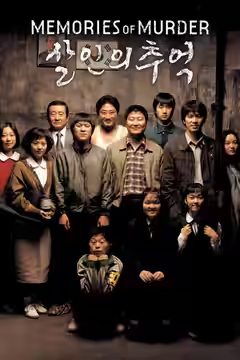
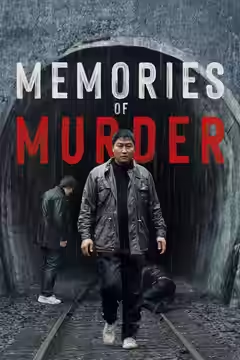
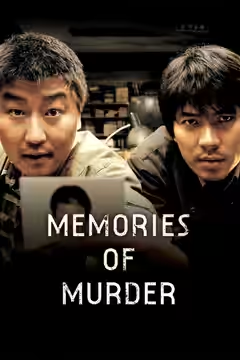
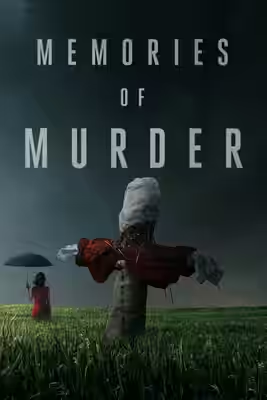
Bong Joon Ho’s second feature is a police procedural about police who cannot do the procedure, and it is one of the best films of its kind we know. Funny, then not funny, then something else; the long middle stretch is the only place it drags.
Bong Joon Ho made this in 2003, before Parasite made him famous in Britain, and it is built on a real case, a run of murders south of Seoul in the late 1980s, unsolved when the film was written. Bong and his co-writer Shim Sung-bo do not solve it either. They spend 131 minutes with the men who tried, and the result is a police film in which almost nothing the police do is any use. We would tell a stranger to see it, and we do not say that often.
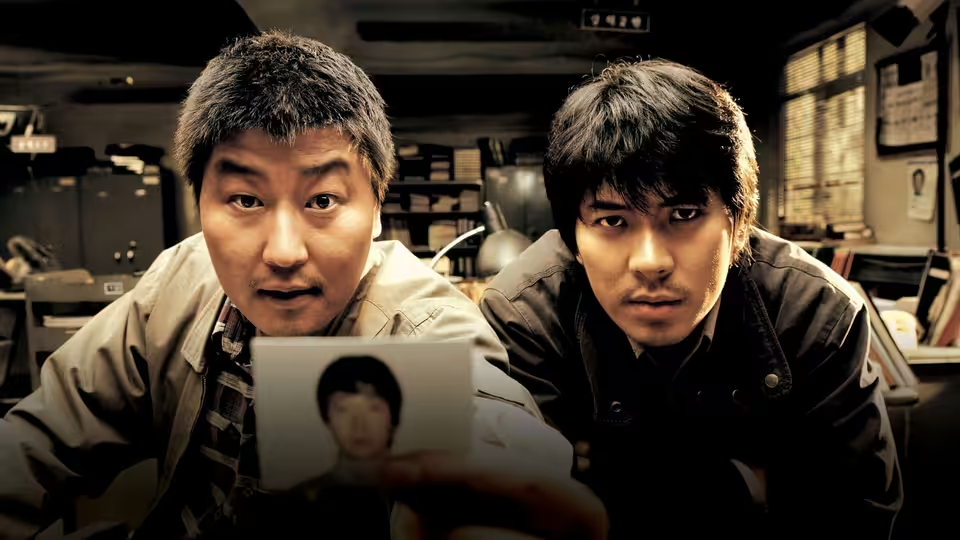
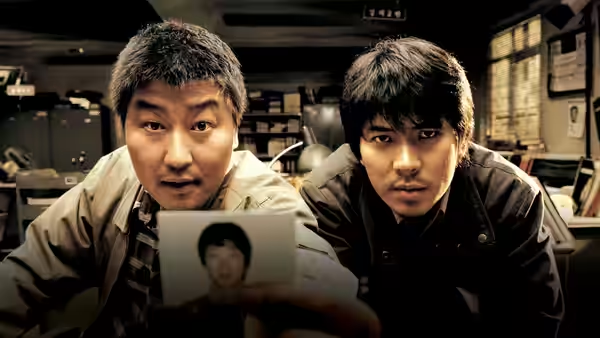
The joke, and it is a joke for about forty minutes, is that these detectives are terrible at their job. Song Kang-ho’s Park Doo-man is a country policeman who thinks he has a gift: he stares at a suspect and knows. Kim Sang-kyung’s Seo Tae-yoon comes from Seoul in a long coat and wants documents, timings, a map. Kim Yu-seon puts Park in a leather jacket that has seen rain and Seo in one that has not yet. Song plays Park with a slow, satisfied face, a man who is nearly always wrong and nearly never doubtful, and it is a great comic performance right up to the point where it stops being one.
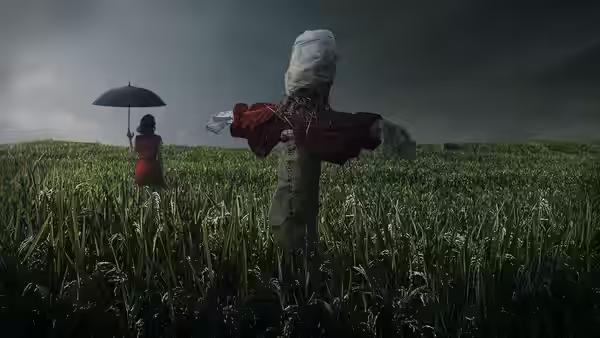
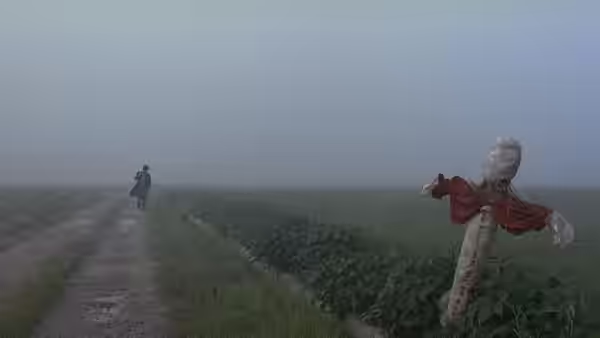
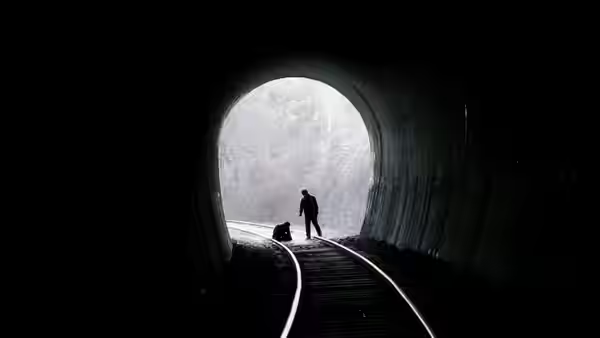
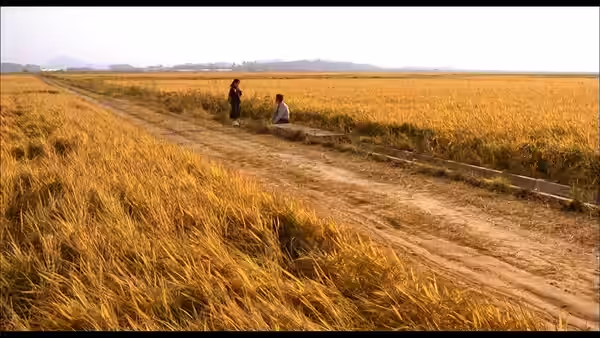
Kim Hyung-koo shoots the countryside in flat grey daylight, wide, with fields to the horizon and a body somewhere in them. At night it rains, and the only light is torches and a squad car, so the woods become small bright circles with black between them. Ryu Seong-hie’s police station has an interrogation room in the basement with a boiler, a pipe and a bulb, and it looks like a place where nobody would hear you. Taro Iwashiro’s score is a single mournful string theme used sparingly; it appears, does its work, and leaves.
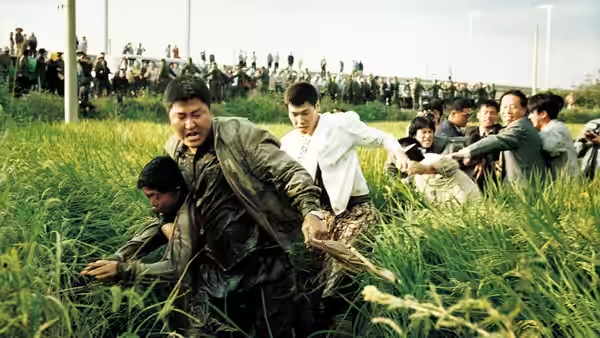
Here is what got at us. Kim Roe-ha’s Cho, the partner, greets suspects with a running drop-kick, and the first time he does it we laughed, because Bong stages it like slapstick. The man he is kicking is Baek Kwang-ho, whom Park No-sik plays as a frightened child in a grown body, and by the second kick we felt sick, and a little ashamed of the first laugh. The brutality is funny because it is stupid, and then it is not funny because it is happening to someone.
Bong keeps widening the frame. This is South Korea under a military government, and the film notices it in passing: the town goes dark for civil-defence drills, riot police are unavailable because they have been sent to beat up students, and a forensic sample has to go abroad because nobody at home can read it. Kim Seon-min’s editing lets these details sit inside ordinary scenes rather than flagging them. Byun Hee-bong and Song Jae-ho, as the sergeants running the station, are exactly the kind of tired men who let this happen.
It is not flawless. The middle hour brings in one suspect after another, and the shape repeats: a lead, an interrogation, a collapse, more rain. Go Seo-hee’s Officer Kwon Kwi-ok is the only person in the building who does real detective work, and the script gives her a fraction of the time it gives the men who do not. Park Hae-il, as a factory worker who comes into view late in the first half, is good in a part we cannot say much about.
Most critics admire it, and one dissenting review calls it too obedient to the serial-killer thriller. We think that misses the point. Bong uses the conventions, the montage of clues, the suspect in the chair, so that we can watch each one fail. Song Kang-ho’s staring method is what the genre has always told us works, and here it does not. The second half goes somewhere we will not describe, except to say that the real case was resolved years after the film was made, and that this changes nothing about how it plays.
The 15 certificate is fair: the violence is mostly to suspects, not victims, and that is deliberate. Watch it with someone who will laugh at the drop-kick, and then watch them stop.