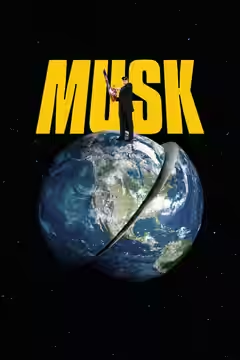
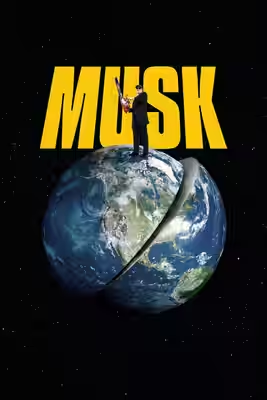
Alex Gibney’s four-hour account of Elon Musk is thorough, cold-eyed and, in its stretch on Tesla’s self-driving cars, properly frightening. It is also too long, and the computer-generated Musk who turns up to read his own words is a gimmick the case never needed.
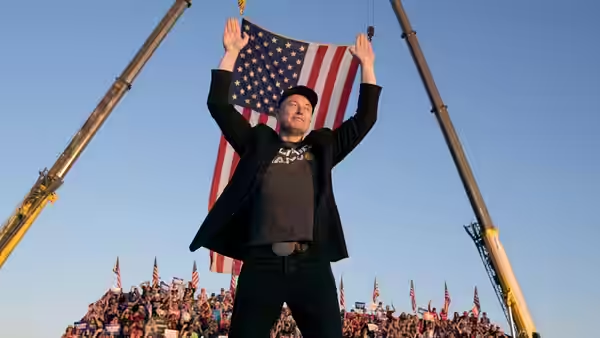
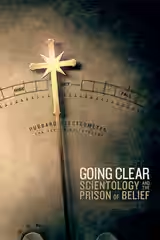
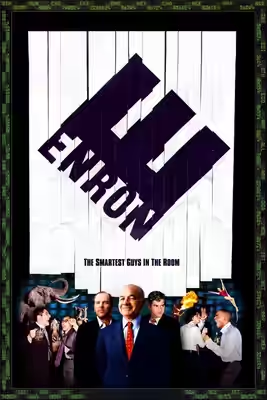
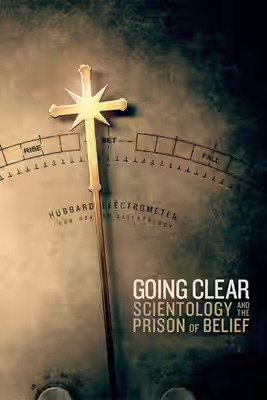
Alex Gibney has made his name on institutions that lied: Enron in Enron: The Smartest Guys in the Room (2005), Scientology in Going Clear (2015). Musk gives him a single man instead, and the man is not short of material. It runs 235 minutes, nearly four hours, built from archive footage of Elon Musk and interviews with people who knew him before he became the richest man alive. It is thorough, it is damning, and in one long stretch it is properly frightening. It is also an hour too long, and it carries a gimmick that keeps getting between us and the evidence.
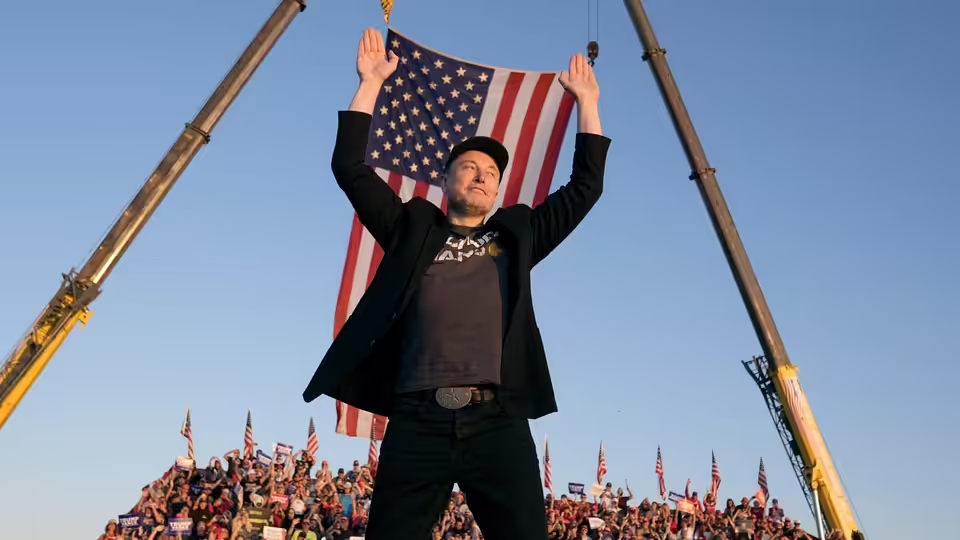
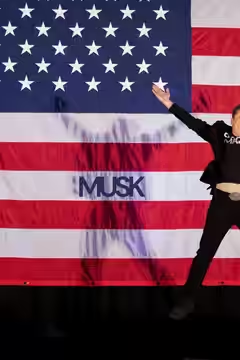
The gimmick first. Gibney and his editor and co-writer Michael J. Palmer have built a computer-generated Musk out of the real one’s own words, and it appears throughout to deliver them back to us. The idea, we think, is that a man who has said this much on the record should be made to say it again, slowly, to our faces. The effect is a waxwork reading tweets. Each time it appeared we found ourselves looking at the rendering of the skin rather than listening to the sentence, which is the opposite of what the film wants. The life is also parcelled out as levels of a video game, with animated interludes to match, and the conceit is amusing for about twenty minutes and then becomes a thing the film has to keep servicing.
The witnesses do not need the help. Justine Musk, his former wife, talks about the marriage with a steadiness that is more unsettling than anger would be, and the film’s account of how he deals with the women who have had his children is its sharpest stretch of character. Ashley St. Clair, a more recent former partner, picks up the thread. Martin Eberhard, one of the former colleagues, tells his part of the story without raising his voice. Kara Swisher and Zoë Schiffer, who have both reported on him, supply the chronology and the scepticism. Geoffrey Hinton, late on, is asked what Musk’s ambitions for artificial intelligence might mean, and gives an answer we would have preferred not to hear. Ben Bloodwell shoots all of them simply, seated and lit without fuss, and nothing in the frame competes with what they are saying.
Then there is the section on Tesla’s self-driving cars. Gibney goes through the crashes one at a time, the claims the company made about what the car could do set beside the record of what it did, and we were horrified. Not in the pleasurable way a horror film manages it; we sat quite still and found we had stopped taking notes. It is the clearest demonstration in the film of the distance between what Musk says and what happens to other people as a result, and it is made out of documents and footage rather than opinion. Daniel Pemberton’s score drops to almost nothing here, which is the right call. Elsewhere it hums away under the archive and swells under the animation more than the animation deserves.
The length is the problem that will not go away. Palmer cuts the archive briskly, and for the first two hours the accumulation works; by the third we knew where it was going and were waiting for it to arrive. Much of the middle will be familiar to anyone who has followed the news, and the film has no interview with Musk himself, so it cannot surprise us with the man, only with the arrangement. One claim about his conduct around an election is stated with more confidence than the film’s own evidence supports, and in a work this careful that stands out.
Most critics have liked it a little more than we did, and the difference is almost all the avatar and the hour we would cut. Enron found one story and told it; this has four or five, and the video-game frame is there to disguise the fact that they do not quite join up. See it, in two sittings, at home, where you can stop after the Tesla section and go for a walk. You will want to.