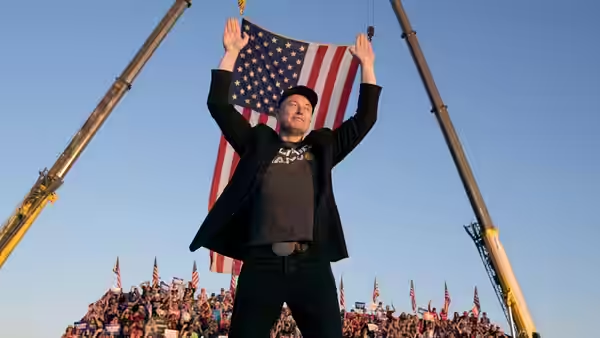
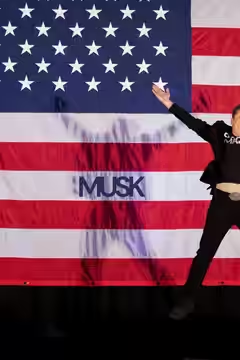
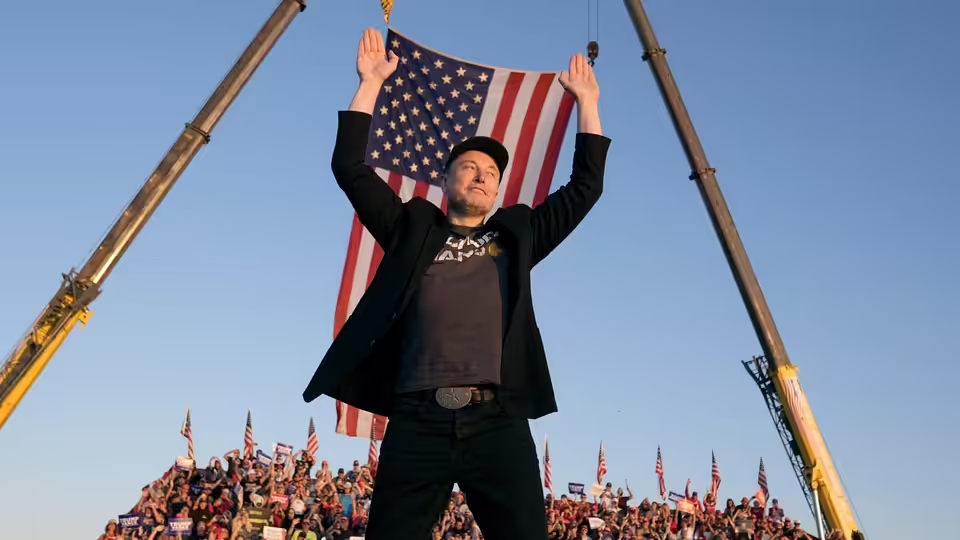
Elon Musk (Elon Musk) raises his arms before a crowd beneath a large American flag
Film review

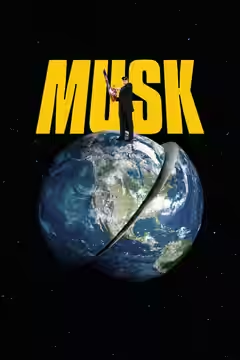
Musk

2026 · Directed by Alex Gibney · 3h 55m

In a sentenceFour hours on the richest man alive, and the most frightening thing in it is a Tesla driving itself

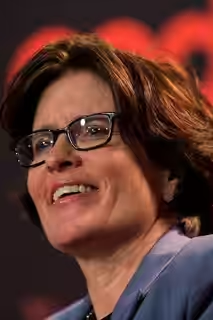
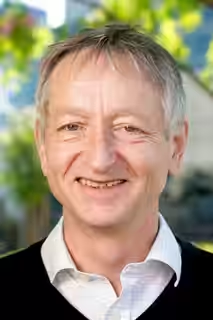
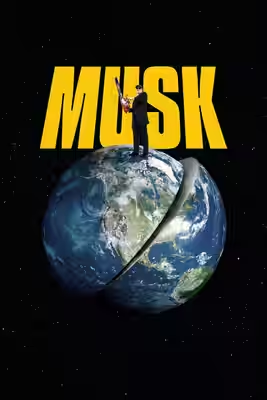
Alex Gibney’s 235-minute documentary assembles the life of Elon Musk from archive footage of the man himself and interviews with the people who knew him before the money. A computer-generated Musk, built from his own recorded words, turns up to introduce each stage, and the stages are laid out as levels of a video game. Justine Musk, his former wife, describes the marriage from the inside. Martin Eberhard, a former colleague, gives his side of the story. The journalists Kara Swisher and Zoë Schiffer supply the chronology and the scepticism. Ashley St. Clair, a later partner, and the AI researcher Geoffrey Hinton appear further in, as the film moves from how he made his fortune to what he is doing with it.

Plays from YouTube when you press play; nothing loads from them until then.

Fi1m review

Alex Gibney’s four-hour account of Elon Musk is thorough, cold-eyed and, in its stretch on Tesla’s self-driving cars, properly frightening. It is also too long, and the computer-generated Musk who turns up to read his own words is a gimmick the case never needed.

Alex Gibney has made his name on institutions that lied: Enron in Enron: The Smartest Guys in the Room (2005), Scientology in Going Clear (2015). Musk gives him a single man instead, and the man is not short of material. It runs 235 minutes, nearly four hours, built from archive footage of Elon Musk and interviews with people who knew him before he became the richest man alive. It is thorough, it is damning, and in one long stretch it is properly frightening. It is also an hour too long, and it carries a gimmick that keeps getting between us and the evidence.

The gimmick first. Gibney and his editor and co-writer Michael J. Palmer have built a computer-generated Musk out of the real one’s own words, and it appears throughout to deliver them back to us. The idea, we think, is that a man who has said this much on the record should be made to say it again, slowly, to our faces. The effect is a waxwork reading tweets. Each time it appeared we found ourselves looking at the rendering of the skin rather than listening to the sentence, which is the opposite of what the film wants. The life is also parcelled out as levels of a video game, with animated interludes to match, and the conceit is amusing for about twenty minutes and then becomes a thing the film has to keep servicing.

The witnesses do not need the help. Justine Musk, his former wife, talks about the marriage with a steadiness that is more unsettling than anger would be, and the film’s account of how he deals with the women who have had his children is its sharpest stretch of character. Ashley St. Clair, a more recent former partner, picks up the thread. Martin Eberhard, one of the former colleagues, tells his part of the story without raising his voice. Kara Swisher and Zoë Schiffer, who have both reported on him, supply the chronology and the scepticism. Geoffrey Hinton, late on, is asked what Musk’s ambitions for artificial intelligence might mean, and gives an answer we would have preferred not to hear. Ben Bloodwell shoots all of them simply, seated and lit without fuss, and nothing in the frame competes with what they are saying.

Then there is the section on Tesla’s self-driving cars. Gibney goes through the crashes one at a time, the claims the company made about what the car could do set beside the record of what it did, and we were horrified. Not in the pleasurable way a horror film manages it; we sat quite still and found we had stopped taking notes. It is the clearest demonstration in the film of the distance between what Musk says and what happens to other people as a result, and it is made out of documents and footage rather than opinion. Daniel Pemberton’s score drops to almost nothing here, which is the right call. Elsewhere it hums away under the archive and swells under the animation more than the animation deserves.

The length is the problem that will not go away. Palmer cuts the archive briskly, and for the first two hours the accumulation works; by the third we knew where it was going and were waiting for it to arrive. Much of the middle will be familiar to anyone who has followed the news, and the film has no interview with Musk himself, so it cannot surprise us with the man, only with the arrangement. One claim about his conduct around an election is stated with more confidence than the film’s own evidence supports, and in a work this careful that stands out.

Most critics have liked it a little more than we did, and the difference is almost all the avatar and the hour we would cut. Enron found one story and told it; this has four or five, and the video-game frame is there to disguise the fact that they do not quite join up. See it, in two sittings, at home, where you can stop after the Tesla section and go for a walk. You will want to.
Critical consensus AI synthesised

73
Positive
12
Mixed
3
Negative
1

Most critics find Gibney’s documentary absorbing and damning, and most say it earns its near-four-hour sitting. The praise clusters on the research: the case built from Musk’s own words and actions, the interviews with his former partners and colleagues, and the detailed investigation of Tesla’s safety claims and the crashes involving its self-driving cars. Several reviews call it chilling; a few go further and call it important.

The reservations cluster on the devices rather than the argument. The AI avatar built from Musk’s words divides the reviews: The Hollywood Reporter calls it inventive, the Los Angeles Times calls it gimmicky and The AV Club finds it off-putting. The 225-minute runtime draws complaints of strain, and some critics note the material is already familiar. The spread is narrow. The one outright dissent is Consequence, which thinks the facts are horrifying enough that the animated sequences and digital clone only get in the way.

The New Yorker
9 October 2026 · Sheelah Kolhatkar
90*

Kolhatkar finds the documentary mesmerizing and chilling, saying it punctures Musk’s self-mythology with a damning portrait of his power. She particularly praises the interviews with Musk’s former partners for illuminating his control over the women who had his children.

Read the full review →
Vulture
8 September 2026 · festival review · Bilge Ebiri
90*

Ebiri finds the documentary gripping and fascinating as a character study, while portraying it as a terrifying warning about the future. He praises its four-hour scope for giving Musk’s story a dramatic sweep rather than reducing it to headlines.

Read the full review →
The Hollywood Reporter
8 September 2026 · festival review · David Rooney
80*

Rooney finds the documentary a persuasive, chilling, and absorbing portrait of Musk’s power, though its 225-minute run invites questions about sustaining outrage. He especially praises Gibney’s inventive use of an AI avatar built from Musk’s own words.

Read the full review →
Time Out
9 September 2026 · ★★★★ · Lou Thomas
80

The review presents the documentary as deep, dark and worrying, while suggesting viewers will enjoy it despite Musk’s dislike. It singles out Gibney’s unsettling portrait of the world’s richest man.

Read the full review →
IndieWire
8 October 2026 · B · Ryan Lattanzio
77

The critic calls the documentary a distressing, damning, and necessary account, despite its limited access and familiar revelations. They praise its exhaustive research and effective use of repeated, blunt visual metaphors.

Read the full review →
The AV Club
11 September 2026 · B · Monica Castillo
77

Castillo delivers a strongly negative verdict, arguing that Gibney exposes Musk as a deceptive and dangerous figure. She praises the documentary’s case built from Musk’s own words and actions, though its uncanny-valley avatar is off-putting.

Read the full review →

Straight answers AI written, from our review

Is Musk worth watching?
Musk is worth watching for anyone with four hours and a strong stomach for how the richest man alive conducts himself, and we scored it 70. It is thorough and in its stretch on Tesla's self-driving cars properly frightening, but it is an hour too long and the computer-generated Musk who reads his own words back to us is a gimmick. We suggest two sittings.
How long is Musk, and what is it rated?
Musk runs 3h 55m. It is a documentary film.
Where can I watch Musk in Poland?
Musk is not on any streaming or rental service in Poland at the moment. Availability is checked daily.
How violent or frightening is Musk, and is it suitable for children?
Musk is a documentary with no UK certificate and an R rating in the United States, and it is not for children. There is no staged violence, but the section on Tesla's self-driving crashes, built from footage and company claims set against the record, horrified us, and the account of how Musk treats the women who have had his children is hard to sit through. Older teenagers who follow the news will manage it.
How does Musk compare to Citizen Kane?
Musk and Citizen Kane are both studies of a rich man who bought his way into public life, but one is a documentary assembled from archive and interviews and the other is a drama that invents its tycoon. Citizen Kane is the better film, because Welles gives its ingenuity a human centre; Gibney has the evidence but not the shape, and his film runs long. Watch Kane for craft and Musk for the facts.
What should I watch after Musk?
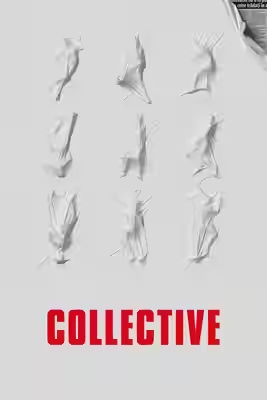
After Musk, try Citizen Kane (1941, Fi1m 93): The original study of a rich man who bought a newspaper and then the world. Then Collective (2019, Fi1m 88): Romanian reporters follow a scandal upwards; patient, furious and under two hours.

Cast

If you liked this, try…

  1. Enron: The Smartest Guys in the Room (2005) · not reviewed yetGibney at his tightest: one company, one lie, and no avatars required.

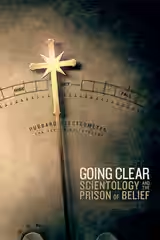
  2. Going Clear: Scientology and the Prison of Belief (2015) · not reviewed yetGibney on a different kind of empire, with witnesses who are still afraid.

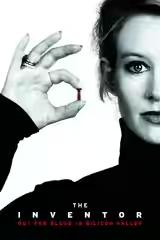
  3. The Inventor: Out for Blood in Silicon Valley (2019) · not reviewed yetElizabeth Holmes and the same question: how long can a promise outrun the product?.

  4. Citizen Kane (1941, Fi1m 93)The original study of a rich man who bought a newspaper and then the world.

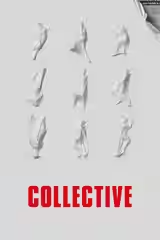
  5. Collective (2019, Fi1m 88)Romanian reporters follow a scandal upwards; patient, furious and under two hours.

Free account

Know what to watch tonight

Two lists that know where things are streaming, collections you can share, your own score beside ours, and Discover that remembers what you have seen.

  • Want to see, sorted by what is streaming now
  • Seen, with your score out of ten
  • No adverts, ever