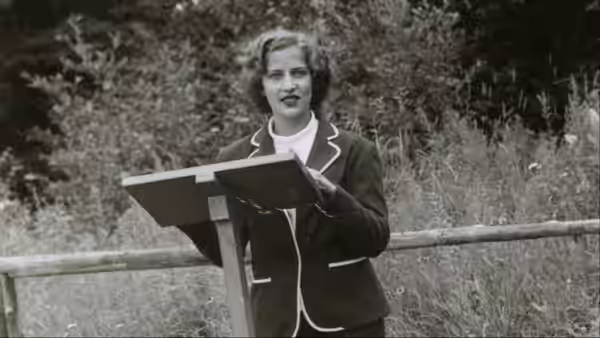
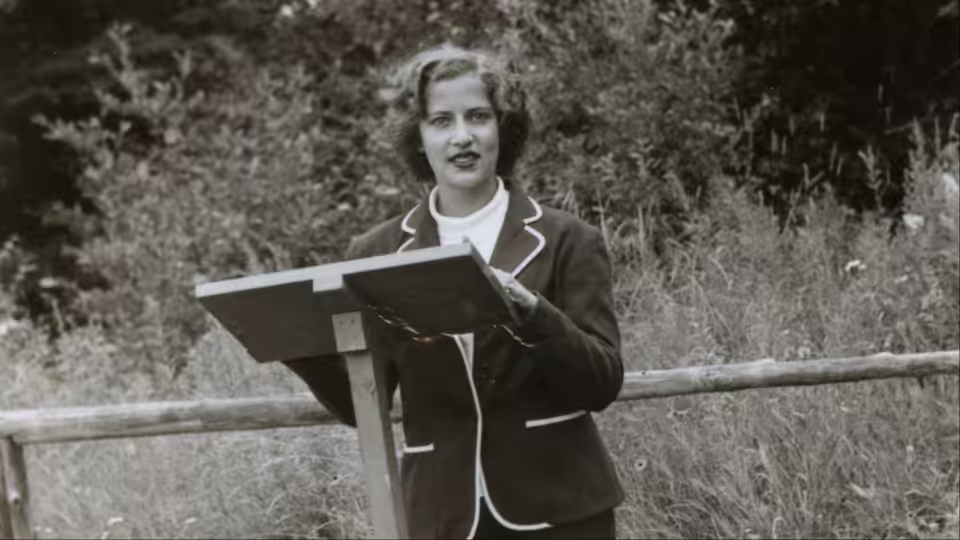
Young Ruth Bader Ginsburg (Ruth Bader Ginsburg) speaks at a lectern outdoors in archival footage
Film review

RBG

2018 · Directed by Betsy West, Julie Cohen · 1h 38m · IFCO PG

In a sentenceRuth Bader Ginsburg gets on with the legal arguments while her film fusses over how much it likes her

Ruth Bader Ginsburg challenges laws that treat men and women differently, building a case for equality through a succession of legal arguments. Betsy West and Julie Cohen’s documentary follows the work behind her public reputation, reaching back before her service on the Supreme Court. Ruth Bader Ginsburg appears as herself alongside Jane C. Ginsburg and Nina Totenberg, who also appear as themselves. The account of her marriage brings her ambitions into family life, where her husband’s support accompanies the struggle against discrimination. Legal work, personal recollections and public acclaim supply different accounts of the woman behind the initials.

Plays from YouTube when you press play; nothing loads from them until then.

Fi1m review

Betsy West and Julie Cohen make an absorbing, affectionate portrait of Ruth Bader Ginsburg, strongest on the patient legal work and her marriage. Their admiration is earned, though their reluctance to question it limits the film.

RBG is an engaging introduction to Ruth Bader Ginsburg, though its admiration sometimes prevents it asking the next question. Betsy West and Julie Cohen want to explain how a reserved woman became a public heroine through patient work against gender discrimination. They make that work accessible and give the person doing it room to speak. We recommend it for the legal history and the marriage, with some reservations about how readily the directors accept another expression of approval.

The strongest passages concern her case-by-case challenge to unequal treatment of men and women. The satisfaction comes from following someone who understands that persuasion requires more than being right, and is prepared to keep doing the work. The directors communicate the persistence behind that approach, even when they compress the arguments. For someone arriving with little legal knowledge, this is useful, engaging history, although there are moments when a memorable phrase has to stand in for a fuller explanation.

The account of her marriage is the part that moved us most. Her husband’s support for her ambitions makes the discussion of equality immediate, rooted in the way two people choose to live together. The directors allow that support to matter without treating it as a distraction from the legal career. It also gives the documentary some welcome warmth when the public praise starts to sound too much alike.

Claudia Raschke’s cinematography serves the film best in its attention to Ruth Bader Ginsburg herself. Her calm delivery lets us hear the force of an argument without much encouragement to find her formidable. There is pleasure in watching someone who feels no obligation to make every sentence sound like a declaration. That restraint gives these passages an authority the more enthusiastic treatment of her celebrity cannot quite match.

Carla Gutierrez’s editing makes a long working life manageable within 98 minutes, though some of the testimony would benefit from firmer cutting. Praise accumulates after the point has been made, taking time that could have gone to testing it. Miriam Cutler’s music suits the film’s warm manner, but we need less help feeling pleased with its subject. The account of the marriage supplies enough feeling on its own.

The weakness is the directors’ tendency to accept admiration as a sufficient answer. Interviewees can tell us that their subject matters, but agreement among them cannot explain every choice she made. Her judicial career needs more scrutiny than it receives here, and the attention to her celebrity makes that omission harder to overlook. The film is so pleased that people have embraced her that it spends too little time asking what they understand about her work.

A biographical documentary need not behave like a prosecution, and this one’s kindness is part of its appeal. We would still have preferred another difficult question to another expression of approval. There is enough here to make the patient business of changing minds feel worth watching for an evening. If a searching account of her judicial decisions is what you want, leave time afterwards for further reading.

Critical consensus AI synthesised

71
Positive
13
Mixed
2
Negative
2

Most critics find RBG an engaging, affectionate portrait of Ruth Bader Ginsburg, with praise clustering around her patient work for gender equality and her partnership with her husband, Marty. The marriage emerges as a particularly moving element, giving the account of her public achievements warmth and personal detail. Several reviews also find Ginsburg herself compelling company, praising her quiet force, eloquence and the opportunity to hear her legal arguments.

The spread is wide, however, and the main disagreement concerns how much the film’s admiration limits its scrutiny. Even favourable reviews question its emphasis on celebrity, its occasionally cutesy approach and its limited dissenting perspectives. The AV Club finds the judicial career glossed over and the interviews reduced to generic praise, while Slant Magazine argues that legal victories and arguments become slogans. For these dissenters, the celebration leaves too little room for a searching account of Ginsburg’s work.

Evening Standard
4 January 2019 · ★★★★★ · Charlotte O'Sullivan
100

O'Sullivan gives the documentary an enthusiastic verdict, calling it revealing and inspiring. She singles out its warm, candid portrait of Ginsburg's marriage and family life.

Read the full review →
Los Angeles Times
3 May 2018 · Kenneth Turan
90*

Turan finds the documentary completely engrossing and admiring, presenting Ginsburg as a force whose influence began well before the Supreme Court. He especially praises her eloquence and candid presence, alongside the film’s attention to her marriage and personal life.

Read the full review →
The New Yorker
3 June 2018 · Sheelah Kolhatkar
90*

Kolhatkar is mesmerized by the documentary and finds it informative and inspiring. She praises its account of Ginsburg’s landmark legal work and its portrait of her partnership with her husband.

Read the full review →
Time Out
30 December 2018 · ★★★★ · Joshua Rothkopf
80

The review makes a strong case for the documentary’s importance. It singles out Ginsburg’s serene yet forceful presence as compelling to watch.

Read the full review →
Empire
2 January 2019 · Beth Webb
75*

Webb finds the documentary an uplifting, timely celebration, though it sometimes makes Ginsburg seem too cute. She praises its account of Ginsburg’s perseverance and the landmark work that advanced women’s rights.

Read the full review →
The Guardian
6 January 2019 · Wendy Ide
70*

The critic finds the documentary solid and quietly eloquent. She praises its capture of Ginsburg’s lasting impact as a feminist pioneer.

Read the full review →

Straight answers AI written, from our review

Is RBG worth watching?
RBG is worth watching for its accessible legal history and moving account of Ruth Bader Ginsburg’s marriage; we scored it 74. We recommend it as an affectionate introduction to her work against gender discrimination, though viewers seeking close scrutiny of her judicial decisions will find the directors too ready to settle for praise.
How long is RBG, and what is it rated?
RBG runs 1h 38m and is rated PG by the IFCO in Ireland. It is a documentary film.
Where can I watch RBG in Ireland?
RBG is available to rent from Apple TV from €3.99. Availability is checked daily; the links above go straight to each service.
How does RBG compare to The Gleaners and I?
RBG offers an affectionate biographical introduction, while The Gleaners and I is a more curious, wandering documentary about people finding uses for what others discard. We favour Varda’s film for the space it gives people to explain themselves, despite occasional detours; RBG suits those who want accessible legal history, though its admiration leaves too many questions unasked.

Cast

Awards

Academy Awards, 2019

Nominated
Best Documentary Feature Film

If you liked this, try…

  1. The Times of Harvey Milk (1984) · not reviewed yetAnother portrait of political change that makes the person matter alongside the public work.

  2. Sisters in Law (2005) · not reviewed yetWomen put legal authority to practical use, with patience and welcome humour.

  3. Made in Dagenham (2010) · not reviewed yetFor a more boisterous account of women refusing to accept unequal treatment.

  4. The Gleaners and I (2000, Fi1m 85)A curious, personal documentary that gives overlooked people room to explain themselves.

  5. 13th (2016) · not reviewed yetA sharper examination of American law and the inequalities it can preserve.