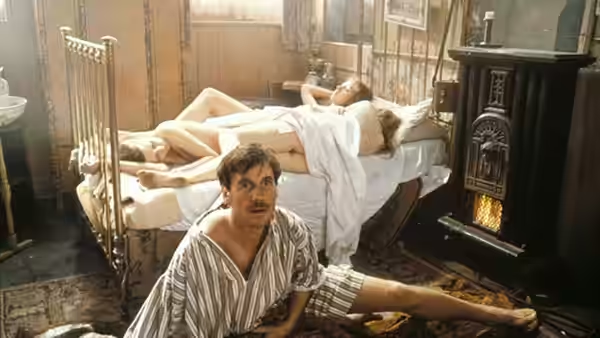
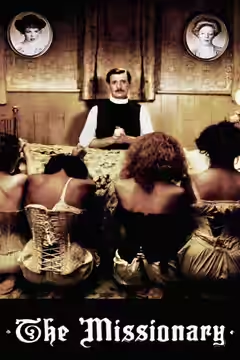
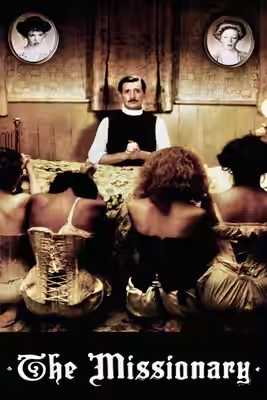
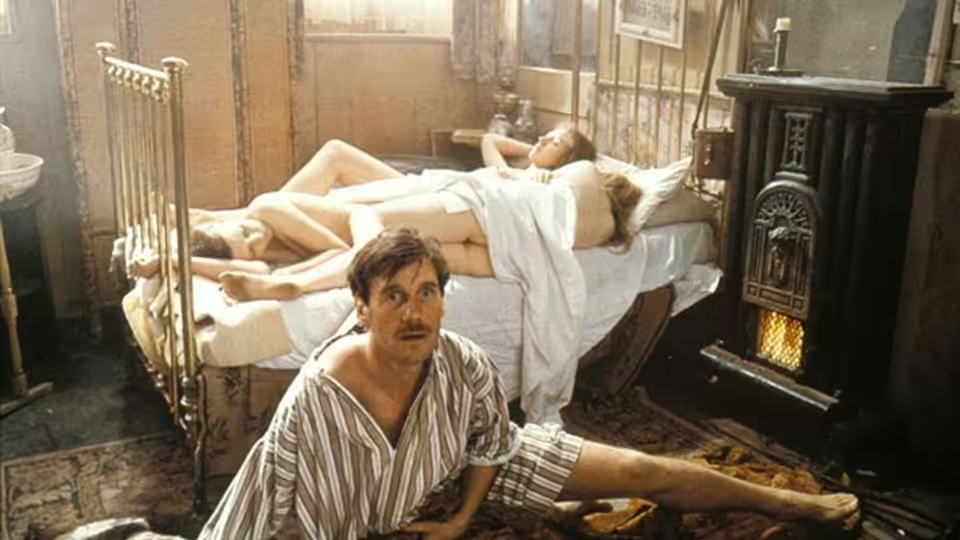
The Reverend Charles Fortescue (Michael Palin) sits on the floor beside women sprawled across a bed
Film review

The Missionary

1982 · Directed by Richard Loncraine · 1h 30m

In a sentenceAn excellent cast waiting politely for the next joke

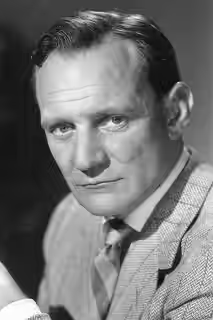
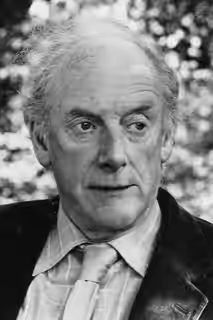
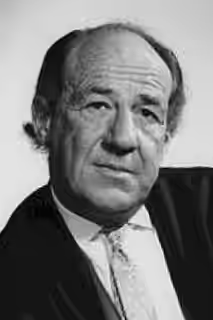
The Reverend Charles Fortescue (Michael Palin) is the central figure in this period comedy. Lady Isabel Ames (Maggie Smith), Lord Henry Ames (Trevor Howard) and The Bishop of London (Denholm Elliott) join him among its principal characters. Graham Crowden plays Fitzbanks, with Phoebe Nicholls as Deborah Fitzbanks and Michael Hordern credited as Slatterthewaite/Narrator. David Suchet appears as Corbett and Timothy Spall as Parswell. Written by Michael Palin and directed by Richard Loncraine, the film brings together clergy, titled figures and a supporting cast that includes Ada (Tricia George) and Emmeline (Valerie Whittington).

Fi1m review

Michael Palin and Maggie Smith supply welcome comic company, but this genteel farce never gathers enough speed. The period presentation is assured; the screenplay leaves too much of the work to its cast.

Richard Loncraine’s The Missionary is a mild, uneven period comedy with a cast that deserves a better supply of jokes. Michael Palin writes and stars as The Reverend Charles Fortescue, bringing enough personal charm to make the film’s failings faintly exasperating. The promise of a saucy farce is there, but the script keeps moving without building much comic pressure. It is an agreeable film to spend a little time with, and a difficult one to recommend for the whole of its 90 minutes.

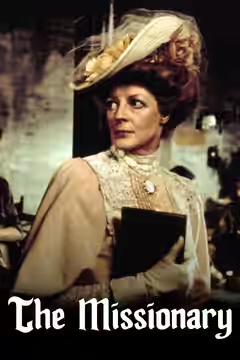
Maggie Smith, playing Lady Isabel Ames, provides the strongest reason to persevere. Her performance has a comic assurance that makes the material seem more substantial while she has hold of it, and the film benefits from giving us someone so enjoyable to watch. Palin is good company too, with a performer’s appeal that survives his uneven writing. Their work supplies individual pleasures, although the comedy depends too heavily on our liking the people delivering it.

The screenplay’s weakness is its reluctance to develop what it starts. A farce needs complications that grow, so that a joke can leave a character in a worse position and make the next joke possible; here, the wandering construction makes too much feel incidental. We were frustrated by that drift, because the performers repeatedly suggest comic possibilities the writing does not pursue. The problem is not that the humour is gentle, or that every exchange needs a laugh, but that too little seems to gather force.

The period presentation is more assured, with Peter Hannan responsible for the cinematography and Norman Garwood for the production design. Along with Shuna Harwood’s costumes, their work gives Loncraine a setting that looks considered and makes the film easy to settle into. That care is welcome in a comedy which could easily have treated its surroundings as an excuse for fancy dress. The visual presentation remains a source of pleasure through the less rewarding stretches of the writing.

Paul Green’s editing cannot quite turn the separate amusements into a satisfying comic progression. The film feels loose in a way that its modest running time does not excuse, and the pauses between rewards give us too much opportunity to notice it. Mike Moran’s music makes less of an impression than the cast and does little to make those diversions feel connected. The difficulty keeps coming back to a screenplay that needs to do more with the situations it introduces.

Against the basic demands of farce, the film is too content to amble. There is room in the genre for mildness, and the cast and period styling make that approach inviting, but sustained comic invention is a reasonable thing to ask of a comedy. The talented company prevents the film from becoming a chore, without making its missed opportunities any less apparent. If Smith and Palin are the attraction, their performances may be enough; anyone after a sustained farce should choose something else.

Critical consensus AI synthesised

51
Positive
0
Mixed
3
Negative
1
The New York Times
5 November 1982
64*

The page could not be retrieved, so the critic’s verdict cannot be established. No specific praise or complaint is available in the provided text.

Read the full review →
Radio Times
★★★ · David Parkinson
60

The review calls the comedy enjoyable and saucy, though it says Michael Palin struggles to sustain the laughs. It singles out Maggie Smith’s performance and Richard Loncraine’s effective period styling for praise.

Read the full review →
Variety
31 December 1982 · Variety Staff
50*

The review finds the comedy amusing but says Michael Palin’s script meanders and fails to develop its possibilities. It praises Palin’s talent as a performer while faulting the screenplay for not making full use of its ideas.

Read the full review →
Empire
1 January 2000 · Scott Russon
30*

The critic finds the farce eccentric but ultimately beneath its writers and star. They fault its familiar Sunday-evening television feel, comparing it to an overlong Two Ronnies sketch.

Read the full review →

Straight answers AI written, from our review

Is The Missionary worth watching?
The Missionary is worth considering for Michael Palin and Maggie Smith, but we find it too uneven to recommend broadly and score it 57 out of 100. Their comic company and the assured period presentation offer pleasures; anyone looking for a farce whose complications build into sustained laughter is likely to find it frustrating.
How long is The Missionary, and what is it rated?
The Missionary runs 1h 30m. It is a comedy film.
Where can I watch The Missionary in Saudi Arabia?
The Missionary is not on any streaming or rental service in Saudi Arabia at the moment. It is available in 5 other countries; change your country at the top of the page to see where. Availability is checked daily.
How violent or frightening is The Missionary, and is it suitable for children?
The Missionary carries a US R certificate, so its mild comic tone should not be taken as a sign that it is suitable for children. That rating requires under-17s to be accompanied by a parent or adult guardian in US cinemas; we have no specific content detail to establish how violent or frightening it is.
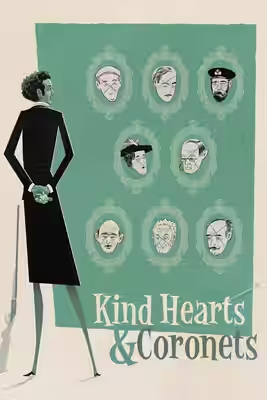
How does The Missionary compare to Kind Hearts and Coronets?
The Missionary is the gentler, looser comedy; we recommend Kind Hearts and Coronets as the more disciplined and consistently funny choice. Palin and Smith provide agreeable company in the former, but the latter makes more of its polite manners and appalling intentions, with a cruelty that better suits those who prefer their humour dark.
What should I watch after The Missionary?
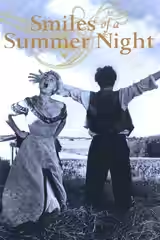
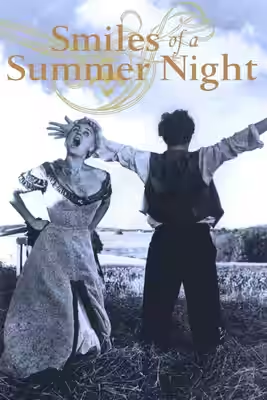
After The Missionary, try Kind Hearts and Coronets (1949, Fi1m 91): Polite manners conceal appalling intentions in a drier, more disciplined British comedy. Then Smiles of a Summer Night (1955, Fi1m 84): Sexual misunderstandings and social rank produce a sharper, warmer comedy of embarrassment.

Cast

If you liked this, try…

  1. A Private Function (1984) · not reviewed yetA more concentrated comedy of respectable people behaving badly, again with Michael Palin.

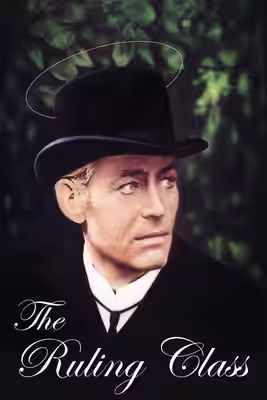
  2. The Ruling Class (1972) · not reviewed yetClergy and aristocrats receive much less gentle treatment in this unruly social satire.

  3. Kind Hearts and Coronets (1949, Fi1m 91)Polite manners conceal appalling intentions in a drier, more disciplined British comedy.

  4. Smiles of a Summer Night (1955, Fi1m 84)Sexual misunderstandings and social rank produce a sharper, warmer comedy of embarrassment.

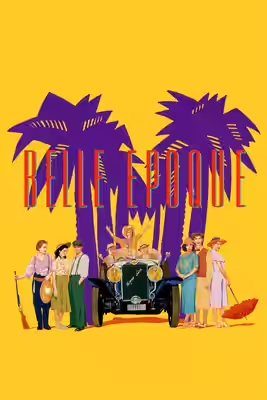
  5. Belle Époque (1992) · not reviewed yetAnother period comedy in which desire proves awkward for respectable rules of conduct.

Free account

Know what to watch tonight

Two lists that know where things are streaming, collections you can share, your own score beside ours, and Discover that remembers what you have seen.

  • Want to see, sorted by what is streaming now
  • Seen, with your score out of ten
  • No adverts, ever