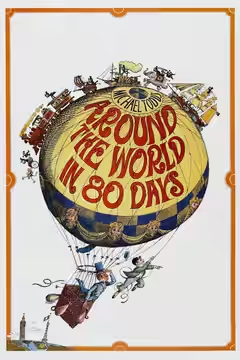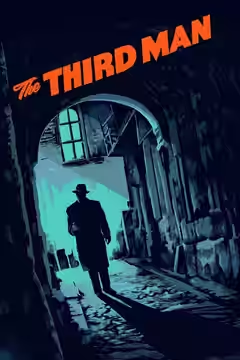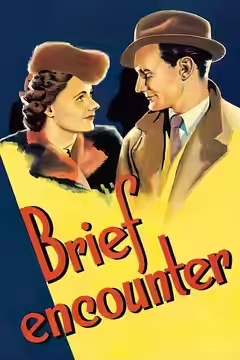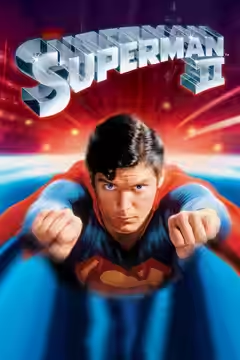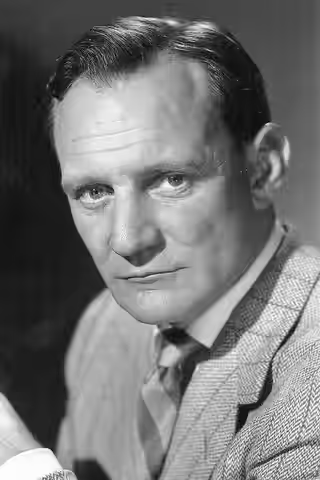
Trevor Howard made ordinary decency convincing and authority difficult to brush aside. We value him most in Brief Encounter and The Third Man; later casting as officers and autocrats sometimes narrowed what was asked of him.
Fi1m perspective
Brief Encounter (1945) asks us to believe that Trevor Howard’s Dr Alec Harvey could pass unnoticed until one person begins to find him indispensable. Howard makes that plausible by playing the attraction without conspicuous charm or romantic swagger. We were moved by how much these two ordinary people came to matter to each other, because Howard makes Alec someone we might otherwise overlook. His breakthrough under David Lean established a leading man whose appeal did not depend on seeming exceptional.
The limitation is how much less we know of Alec than of Celia Johnson’s Laura. Coward’s writing gives Johnson the fuller account of an inner life, while Howard sometimes has to make simple decency last longer than it should. A little more uncertainty from him would have made their meetings richer. Cyril Raymond’s Fred Jesson, Laura’s decent, unexciting husband, also prevents us from treating the marriage as something she ought simply to escape. That keeps the romance honest, even when Alec remains less fully known.
In Carol Reed’s The Third Man (1949), Howard’s Major Calloway is firm where Joseph Cotten is uncertain. He matters because he does not simply confirm the leading man’s importance. Alongside Alida Valli’s Anna Schmidt, he helps make the mystery feel inhabited by people with concerns of their own. Reed gives that firmness a clearer dramatic use than Alec’s decency has in Lean’s romance. It is easy to see why authority became such a regular part of Howard’s work, though the later casting could become restrictive.
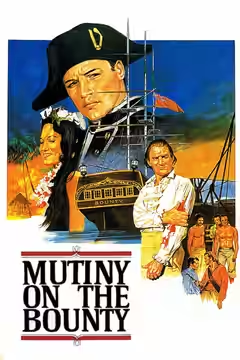
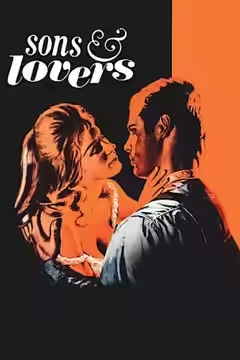
From the 1960s, supporting and character parts took more of his time, often as military men or other figures accustomed to obedience. Walter Morel in Sons and Lovers (1960) offered a working-class role; Captain William Bligh in Mutiny on the Bounty (1962), opposite Marlon Brando, fits the more familiar pattern of the autocrat. The rasping voice and increasingly craggy face suited such casting, but another autocrat was not always an interesting use of him. Start with Brief Encounter and The Third Man; give him both evenings before deciding that he was simply good at giving orders.
Biography
Trevor Howard, born Trevor Wallace Howard-Smith, was an English actor. He trained at the Royal Academy of Dramatic Art after education at Clifton College and began his career on the London stage in the 1930s, with his professional debut in the play Revolt in a Reformatory (1934).
Howard rose to prominence with his performance as Dr Alec Harvey opposite Celia Johnson in David Lean's Brief Encounter (1945). He followed this with the role of Major Calloway in Carol Reed's The Third Man (1949). Among his other notable film appearances were Mutiny on the Bounty (1962), Gandhi (1982) and the Superman films (1978 and 1980). He received a BAFTA Award for Best Actor for The Key (1958).
He was married to the actress Helen Cherry from 1944 until his death in 1988.