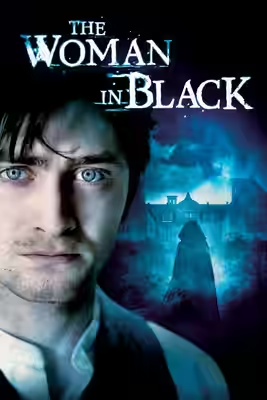
James Watkins’s Hammer ghost story is handsomely built, properly gloomy and frightening in short bursts, most of them loud. Daniel Radcliffe is a decent, slightly young widower, and the ending goes softer than the house deserves.
The set-up is as old as the genre and none the worse for it. A solicitor in mourning, Arthur Kipps (Daniel Radcliffe), is sent out of London by his employer Mr Bentley (Roger Allam) to settle a dead woman’s affairs at a house on a marsh, and the house does not want him there. James Watkins directs from Jane Goldman’s screenplay of Susan Hill’s novel, and the film arrives under the Hammer name, which tells you the kind of evening it has in mind. It is a good evening of that kind, and it would have been a better one if it trusted silence as much as it trusts a bang.
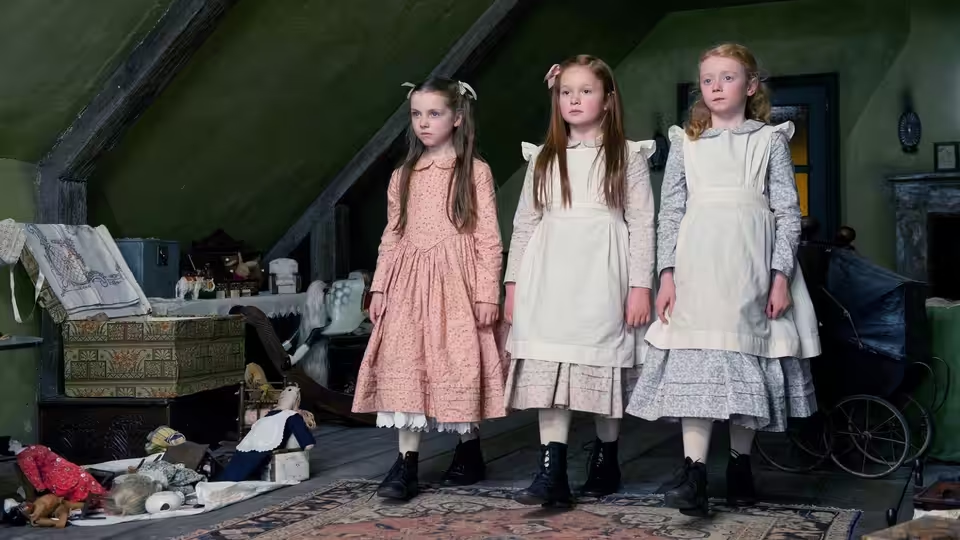
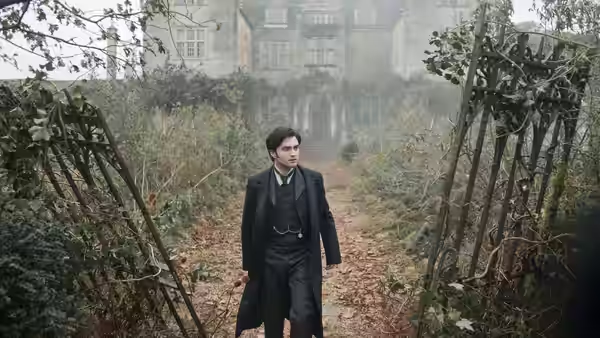
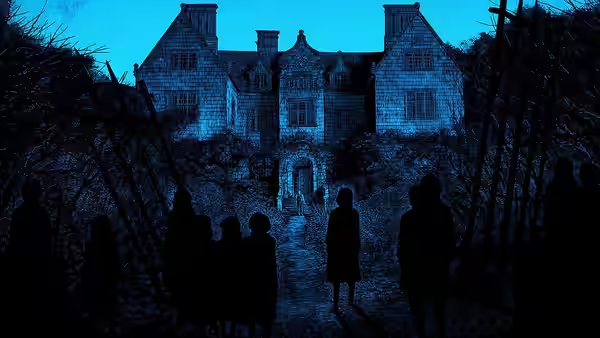
The house is the reason to go. Kave Quinn designs Eel Marsh House as a place where nobody has thrown anything away: dust sheets over the furniture, a nursery stacked with wind-up monkeys and dolls with china faces, a rocking chair that has no business moving. Tim Maurice-Jones shoots the marsh in flat grey-green and the interiors by candle and oil lamp, so that Kipps carries his own small circle of light through rooms we can see are far larger than it. Keith Madden puts Radcliffe in black from hat to boots, so that on the causeway he is already dressed as a ghost. The whole production looks like money spent on the right things.
The scares are another matter. Watkins has two kinds. The first is the slow one: a figure at the edge of the frame, a reflection that should not be in the window, a face in the upstairs glass that Kipps sees and we see a half-second earlier. The second is the loud one, and Jon Harris cuts to it the same way every time, a long quiet hold and then a crash of Marco Beltrami’s strings and something moving fast. We jumped four times and resented three of them, because the house had already frightened us and the noise only told us the film did not believe it had.
The fourth time we did not resent at all. It comes in the nursery, late in the first act, and involves nothing more than a toy, a chair and Radcliffe refusing to turn round. Watkins holds the shot until we were genuinely unsure whether we wanted him to look, and Beltrami drops to a music-box figure so faint we leaned in. That is the film it could have been throughout. It is unsettling in the proper, patient way, and it is the sequence we were still thinking about on the way home.
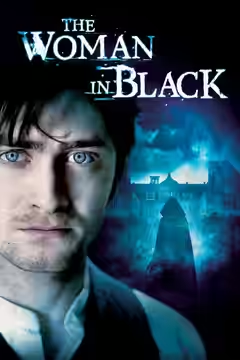
Radcliffe does what the part needs. He is grave, watchful and convincingly tired, and he has the sense to do most of his acting with his eyes and his breathing rather than his voice. He is also plainly too young to have buried a wife and nearly lost a career, and the film never quite finds a way round that. Ciarán Hinds gives Mr Daily a bluff, practical decency that the village otherwise lacks, and Janet McTeer, as his wife, gets the most alarming dinner scene in the film and plays it without a trace of camp. Liz White’s Jennet Humfrye is used sparingly, which is right, and is the more frightening for it.
Goldman’s screenplay is efficient where it is following Hill and uncertain where it is not. The villagers’ hostility is established in the first ten minutes and then restated every time Kipps leaves the house, so that the middle of the film has the rhythm of a man being told to go home. The reasons for the haunting arrive in a bundle of letters and are read out, which is tidy and not very dramatic. And the ending departs from the novel in a direction we will not describe, except to say that it reaches for consolation, and a ghost story this bleak has not earned any.
Against the best British ghost films, the ones that trust a corridor and a draught, this is a notch below: too keen to be liked, too quick to make a noise. Against most of what passes for a haunted house film now, it is a model of taste. It runs 95 minutes and carries a 12A, which is about right for the jolts and a little generous for the dread. See it in a dark room with the volume down a touch. The house will still get you; the strings will have to work harder.