Marlon Riggs’s 55-minute essay on being Black and gay in America is rough on the eye, made on video and occasionally stagey, and it says what it means with a directness few films of any length manage. Worth an hour of anyone’s evening.
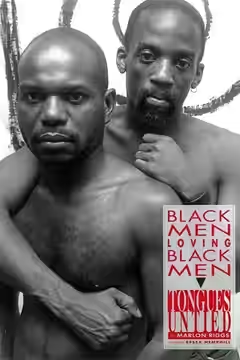
Marlon Riggs made Tongues Untied in 1990, on video, and it runs 55 minutes. It is about being Black and gay in America and about the silence that comes with it: the silence of a Black community that would rather not know, and of a gay world that looked white. It is not a documentary in the usual sense. There are no experts, no captions, no history lesson. There is Riggs, and the men he gathered, and what they have to say. It is worth an hour of anyone’s evening, and we mean that for people who assume this sort of film is not for them.
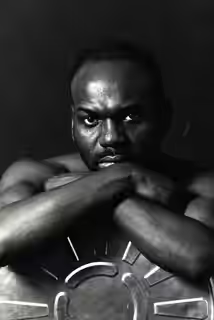
Riggs did most of it himself. He shot it, with Vivian Kleiman, he cut it, he produced it, and he shares the writing credit with a group of poets including Essex Hemphill, Joseph Beam, Donald Woods and Reginald Jackson, and the music credit with Steve Langley and Alex Langford. The result is a collage. Riggs sits bare-shouldered against black and talks to us. Hemphill reads his poems flat, without performance, which is why they land. Three men stand in a row and run through the whole vocabulary of the finger snap, the dismissive snap, the flirting snap, the snap that ends an argument, while Riggs’s voice explains each one. Willi Ninja vogues. And in the middle of it there is half a minute of Eddie Murphy’s stand-up, a hall full of people roaring at jokes about gay men, left in without comment because none is needed.
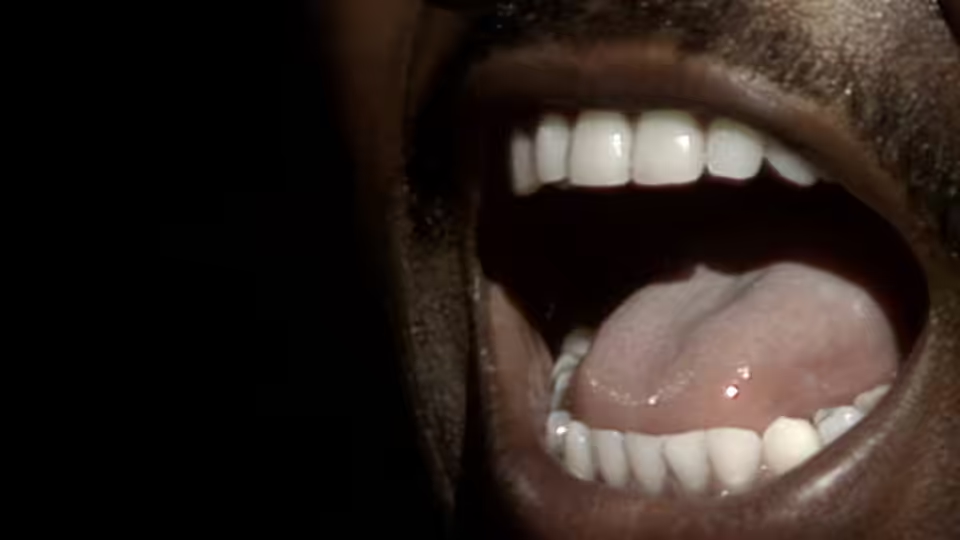
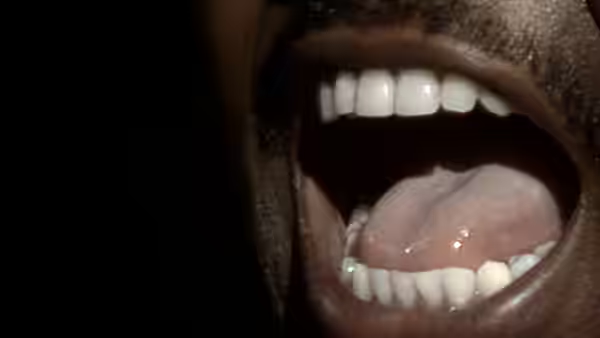
The snap sequence made us laugh out loud, and the laugh was the point: it is the first time the film lets these men be funny on their own terms, and it is over quickly. Later, Riggs talks about being a boy in Georgia and being called one name by the white children and another by the Black ones, and he does not raise his voice or look away, and it moved us more than the poems did. The face against black is the film’s one big visual idea and Riggs and Kleiman never overwork it. They shoot it close, lit from one side, so that half of him is always in the dark.
It looks its age, and that needs saying. This is standard-definition video from 1990: the blacks are grey, the reds bleed, the street footage of the Castro is loose and handheld and slightly soft. On a large modern screen it is hard on the eye for the first ten minutes and then you stop noticing, because Riggs the editor is doing something the picture quality cannot spoil. He cuts on the rhythm of speech, repeats a phrase until it becomes a chant, lays one man’s voice under another’s, and lets a chorus of “brother to brother” build under the poems. The music is mostly voices: a spiritual, hand claps, a line of doo-wop, sung by the same men who speak.
Not all of it works. Some of the staged pieces, men in matching outfits declaiming to camera, have the look of a college theatre workshop and have not aged as well as the plain talk around them. The Murphy clip is a blunt instrument; Riggs knows it, and uses it as one, but it is the least interesting thing in the film. And the sentence in the tagline, Black men loving Black men, is stated and never explained, so a viewer who arrives unpersuaded will leave unpersuaded. Fifty-five minutes is enough time to make the case, and the film spends some of it saying things twice.
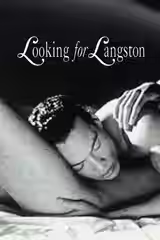
It was shown on American public television in 1991 and caused a row, and the reviews from that year treat it as a challenge before they treat it as a film. Watching it now, the challenge has faded a little and the film has not. The nearest relative is Isaac Julien’s Looking for Langston (1989), which is silkier and shot in black and white; Riggs is rougher, angrier and more direct, and the men in his film talk about AIDS as something already present. Riggs himself died of AIDS-related illness in 1994, at 37, which is not the film’s fault and is impossible to forget while watching it.
Watch it at home, close to the screen, alone or with someone you can be quiet with. It does not need a cinema; it was made for a room, and it is over before you have finished your tea.