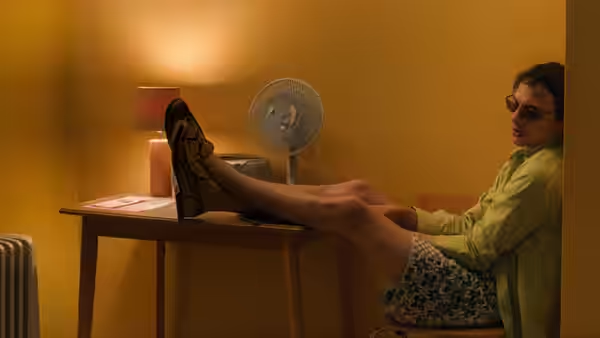
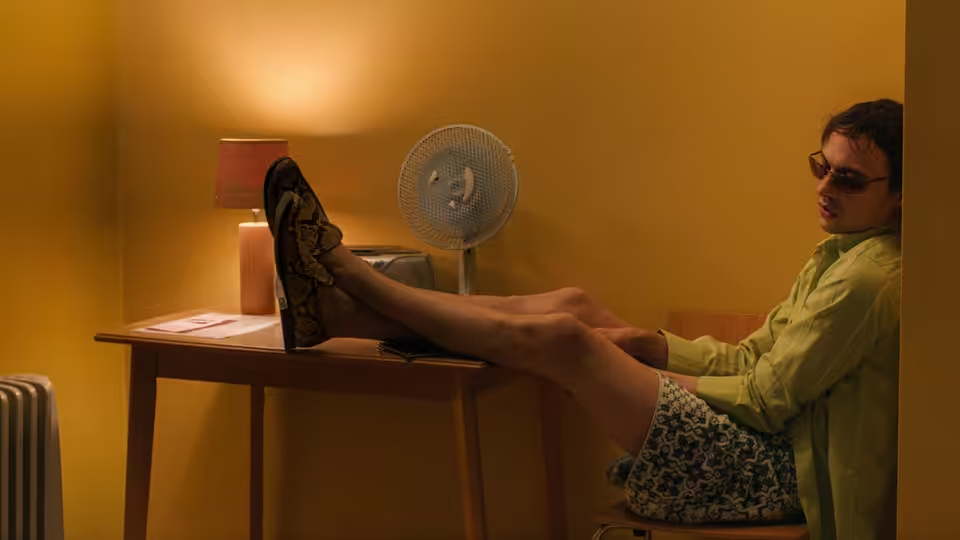
Mike (Frank Dillane) reclines with his feet on a table in a yellow room
Film review

Urchin

2025 · Directed by Harris Dickinson · 1h 39m

In a sentenceA charming man tells everyone he is going to be fine, and the film watches to see if anyone believes him, including us

Mike (Frank Dillane) sleeps rough in London. He is quick, funny, plausible, and very good at getting people to give him things. One morning a passer-by, Nathan (Harris Dickinson), takes pity and buys him a meal. Mike thanks him, follows him, knocks him down and takes his watch. That earns him a prison sentence, and the film picks him up on release: a probation officer, a room in a hostel, a job washing pots in a hotel kitchen under the head chef Franco (Amr Waked), and a colleague, Andrea (Megan Northam), who is friendlier than he expects. What Mike wants is to stay clean and keep his room. What stands in the way is Mike.

Plays from YouTube when you press play; nothing loads from them until then.

Fi1m review

Harris Dickinson’s first film as writer and director follows a London rough sleeper out of prison and into a kitchen job. Frank Dillane is remarkable in the lead and the film around him is honest and often funny. Its shape, though, is one we have seen before.

Harris Dickinson has spent a decade in front of other people’s cameras and has now written and directed a film of his own. Urchin follows Mike (Frank Dillane), who sleeps rough in London and is very good at talking. In the opening minutes a stranger buys him a meal; Mike eats it, thanks him, follows him and robs him. The stranger, Nathan, is played by Dickinson himself, which is a dry joke about who is in charge here and who is getting hurt. The film that follows is good, and worth your evening. It is held together almost entirely by Dillane, and its shape is one British cinema has made before.

Dillane is the reason to see it. He plays Mike as someone who has learned that a smile and a story will get him through the next ten minutes, and who has never had to plan further than that. Watch how fast he moves from pleading to threat and back, and how little his face changes while he does it. We liked him within a scene and knew we should not, and the film knows we know. It never asks us to forgive the man on the pavement with his watch gone. It asks us to see why someone might want to.

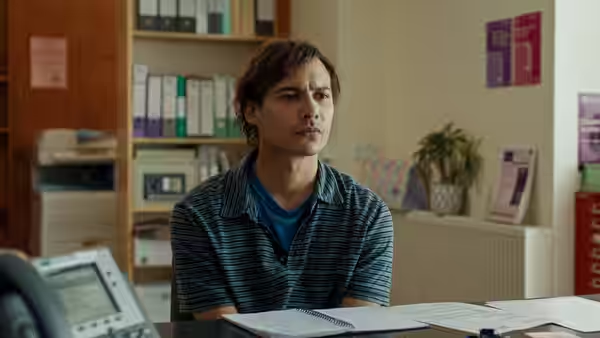
Josée Deshaies shoots London in flat daylight and keeps the camera at a distance, so that Mike is one figure in a street of figures until he chooses to become the loudest. Anna Rhodes gives him a hostel room with a bed, a window and nothing on the walls, and a hotel kitchen of steel and steam where every surface has to be wiped. Cobbie Yates dresses him first in the clothes he was arrested in and then in kitchen whites, and the whites do a lot of work: for a while he looks like a man with a job. Rafael Torres Calderón lets scenes run past the point where a nervier editor would cut, and Scott O’Conell and Archie Pearch keep the music low enough that the sound of the streets and the kitchen does most of the talking.

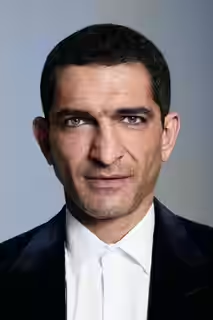
The kitchen scenes are where the film is most alive. Amr Waked’s Franco is neither a saint nor a bully, just a chef who needs the pots done and has heard every excuse. Megan Northam’s Andrea gives Mike someone to be charming at who is not paying for anything, and the film finds a lightness in their scenes that we did not expect from the subject. The moment that moved us most is small. Someone tells Mike he is doing well. Dillane holds the compliment for a beat too long, as if he has been handed something he does not know how to carry, and then makes a joke to put it down.

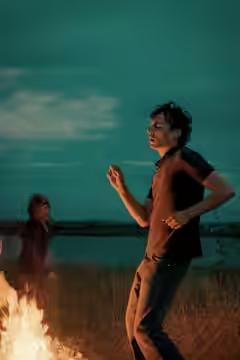
What works less well are the interludes where Dickinson leaves the street. Several times the film slips out of Mike’s day into something dreamlike, dark spaces and strange colour, and we could see what these were for without ever feeling they were needed. Dillane’s face is already telling us what is happening inside the man. The pictures repeat it, more prettily and less precisely. And once the job and Andrea are in place, most critics who have seen a film about addiction will know roughly which way the second half goes. We will not describe it. We will say that Dickinson is more interested in watching it happen than in explaining it, and that this is mostly a strength.

The film sits in the tradition of Loach and Leigh without borrowing their anger. There is no speech about the system, no probation officer written to be despised, no scene in a benefits office arranged for our outrage. Dickinson’s interest is in one man’s habits, the way he makes the same mistake in a new place, and the people who briefly stand near him. That is a narrower film than the ones it resembles and, at 99 minutes, an honest one about its own size.

It is a 15 certificate and it earns it in the first ten minutes. Go for Dillane, stay for the kitchen, and forgive the caves.

Critical consensus AI synthesised

78
Positive
16
Mixed
1
Negative
0

Most critics are impressed by Urchin, and the praise lands in the same two places. Nearly every review calls Dickinson’s first film as director compassionate and assured, and almost all of them single out Frank Dillane’s performance as Mike, a homeless man caught in addiction, for conveying neediness and volatility without asking for easy sympathy. Several also admire how the film moves between everyday comedy and dread, and how it refuses to promise recovery.

The reservations are mild and cluster around familiarity. Sight and Sound and The AV Club both find the shape of Mike’s relapse predictable, and Slant thinks the film occasionally falls back on cliché despite its good intentions. The Los Angeles Times enjoys the film but finds its dreamy interludes unnecessary, where Empire counts the surreal sequences among its virtues. The spread is narrow: no critic dislikes it, and even the coolest reviews call it respectable and affecting.

Empire
30 September 2025 · Iana Murray
85*

Murray praises Urchin as an empathetic, original directorial debut that resists easy answers. She singles out Frank Dillane’s outstanding performance and the film’s observational visuals and surreal sequences.

Read the full review →
The Guardian
18 May 2025 · festival review · Peter Bradshaw
85*

Bradshaw finds the film a smart, compassionate and impressive directorial debut, though it offers no easy answers. He particularly praises Frank Dillane’s vulnerable, finely observed central performance.

Read the full review →
IndieWire
7 October 2025 · B+ · David Ehrlich
83

Ehrlich praises Dickinson’s debut as a perceptive, bracing portrait of a homeless man caught in destructive patterns. He singles out Frank Dillane’s magnetic performance for conveying neediness and volatility without resorting to easy sympathy.

Read the full review →
Little White Lies
festival review · Hannah Strong
80*

Strong finds the film poignant and humane, balancing its bleakness with moments of lightness. She especially praises Frank Dillane’s charismatic, vulnerable performance at the film’s centre.

Read the full review →
The Hollywood Reporter
17 May 2025 · festival review · David Rooney
80*

Rooney finds Dickinson’s debut a thoughtful, distinctive portrait of addiction and homelessness. He especially praises Frank Dillane’s volatile, deeply committed performance as Mike.

Read the full review →
Time Out
12 May 2025 · ★★★★ · Kaleem Aftab
80

The review presents Dickinson’s debut as an arresting, hard-hitting film. It singles out its portrayal of London’s underbelly as its defining strength.

Read the full review →

Straight answers AI written, from our review

Is Urchin worth watching?
Urchin is worth watching, and we scored it 76, chiefly for Frank Dillane's performance as a charming London rough sleeper who keeps talking his way into and out of trouble. Harris Dickinson's first film as writer and director is honest and often funny, especially in the hotel kitchen scenes. Its second half follows a course most films about addiction have followed before.
How long is Urchin, and what is it rated?
Urchin runs 1h 39m. It is a drama film.
Where can I watch Urchin in the UAE?
Urchin is not on any streaming or rental service in the UAE at the moment. It is available in 6 other countries; change your country at the top of the page to see where. Availability is checked daily.
How violent or frightening is Urchin, and is it suitable for children?
Urchin carries a UK 15 certificate and earns it in its first ten minutes, when Mike thanks a stranger for a meal, follows him and knocks him down for his watch. There is no sustained violence after that, but the film is about addiction, prison and rough sleeping, and is not for children. Older teenagers who can take a hard subject will be fine.
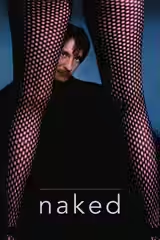
How does Urchin compare to Naked?
Urchin is the gentler film: it follows a fast-talking London drifter, as Naked does, but Harris Dickinson leaves out Mike Leigh's anger and lets nobody make a speech about the system. Frank Dillane is remarkable, though David Thewlis's Johnny is the more frightening and the harder to forget. Start with Naked if you want the bleaker night; Urchin is the shorter and kinder one.
What should I watch after Urchin?
After Urchin, try Naked (1993, Fi1m 84): Mike Leigh’s London drifter talks as fast and hurts more people; David Thewlis unforgettable. Then Rosetta (1999, Fi1m 82): The Dardennes follow a young Belgian woman who wants a job the way Mike wants a room.

Cast

If you liked this, try…

  1. Naked (1993, Fi1m 84)Mike Leigh’s London drifter talks as fast and hurts more people; David Thewlis unforgettable.

  2. Rosetta (1999, Fi1m 82)The Dardennes follow a young Belgian woman who wants a job the way Mike wants a room.

  3. Cathy Come Home (1966) · not on Fi1m yetLoach’s television film on homelessness; angrier than Dickinson and still shaming.

  4. Wendy and Lucy (2008) · not on Fi1m yetKelly Reichardt watches a woman lose her footing in Oregon with the same patience.

  5. Sweet Sixteen (2002) · not on Fi1m yetA Greenock boy’s plan to go straight; Loach at his least sentimental.