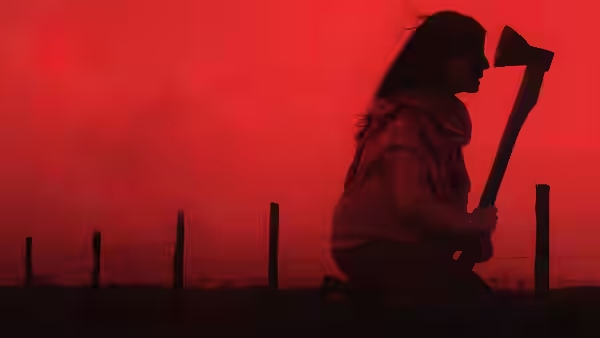
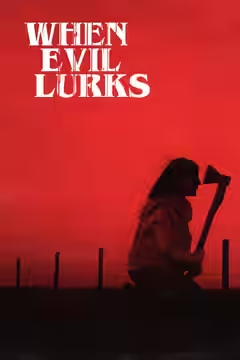
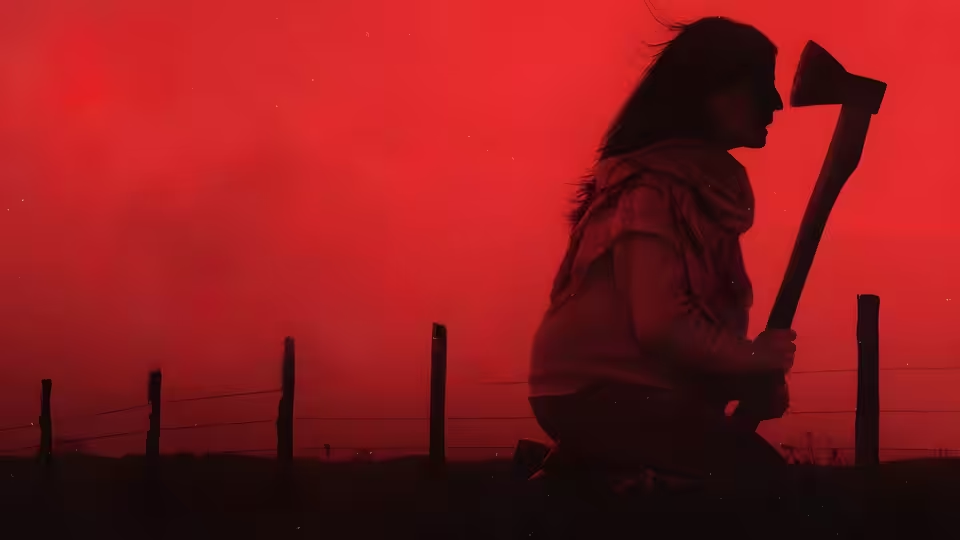
A kneeling figure grips an axe beside a fence under a red sky
Film review

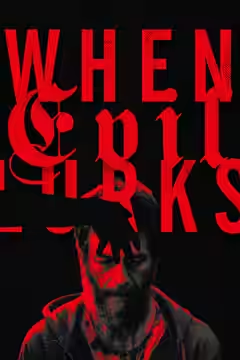
When Evil Lurks

2023 · Directed by Demián Rugna · 1h 40m

In a sentenceThe rules for surviving a demon are simple, and every man in this film has broken all of them before lunch

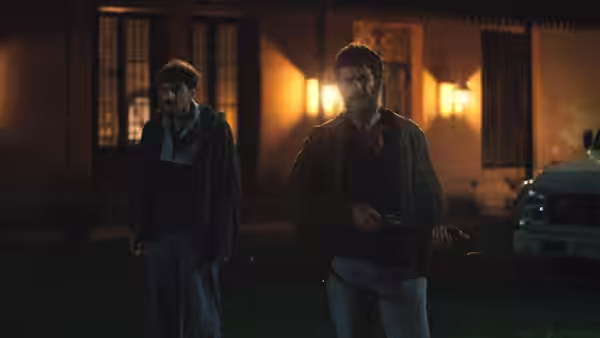
On a farm in rural Argentina, brothers Pedro (Ezequiel Rodríguez) and Jimi (Demián Salomón) hear gunshots in the night and at dawn find half a man in the grass. At the neighbours’ shack they find a son swollen and rotting in his bed, still breathing, possessed by something the locals call a rotten, and a mother who has waited a year for someone official to come. Nobody is coming. Pedro, Jimi and the landowner Ruíz (Luis Ziembrowski) load the body onto a truck to dump it far away. There are rules for handling a rotten, and they break the first within the hour. Pedro drives for the town where his ex-wife Sabrina (Virginia Garófalo) lives with their sons Santino (Marcelo Michinaux) and Jair (Emilio Vodanovich).

Plays from YouTube when you press play; nothing loads from them until then.

Fi1m review

Demián Rugna’s possession film treats the demonic as a rural outbreak, handled badly by farmers and ignored by the authorities. For an hour it is as frightening as anything we have sat through; the second half loosens its grip, though never its nerve.

Demián Rugna’s second horror feature, after Terrified (2017), takes the possession film out of the suburban bedroom and puts it in a field. In his corner of rural Argentina a demon is not a visitor but a condition, something like foot-and-mouth: it gets into a body, festers there for months, and spreads to whoever handles it carelessly. The men who find it are farmers, and they treat it the way farmers treat a sick animal, which is the film’s best idea and its cruellest joke. It frightened us more than anything we have watched in a long while, and it does not quite hold together to the end.

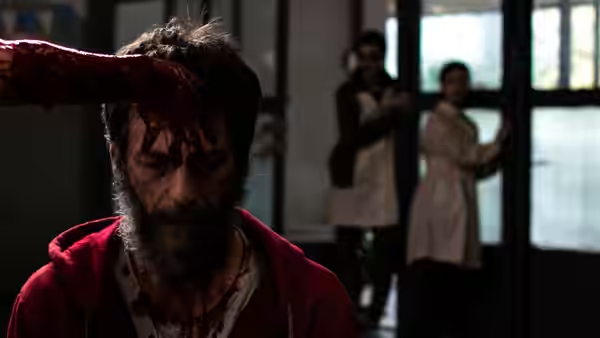
The first hour is close to faultless. Mariano Suárez shoots almost all of it in daylight, in wide frames of flat grey land under low cloud, so that there is nowhere for anything to hide and it hides anyway. Laura Aguerrebehere’s neighbours’ shack is the film’s one great set: a mattress black with seepage, a man on it so bloated the skin has split, flies, a mother in a cardigan pouring tea beside him as if he had a cold. Fuu Pablo’s score barely exists for long stretches, a low hum under the wind, and when it does arrive it arrives late, after the image has already done the work.

Rugna, who also wrote it, gives us the rules the way the characters get them, in fragments and arguments. Do not shoot it. Do not use electric light near it. Do not say its name. Do not take anything that belonged to it. Ezequiel Rodríguez plays Pedro as a man who has heard all of this since childhood and believes about half, and his gradual understanding that his father’s generation was right about everything is the film’s real story. Luis Ziembrowski’s Ruíz is the landowner who wants the problem off his property by nightfall, and Demián Salomón’s Jimi is the brother who keeps his mouth shut and his eyes open. Silvina Sabater, as Mirtha, arrives well into the film carrying the knowledge everyone needed at the start, and plays her as tired rather than wise.

Here is what we felt. There is a scene, early in the town, involving a dog, that we will not describe further, and it made us put a hand over our mouths and keep it there. Rugna does not cut away from it and he does not linger either; Lionel Cornistein holds the shot for exactly as long as it takes to understand what has happened, then moves on to the people who saw it. We were horrified, properly, in the way we had assumed a horror film could no longer manage after thirty years of practice. It is the moment the film tells you it means it.

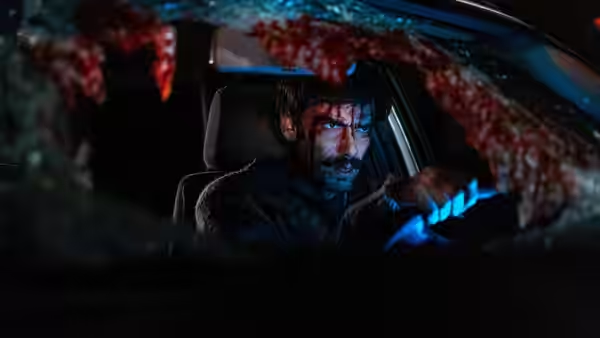
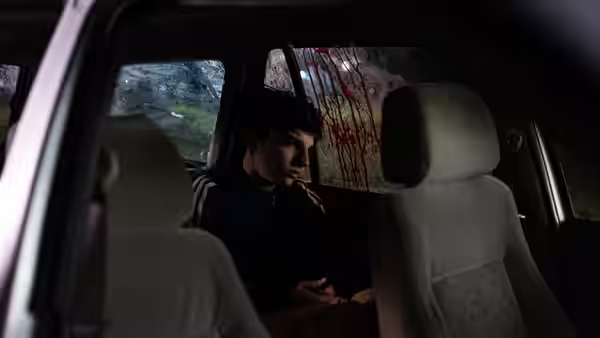
The second half is where it loosens. Once Pedro has gathered his sons and his ex-wife’s household into a car, the film becomes a series of arrivals at places where the rotten has got there first, and the rules that were so carefully laid out start to bend when the plot needs them to. A character who could not have known something knows it; a warning given twice is ignored a third time for no reason we could find. Emilio Vodanovich, as the autistic Jair, is given a role in the ending that the script has not prepared, and the climax is rushed through as if Rugna were worried we might stop believing if he slowed down. We did not stop believing. We did stop being able to say where everyone was.

Still, it is a long way ahead of the genre’s usual standard. Most possession films end with a priest and a prayer; this one has neither, and its tagline says as much. There are no churches in it, no holy water, no argument about faith. There is a bureaucracy that has given up, a few old women who remember how it used to be done, and a landscape that does not care. Terrified had the same director’s talent for the wrong thing in the frame; this is the film where he found something to say with it.

See it, with the lights on and a strong stomach, and preferably not alone. It runs 100 minutes and carries a 15 certificate, which strikes us as generous.

Critical consensus AI synthesised

72
Positive
9
Mixed
3
Negative
0

Most critics like When Evil Lurks: nine of the twelve reviews are positive and none is negative. The praise clusters on Rugna’s mythology, a possession outbreak whose rules are revealed gradually rather than explained, and whose shocks grow out of the characters and the rural Argentine setting rather than arriving on cue. Several reviews also single out the craft, in particular the widescreen photography, the score and the practical effects, and most agree the violence is brutal, unflinching and staged with real skill.

The reservations gather in the second half. The Los Angeles Times finds the climax rushed, Paste finds some third-act choices too mystifying, and Collider thinks the setup is laboured. The spread is fairly wide. Polygon sits at the top, treating the film as a memorable revival of possession horror, while IndieWire is the only dissenter of note, finding it mediocre and saying it squanders a promising opening by losing momentum.

Slant Magazine
13 October 2023 · ★★★/4 · Steven Scaife
75

Scaife finds the film disturbing and truthful in its depiction of a world overtaken by human failures. He praises Rugna’s inventive, gradually revealed mythology and the way its shocking images emerge from character and context.

Read the full review →
Los Angeles Times
6 October 2023 · Amy Nicholson
70*

Nicholson finds the film an enjoyable, unpredictable horror thriller, though its rushed climax weakens the emotional payoff. She praises Rugna’s sustained dread and skillfully staged, brutal violence.

Read the full review →
Variety
5 October 2023 · Dennis Harvey
70*

Harvey finds the film uneven but engrossing, ultimately calling it a bracing and unpredictable ride. He praises its atmospheric craft, especially the widescreen cinematography and unsettling score.

Read the full review →
RogerEbert.com
64*

The page is blocked, so the critic’s verdict cannot be determined. The review’s specific praise or complaint is also unavailable.

Read the full review →
Screen Daily
3 October 2023 · Nikki Baughan
64*

The accessible text confirms this is a review, but does not reveal the critic’s verdict. The standfirst describes rural Argentine horror centered on an ancient evil.

Read the full review →
IndieWire
14 September 2023 · C · Wilson Chapman
57

Chapman finds the film feverishly mediocre, saying it squanders an intriguing premise and loses momentum in its second half. He praises the opening’s restrained world-building, which lets the audience piece together the rules of demonic possession.

Read the full review →

Straight answers AI written, from our review

Is When Evil Lurks worth watching?
When Evil Lurks is worth watching for anyone with a strong stomach who wants a possession film without priests or holy water, and we scored it 76. The first hour is as frightening as anything we have sat through in years; the second half loosens, bending its own rules and rushing the climax, though it never loses its nerve.
How long is When Evil Lurks, and what is it rated?
When Evil Lurks runs 1h 40m. It is a horror and thriller film.
Where can I watch When Evil Lurks in South Africa?
When Evil Lurks is not on any streaming or rental service in South Africa at the moment. It is available in 26 other countries; change your country at the top of the page to see where. Availability is checked daily.
How violent or frightening is When Evil Lurks, and is it suitable for children?
When Evil Lurks is not suitable for children and carries a UK 15 certificate, which strikes us as generous. It is unsparingly violent and frightening, with a swollen, rotting body on a mattress and an early scene involving a dog that we will not describe and that made us cover our mouths. The squeamish should stay well away.

How does When Evil Lurks compare to Kill List?
When Evil Lurks and Kill List both send men into the countryside to meet something older than they understand, but the Argentine film is the more frightening and the more physically brutal of the two. Wheatley builds dread out of suburban tension and hitmen at work; Rugna treats the demonic as a rural outbreak, handled badly by farmers. Both lose some grip in their final stretch.

Cast

Awards

Sitges Film Festival Best Feature-Length Film award, 2023

Won
Sitges Film Festival Best Feature-Length Film award

If you liked this, try…

  1. Terrified (2017) · not on Fi1m yetRugna’s previous film: the same knack for putting the wrong thing in the frame.

  2. The Wailing (2016) · not on Fi1m yetKorean village possession where the rules keep changing and nobody is in charge.

  3. Kill List (2011, Fi1m 82)British hitmen drive into the countryside and find something older waiting for them.

  4. Possession (1981) · not on Fi1m yetŻuławski’s Berlin marriage collapses into something wet and unspeakable; not for everyone.

  5. Noroi: The Curse (2005) · not on Fi1m yetJapanese found-footage that builds its mythology in fragments and pays every one of them off.