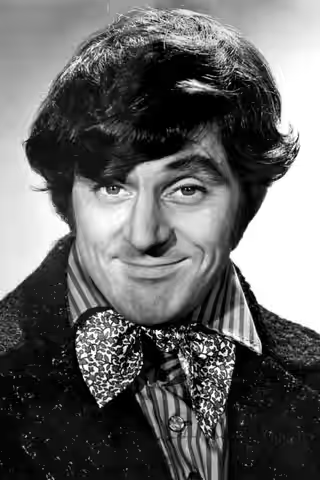
Anthony Newley was a songwriter who acted, and every line comes with a wink to the stalls. A fine Artful Dodger as a boy, he oversells as a grown man on screen; his best work is in songs sung by others.
Fi1m perspective
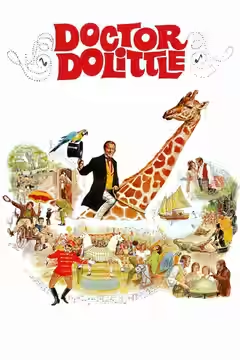
The wink. Anthony Newley cannot land a line in Doctor Dolittle (1967) without letting the camera know he has landed it, and since his Matthew Mugg sings most of the worst of the film's dozen songs, in an Irish accent, there is a great deal of landing. It is the habit of a man who learned his trade in front of live audiences and never trusted a lens to notice him on its own. Our review found he wore out his welcome before the first hour was up, and we hold to that: by the third number we were tired of him and slightly cross with the film for keeping him in the middle of the frame.
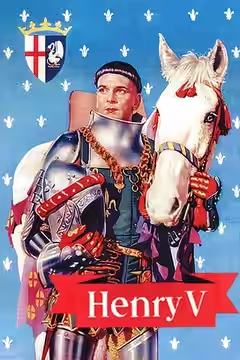
He had been on screen since childhood: an uncredited part in Henry V (1944), then the Artful Dodger in David Lean's Oliver Twist (1948), the role that made him a screen presence. After national service and more film work in the 1950s he became a pop singer with British chart hits, and in 1961 he wrote, with Leslie Bricusse, and starred in the stage musical Stop the World – I Want to Get Off, which went to Broadway. The Roar of the Greasepaint – The Smell of the Crowd followed in 1965. By the time of Dolittle he was a songwriter who acted, singing songs Bricusse wrote, and they are pleasant, wordy numbers short of tunes, each one oversold by a man determined that it should land.
The partnership at its best is Willy Wonka & the Chocolate Factory (1971), for which the two of them wrote the songs and Newley stayed off screen. 'Pure Imagination' and 'The Candy Man' have outlasted everything he did in front of a camera. Given a tune and someone else to sing it, he wrote plainly and well; given a camera and his own face, he oversold.
The selling got worse. The consensus on Can Hieronymus Merkin Ever Forget Mercy Humppe and Find True Happiness? (1969) is that it is self-parody of a kind that damaged him, and nothing we know of it makes us want to argue. Later stage shows such as The Good Old Bad Old Days (1972) were found preachy, and the career ended in Las Vegas cabaret. The big, unguarded emotional delivery and the Cockney vowels he kept from Hackney turned up again in British performers who came after him, and that is a legacy of a kind.
Our advice is to listen rather than watch. Put on the Wonka songs; if you must have him on screen, find the boy in Oliver Twist and stop there.
Biography
Anthony Newley was an English actor, singer and songwriter. Born in London on 24 September 1931, he trained at the Italia Conti Stage School and made his screen debut as a child. He played the Artful Dodger in David Lean's Oliver Twist (1948).
Newley appeared in numerous British films during the 1950s before achieving success on stage and in song. With Leslie Bricusse he created the musical Stop the World – I Want to Get Off (1961), which transferred to Broadway and yielded the hit 'What Kind of Fool Am I?'. He played Matthew Mugg in the film Doctor Dolittle (1967) and contributed songs to Willy Wonka & the Chocolate Factory (1971). Newley died in Jensen Beach, Florida, on 14 April 1999.