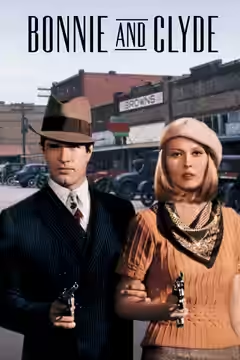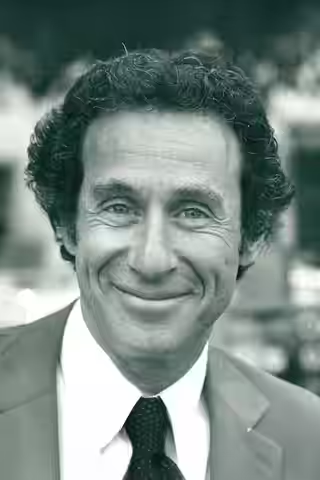
Arthur Penn put outsiders at the centre of American genres and let us laugh a moment before the shooting started. In Bonnie and Clyde the trick still works; the rest is patchier, and better than the notices it got at the time.
Fi1m perspective
A grocer is robbed and within ten minutes the robbers are gone. A few scenes later somebody makes a joke in a getaway car, and then Penn puts a bullet through a face and does not stop to let anyone recover. That is Arthur Penn's habit, and in Bonnie and Clyde (1967) he made it his own: an everyday moment, a laugh, and violence arriving before you have braced for it. Dede Allen's cutting does the work, the robbery played fast and light and the killing given no more time than the joke. Penn plays the same trick for 111 minutes, faster each time.
He came to films sideways. After Black Mountain College and the Actors Studio he directed live television drama in the 1950s, then Broadway, where The Miracle Worker became a film in 1962. The Left-Handed Gun (1958) had already given him Billy the Kid, the first of the misfits he kept returning to, and The Chase (1966) was recut by the studio in ways he partly disowned. The subject was settled early. In his own words: "The outsider appeals to me because I believe there are so many odd characteristics of human behavior that don’t get into films."
Bonnie and Clyde was the breakthrough, and what followed carried the same interest into the rest of the American repertoire. Alice's Restaurant (1969) came next. Little Big Man (1970), with Dustin Hoffman and Chief Dan George, turned the Western against the myths it usually flatters, and audiences of the time saw Vietnam in it. Night Moves (1975) and The Missouri Breaks (1976) were received coolly when they opened and have been thought better of since; Night Moves is the later film his admirers point to. After that the work came less often, on television and stage as much as in cinemas.
What he did best was actors. Penn came out of the Method and wanted performances you could see in the body, and Dunaway and Beatty give him exactly that, restless and never quite still. Beatty made three films with him, Marlon Brando two, the playwright William Gibson two. The flaw sits next to the strength. He liked his killers, and the fondness that makes Bonnie and Clyde such good company keeps the film from ever quite judging them. We laughed at the getaways, and by the last reel we could not tell whether we were meant to be enjoying ourselves; that unease is what Penn is after, and it is also where his affection gets the better of him.
Start with Bonnie and Clyde, and do not trust the laugh.
Biography
Arthur Penn was an American film, theatre and television director. Born in Philadelphia in 1922, he served in the US Army during the Second World War and later studied at Black Mountain College. He began his career directing live television dramas in the 1950s before moving into theatre and film.
Penn achieved early success on Broadway, winning a Tony Award for directing the play The Miracle Worker. He received an Academy Award nomination for the 1962 film adaptation. His 1967 film Bonnie and Clyde is credited with helping to launch the New Hollywood era through its blend of violence, comedy and countercultural themes. Other notable films include Alice's Restaurant (1969), Little Big Man (1970), Night Moves (1975) and The Missouri Breaks (1976). He received two further Oscar nominations for best director.
Penn was also known for his work in television and returned to stage directing later in his career. He died in New York City in 2010.