Film review

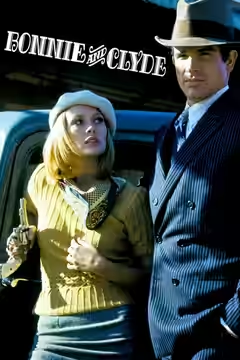
Bonnie and Clyde

1967 · Directed by Arthur Penn · 1h 51m · MPA R

In a sentenceTwo beautiful people rob bankrupt banks to a banjo, and it is funny right up until it isn’t

CrimeDrama

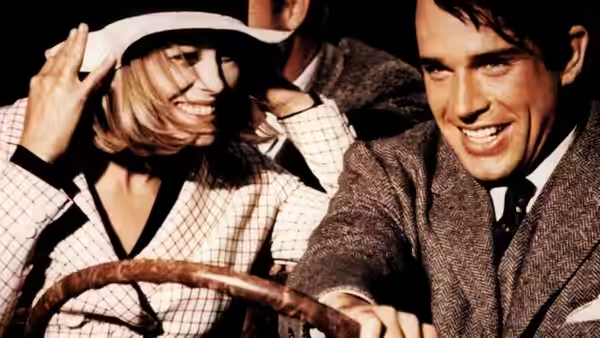
West Dallas, Texas, in the early 1930s. Bonnie Parker (Faye Dunaway), a waitress bored to distraction, looks out of her bedroom window and sees Clyde Barrow (Warren Beatty) trying to steal her mother’s car. He shows her a pistol and, to prove he means it, holds up the grocery store across the street. By the afternoon they are on the road. They steal cars, sleep in abandoned farmhouses and try to rob banks that have already gone bust in the Depression. At a filling station they pick up a mechanic, C. W. Moss (Michael J. Pollard), who can fix any engine and cannot park a car. Clyde’s brother Buck (Gene Hackman) and Buck’s wife Blanche (Estelle Parsons), a preacher’s daughter, join them. The newspapers begin to print their names.

Plays from YouTube when you press play; nothing loads from them until then.

Fi1m review

Arthur Penn’s outlaw film still has its shock: it lets you laugh at the getaway and then puts a bullet through a face. Dunaway and Beatty are glorious, Dede Allen’s cutting is the real star, and it likes its killers rather more than it should.

Arthur Penn takes two small-time Texas thieves from the Depression and makes a film that cannot decide whether it is a comedy or a funeral, and does not want to. Bonnie Parker (Faye Dunaway) is a waitress with nothing to do. Clyde Barrow (Warren Beatty) is a boy with a pistol in his trouser pocket and a need to be looked at. Within ten minutes they have robbed a grocer and are gone. We recommend it without much hesitation and with one caveat: it likes these two rather more than it ought.

The moment that got us comes at the end of the first act. C. W. Moss (Michael J. Pollard) is left in the getaway car outside a bank and, because nobody told him not to, parks it in a space. The robbery becomes a farce of reversing and horn-blowing, and we were laughing. Then a clerk jumps on the running board, Clyde fires through the window, and the man’s face comes apart behind the glass. The laugh stuck in our throats. Dede Allen cuts it in a handful of shots and moves on, and that is worse, because the film moves on too.

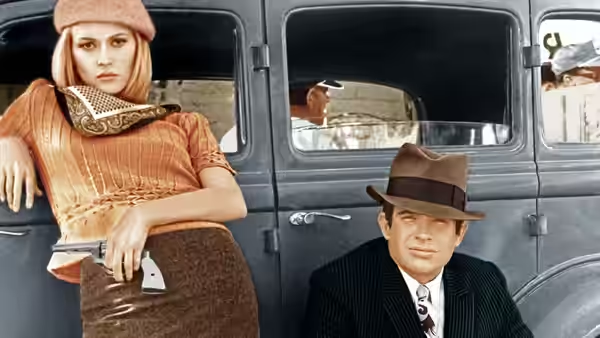
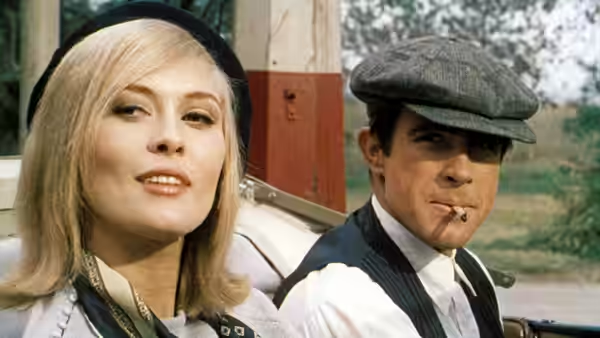
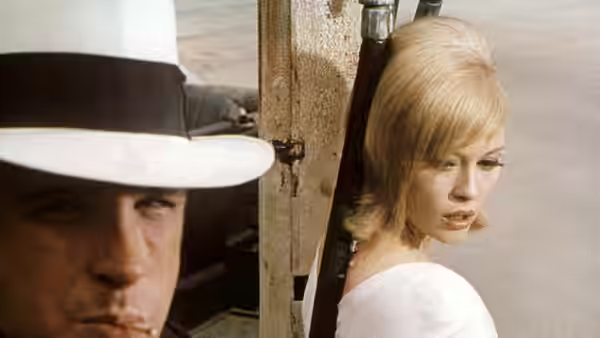
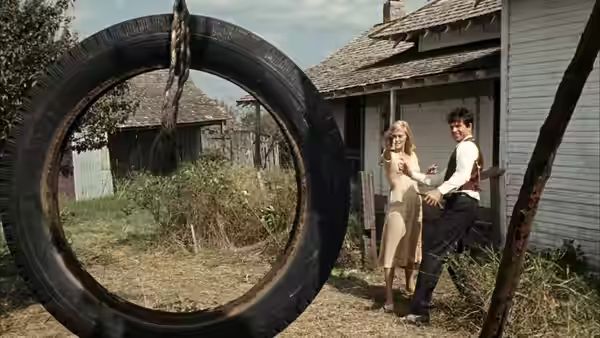
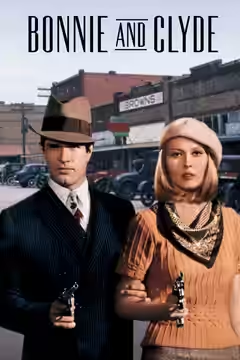
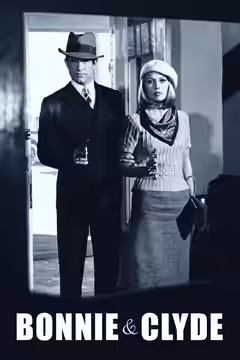
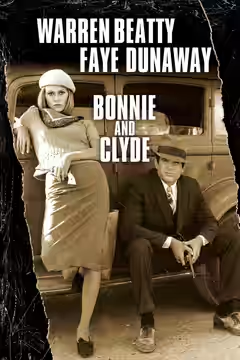
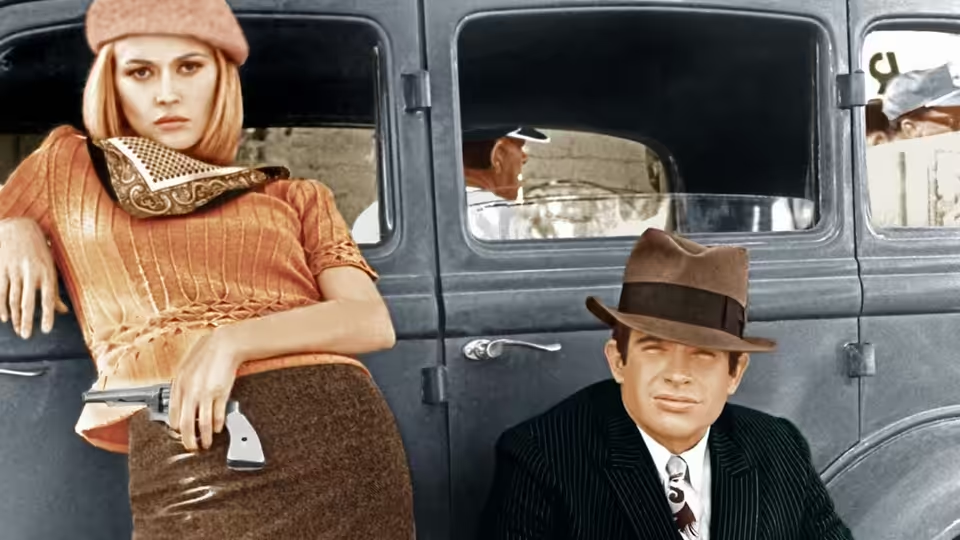
Allen is the reason this is the film it is. She cuts into scenes after they have started and out before they have finished, so the first hour plays as a run of snapshots, like the photographs it opens on. The getaways are chopped into jolts. Burnett Guffey shoots the country around them flat and hazy, dust roads and pale sky, greens and golds like an old postcard, and against it the stolen cars sit black and shining. Theadora Van Runkle puts Bonnie in berets, long skirts and cardigans, and Clyde in a hat and a good suit. They look like people who expect to be photographed.

Beatty plays Clyde as a show-off who bruises easily, and the film’s boldest decision comes in the first act, in a motel bed, when he tells Bonnie he is no good to her as a lover. Its glamour couple is not a couple in that sense at all, and everything they do afterwards reads as what they do instead. Dunaway is restless, biting her lip, a woman who has decided to be famous and is waiting for the world to catch up. Gene Hackman’s Buck is all backslaps and one dreadful joke he tells more than once. Estelle Parsons plays his wife Blanche at full shriek. Gene Wilder turns up for one sequence as a passenger who did not ask to be one, and it is the funniest stretch of the film.

The people this pair rob and shoot barely exist. The clerks are faces, the farmers turned off their land are a chorus who cheer, and the one lawman with a name, Frank Hamer (Denver Pyle), is there to be humiliated, photographed and laughed at. Blanche is written as a fool so that Bonnie looks cooler beside her, and although Parsons commits to it, it is a mean piece of writing from David Newman and Robert Benton. Charles Strouse is credited with the music, but the sound the film keeps going back to is a banjo, sawing away under the chases as if this were a picnic. We take it the tune is meant to sour as the bodies mount. It sours a little late.

Most critics treat it as the film that let real violence into American cinema, and we are close enough to the consensus not to quarrel. The one dissent we have read says the violence looks tame now. We think the violence was never the shock. The shock was the laugh just before it, and that has not aged. Penn plays the same trick for 111 minutes, faster each time, and by the end we could not tell whether we were meant to be enjoying ourselves.

The last two minutes are the most argued-about in it, and we will not describe them. Watch it with someone who believes old films are slow; Allen does not waste a shot. The 15 certificate is about right. It is not the blood that earns it. It is the laughing.
Critical consensus AI synthesised

84
Positive
8
Mixed
1
Negative
0

Most critics rate the film highly and the reviews lean almost uniformly positive. The praise settles on Arthur Penn’s direction and the way the film moves between farce and brutality, treating its outlaws as comic figures one minute and bleeding bodies the next. Beatty and Dunaway are singled out in nearly every notice, with Hackman, Pollard and Parsons credited for the ensemble around them. Time Out adds that the dusty towns shot in muted greens and golds give the story the feel of folk legend.

The spread is narrow, with most scores clustered near the top. What reservations there are concern the violence and how it has aged. The Skinny, the one mixed notice, finds the shootings now feel tame and the film loses force after a stylish opening. Slant Magazine, warmer but not effusive, points to a self-absorbed romantic fatalism in the leads. Much of the later writing treats the film as a historical event rather than something to be watched fresh.

RogerEbert.com
25 September 1967 · ★★★★/4 · Roger Ebert
100

Ebert calls the film a milestone of truth and brilliance that reflects the full range of human life, including its cruelty, humor, and violence. He singles out the realistic, suffering deaths and strong ensemble performances, especially by Beatty, Dunaway, Pollard, Hackman, and Parsons, as making it a landmark of the 1960s.

Read the full review →
Empire
1 January 2000 · Simon Braund
90*

The critic hails Arthur Penn's film as a revolutionary work that changed American cinema forever through its anti-hero focus, freewheeling style and graphic violence. He singles out the shocking, prolonged ambush death scene as one of the most memorable and realistic in film history.

Read the full review →
The Guardian
26 August 2007
90*

The film is a landmark that shocked audiences with its blend of farce and brutality when it opened in London 40 years earlier, opening the floodgates for screen violence. It credits director Arthur Penn and the script's fusion of European influences with American outlaw mythology for its enduring impact and controversy.

Read the full review →
The Hollywood Reporter
14 August 2015 · John Mahoney
90*

The critic calls the film an outstanding achievement and a new peak for director Arthur Penn, praising its blend of black comedy and elegy, strong performances (especially Beatty and Dunaway), screenplay, and technical craft while noting its documentary-like period evocation and tasteful handling of violence.

Read the full review →
Time Out
25 February 2015 · TM
90*

The critic calls the film great, noting it successfully reclaims the American gangster movie after the French New Wave while treading a line between comic fairytale and brutal fact that captures the ambiguity of its real-life outlaw heroes. The weird landscape of dusty towns and verdant highways, shot in muted tones of green and gold, gives it the quality of folk legend.

Read the full review →
The New York Times
12 August 2007 · A.O. Scott
85*

Scott describes the film as a scandal and sensation that introduced a new kind of raw, choreographed violence to movies while becoming a touchstone of Hollywood and cultural history. He highlights its formal panache in mayhem scenes and its role as a parable of generational and cultural shifts.

Read the full review →

Cast

Awards

Academy Awards, 1968

Nominated
Best Actor
Nominated
Best Actress
Nominated
Best Costume Design
Nominated
Best Director
Nominated
Best Supporting Actor
Nominated
Best Writing, Original Screenplay
Won
Best Cinematography
Won
Best Supporting Actress

National Society of Film Critics Award for Best Screenplay, 1968

Won
National Society of Film Critics Award for Best Screenplay

If you liked this, try…

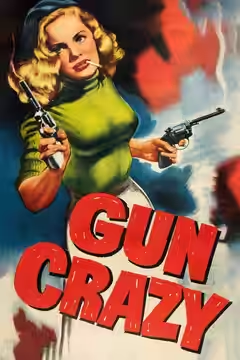
Gun Crazy poster

Gun Crazy

1950 · The lovers-on-the-run film that got there first; leaner, cheaper and nearly as good.

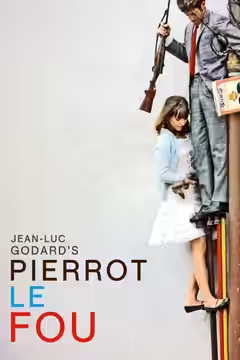
Pierrot le Fou poster

Pierrot le Fou

1965 · Godard’s version of the same idea, with more colour, more talk and less plot.

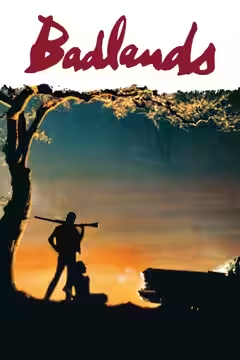
Badlands poster91

Badlands

1973 · Malick’s answer: two killers, a Midwest sky, and a narrator who does not understand herself.

Thieves Like Us poster

Thieves Like Us

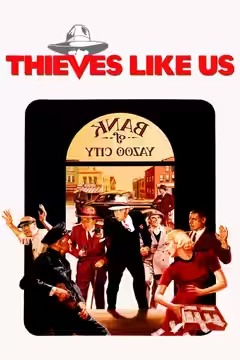
1974 · Altman’s Depression bank robbers, told slow and sad, with the radio doing the commentary.

Thelma & Louise poster85

Thelma & Louise

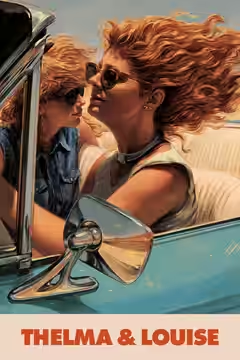
1991 · Two women, one car, the law behind them; the debt to Penn is plain.