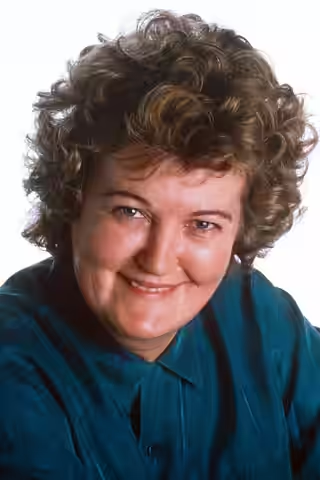
Brenda Fricker made a mother's work look like nothing worth mentioning, the hardest way to play it. In My Left Foot she carries her son upstairs without a speech or a plea for sympathy, and never once looks at him as though he is a burden.
Fi1m perspective
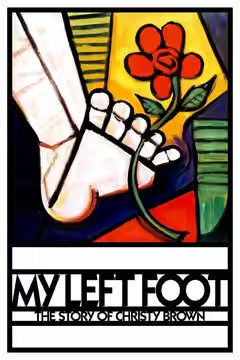
Somewhere in My Left Foot: The Story of Christy Brown (1989), Mrs Brown puts coins into a tin, saving towards a wheelchair for her son. Nobody makes a speech about it. Brenda Fricker carries Christy up the stairs, feeds him and gets on with the next thing, and she never once looks at him as though he were a weight. Ray McAnally's Mr Brown cannot decide whether to be ashamed of the boy or proud of him; Fricker's Mrs Brown settled that question long before the film began. The tin moved us, and it moved us because Fricker does nothing with it: no glance at the camera, no held breath, only a woman putting money away while Elmer Bernstein's score does the feeling for her.
She was 44 when she made it and had been working for a quarter of a century. Irish television and theatre in the 1960s, including Tolka Row; Coronation Street in 1977; and from 1986 the nurse Megan Roach in Casualty, a part she kept returning to until 2010. Jim Sheridan's film turned a familiar face into a name, and Sheridan used her again the following year in The Field (1990), as Maggie McCabe opposite Richard Harris. Then came the American parts: the Pigeon Lady in Home Alone 2: Lost in New York (1992) and May Mackenzie in So I Married an Axe Murderer (1993), which found a comic timing the dramas had no use for. After that she went back to Irish, British and Canadian films and worked into the 2020s.
What she did was character work, and she did the same kind of it for a long time. Stoic mothers, earthy mothers, mothers who have buried people and put the kettle on regardless. Most critics noticed this and so did she: after 1989 the offers narrowed to variations on Mrs Brown, and the later Casualty years asked less of her than the early ones had. That is the industry's failure more than hers. The thing she could do was be believable in a kitchen, and few writers know what to do with that.
Start with My Left Foot, which is rougher and funnier than its reputation. Daniel Day-Lewis has the part everyone remembers; Fricker has the part that makes his believable. Then, if you want more of her, The Field, where Sheridan gives her something harder. Notice how little she is given to say in Sheridan's first film and how much you know about her by the end. It is an old-fashioned way of acting, and it has not dated, because it never depended on being noticed.
Biography
Brenda Fricker (1945–2026) was an Irish actress whose career spanned stage, film and television over six decades. Born in Dublin, she began acting in radio plays as a child and made her first screen appearance in an uncredited role in the 1964 film Of Human Bondage. She performed with Irish theatre companies and later with the National Theatre, the Royal Shakespeare Company and the Royal Court in Britain.
Fricker gained prominence in the United Kingdom for playing nurse Megan Roach in the BBC drama series Casualty from 1986 to 1990. She received international recognition for her performance as Mrs Brown in Jim Sheridan’s My Left Foot (1989), for which she won the Academy Award for Best Supporting Actress, becoming the first Irish actress to receive an Oscar. Other notable film roles include the Pigeon Lady in Home Alone 2: Lost in New York (1992), Ethel Twitty in A Time to Kill (1996), Polly in Albert Nobbs (2011) and appearances in The Field (1990), So I Married an Axe Murderer (1993) and Veronica Guerin (2003). She continued working in television and film into the 2020s.