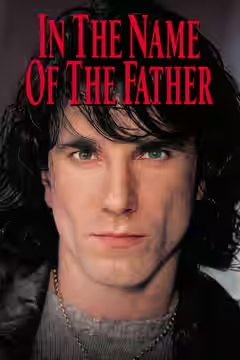
Jim Sheridan’s account of the Dublin writer and painter Christy Brown is rougher, funnier and less pious than its reputation suggests, and Daniel Day-Lewis’s performance is exact throughout. A stiff framing device and Elmer Bernstein’s insistent score are the price of admission.
Christy Brown was born into a large Dublin family with cerebral palsy so severe that he could control only his left foot, and with it he learned to write and paint. Jim Sheridan’s first feature, written with Shane Connaughton from Brown’s autobiography, tells that story in 103 minutes and mostly refuses to ask for our pity. Our verdict: it is better than most films of its type, and its two weakest elements were added to make it easier to sell, a framing device and a score.
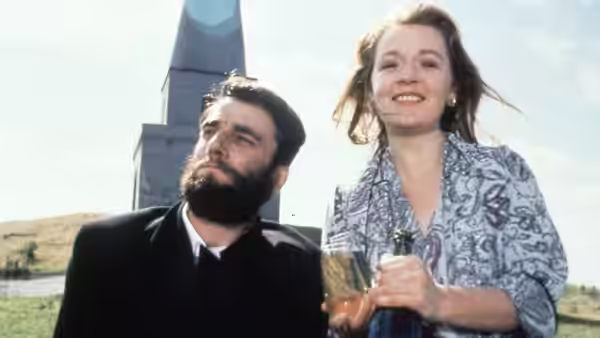
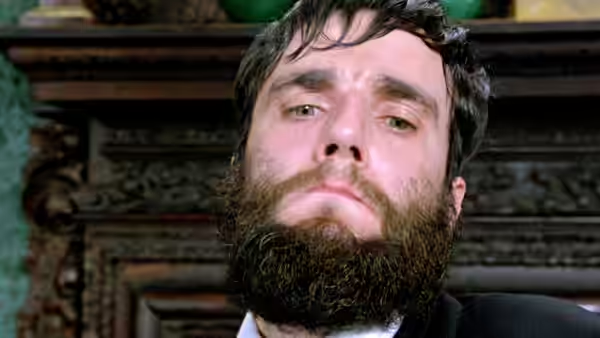
Daniel Day-Lewis plays the adult Christy, and the performance is not a stunt. The twisted neck, the mouth working ahead of the words, the head swung round to look at anyone: all of it consistent from scene to scene, and after ten minutes we stopped watching the technique and started watching the man. He drinks, swears, sulks, falls in love with the wrong people and is not always kind to the right ones. Sheridan lets him be unpleasant, which is the film’s best decision.
Hugh O’Conor plays the boy Christy, and the two halves of the part fit. The scene in which the child, dismissed by everyone as feeble-minded, gets a piece of chalk between his toes and scrapes a word onto the floorboards moved us more than we were ready for. Sheridan holds the shot on the floor and the foot and does not cut to a single reacting face until the word is finished, so we work out what he is writing at the same speed as the family does.
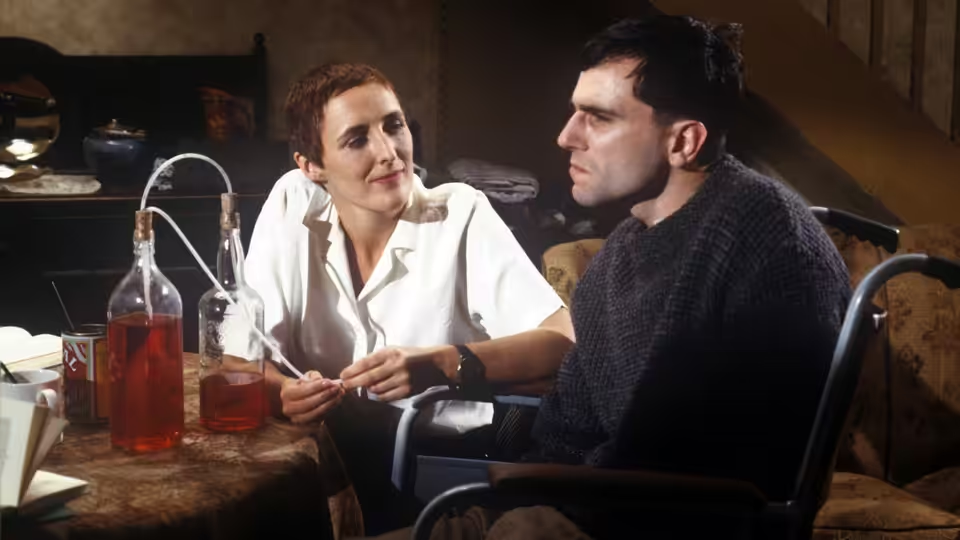
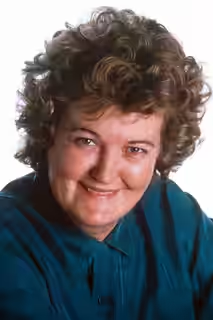
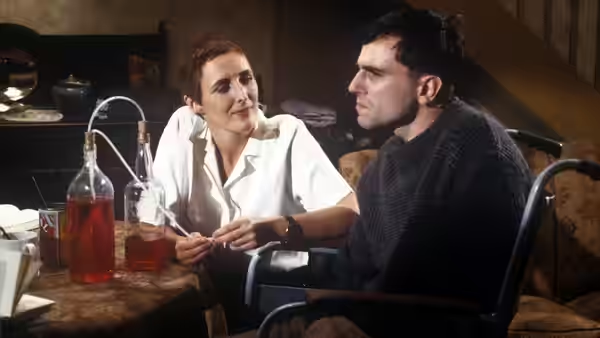
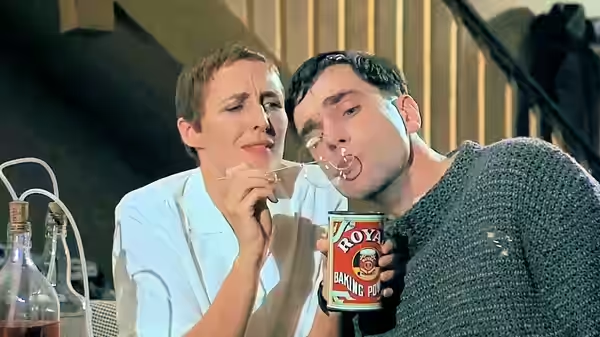
Brenda Fricker plays Mrs. Brown without a raised voice or a speech. She carries Christy up the stairs, feeds him, puts coins into a tin towards a wheelchair, and never once looks at him as though he is a burden. Ray McAnally’s Mr. Brown is a bricklayer who cannot decide whether he is ashamed of the boy or proud of him, and McAnally plays both at once: the night he carries Christy into the pub on his shoulders is the film’s clearest picture of a man who loves his son and does not know what to do about it. Fiona Shaw arrives later as Dr. Eileen Cole, who tries to teach Christy to speak more clearly, and plays her as brisk, decent and slightly out of her depth.
Jack Conroy keeps the camera low, at the height of a boy in a wheelbarrow, so that adults loom and doorways become obstacles. His Dublin is brown and grey, coal smoke and wet brick, and the kitchen Austen Spriggs has built is small enough that a family that size can barely turn round in it. Joan Bergin dresses the children in jumpers stretched by the bodies that wore them before. J. Patrick Duffner cuts cleanly between the childhood and the gala, though the gala is where the trouble is.
The framing device has Christy waiting in a side room at Lord Castlewelland’s house while a nurse, Mary, reads his book, so the past can be visited in order and a romance hinted at. Ruth McCabe does what she can, but Mary is written to sit still and turn pages, and the scenes around her are stiff in a way nothing in the Brown house is. Elmer Bernstein’s music is the other addition we could have done without: flutes and strings swell under moments that were already working, telling us how to feel about a scene we were already feeling. The screenplay also takes liberties with Brown’s own account, which is fair game for a drama but worth knowing.
Most films about disability are about the able-bodied learning a lesson; this one is about a difficult, clever, thwarted man and the household that made room for him. The second half takes turns we will not describe, some harder to watch than the first hour suggests; the 15 certificate is earned mostly by the language, of which Christy has plenty.
Watch it for Day-Lewis, Fricker and McAnally, and for a family kitchen that feels lived in rather than designed. Then read the book, which the film keeps pointing at and does not quite trust you to pick up.