Broderick Crawford had a bulldog face and a barking voice, and in All the King's Men he put them to work on a whole idea about how power is won. The films that followed mostly asked him to be loud, and he was.
Fi1m perspective
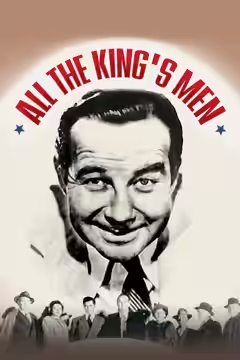
Watch what Broderick Crawford does with a prepared speech. For the first stretch of All the King's Men (1949) his Willie Stark reads one from the platform, a stiff country man with honest intentions and nothing anyone wants to hear, and the crowd talks over him. Then Sadie Burke tells him, over a bottle, what the men behind him really think, and the next morning he throws the pages away and talks to the farmers as one of them. Crawford does not shout. He leans his whole weight into the words, and a hall of extras turns into a movement. We wanted Willie to win, and it took us a moment to notice we had stopped asking what he would do once he had. That is the performance in one scene: a man who is entirely convincing and not to be trusted, played by an actor who lets us feel both at once.
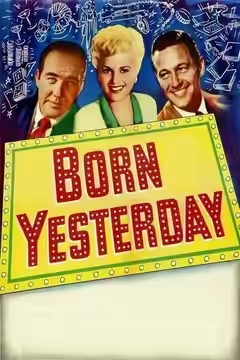
He had been around a while by then. He came out of a vaudeville family, created Lennie in the 1937 Broadway production of Of Mice and Men, made his film debut the same year and spent the early 1940s in supporting parts. Willie Stark made him a lead in his late thirties. He followed it with Born Yesterday (1950), reprising his stage part of Harry Brock opposite Judy Holliday, and with hard-boiled pictures like The Mob (1951), which he went at with some relish. Fritz Lang used him in Human Desire (1954) and Fellini in Il bidone (1955), and neither of them wanted a nice man.
The trouble was the face. A heavy jaw and a bark of a voice are a gift for a demagogue and a trap for nearly everything else, and after the early 1950s the industry mostly asked him for the brute and the slob. The parts got smaller and the pictures got cheaper. Television took him in: Highway Patrol (1955–59), for the producer Frederick W. Ziv, gave him Chief Dan Mathews and a second career, and fixed him as the tough cop for good. It kept him working. It did not ask him for much.
He had no patience with theory. "I act by having led multiple lives," he said in 1977, and you can see what he meant: nothing in Willie Stark looks studied, and the stiffness of the early scenes is a man who has never been asked to perform, not an actor signalling it. Robert Rossen got the best out of him by giving him someone who changes, and Crawford is at his best while the change is happening. When it stops, in the film's rushed second hour, he is left holding the finished article, which is a smaller thing to play. Start with Willie Stark, the first hour above all. There is a great deal more of Crawford after that, but rarely more to him.
Biography
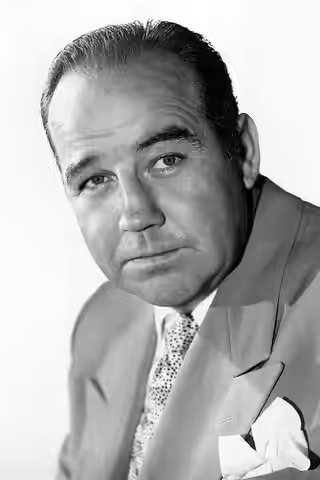
Broderick Crawford was an American actor, also credited as William Broderick Crawford. He played Willie Stark in the 1949 film All the King's Men and Harry Brock in Born Yesterday (1950).
Crawford won the Academy Award for Best Actor and a Golden Globe Award for his performance in All the King's Men. He later starred as Dan Mathews in the television series Highway Patrol (1955–1959).