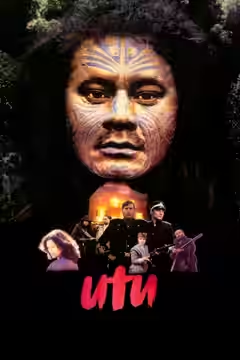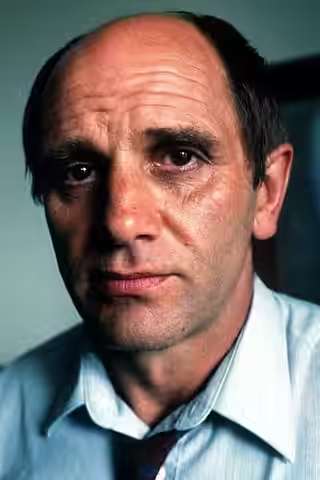
Bruno Lawrence played men who might do anything in the next thirty seconds, and he played them with a drummer's sense of when to hold still. He was the face of New Zealand's cinema in its 1980s revival, and Utu shows why we rate him.
Fi1m perspective
Early in Utu (1983), a settler who has lost his farm to a raid builds himself a shotgun with four barrels and walks into the hills. His name is Williamson, he is played by Bruno Lawrence, and for the rest of the film he is a bearded, muttering figure at the edge of things, a man grief has made practical. Lawrence does not ask us to feel sorry for him and does not let us write him off either. We found him hard to watch, because he never tells us how frightened of him to be, and that uncertainty is the whole performance.
It was the thing he did best. Lawrence's men, farmers, racing drivers, the last man in the world, all give the impression that something is about to happen and that they have not yet decided what. He came to acting from music. Brought to New Zealand from England as a child, he spent years as a jazz and rock drummer, in Quincy Conserve and The Crocodiles, and in the early 1970s founded Blerta, a travelling troupe that mixed music, film and whatever else was to hand. It shows on screen. He listens the way a drummer listens, and he knows when not to come in.
The acting career, once it started, moved fast. Roger Donaldson's Smash Palace (1981) gave him Al Shaw, a former racing driver whose marriage is coming apart, and Lawrence, who also advised on the script, plays him as aggression, hurt and fatherly tenderness at the same time, none of them cancelling the others. It made him a lead. The same year he turned up briefly as Mulvaney in Geoff Murphy's Goodbye Pork Pie, and Murphy became the director who got the most out of him: Utu two years on, then The Quiet Earth (1985), in which Lawrence plays Zac Hobson, a man alone in an emptied world, and shares the writing credit. Between them came Heart of the Stag (1984), another part he helped to write. By the end of the decade he was working in Australia as much as at home, and he was still there in the 1990s, in the newsroom satire Frontline, when he died in 1995.
The reservations are small and mostly about supply. New Zealand's was a small industry having a good decade, Lawrence was in a great deal of it, and after a while the bearded man who might do anything started to look less like a choice and more like the national costume. Murphy's films, which run drama, action and genre through the same scene, suited his refusal to settle; a stiller director might have found something else in him, and mostly did not get the chance.
Start with Utu, where he is one voice among several and the film is the better for it. Then go to The Quiet Earth, where he is on his own with the camera for long stretches, and see whether the thirty seconds still feel dangerous when there is nobody left to be dangerous to.
Biography
Bruno Lawrence, born David Charles Lawrence, was an English-born New Zealand actor and musician. He was born on 12 February 1941 in Worthing, West Sussex, England, and died on 10 June 1995. His family migrated to New Zealand in 1946, settling first in New Plymouth and then Wellington.
Lawrence began as a jazz and rock drummer, performing with bands including Max Merritt & The Meteors, Quincy Conserve, Blerta and The Crocodiles. In the early 1970s he founded the multi-disciplinary theatrical co-operative Blerta, which toured New Zealand and Australia. He later became known for screen roles in New Zealand and Australian productions.
His film credits include Williamson in Utu (1983) and Zac Hobson, which he also co-wrote, in The Quiet Earth (1985). Other notable films include Smash Palace (1981). He received the Rudall Hayward Award at the 1995 New Zealand Film and Television Awards.