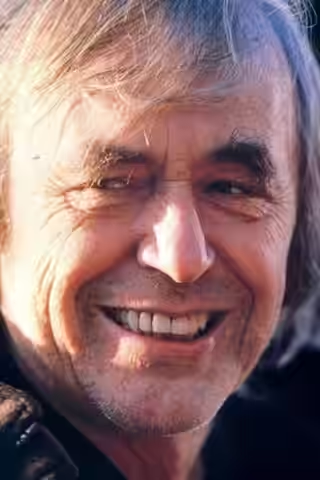
Geoff Murphy took the western, the road film and the last-man-on-Earth story and set them loose in New Zealand, where they looked new. The one to see is Utu, rough and fair and a little unruly; Hollywood later gave him bigger toys and less to say.
Fi1m perspective
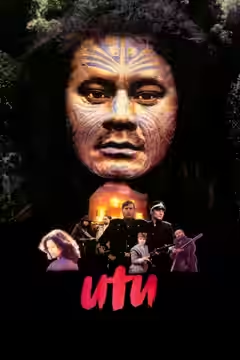
Early in Utu (1983), Te Wheke comes back to a village the colonial army has burnt, and Geoff Murphy holds on his face while it is tattooed. A few scenes on, a colonel wheezes through a piece of farce. That is Murphy in one reel: a director who could carry a story in an image and could not resist a joke, and who would cut from a slaughter to a pratfall without warning.
He came out of Blerta, a multi-media collective, self-taught, shooting shorts and television. The first film anyone noticed was Goodbye Pork Pie (1981), a car-chase comedy co-written with Ian Mune and shot by Alun Bollinger, and the first New Zealand feature to find a large audience at home. Utu came two years later and took the shape of a western into the bush of the 1870s. The Quiet Earth (1985) left one man alone in an emptied world and got him noticed abroad. Three films, three borrowed genres, one country, and Bruno Lawrence from the Blerta circle in front of the camera more often than not.
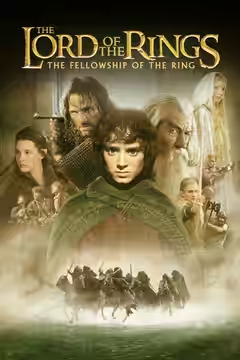
Then Hollywood. After Never Say Die (1988) came a decade of assignments: Young Guns II (1990), Freejack (1992), Under Siege 2: Dark Territory (1995). They are action films made to order, and most critics have filed them as routine, and we are not going to argue. It is hard to find the man who made Utu in any of them. He went home in the early 2000s to shoot second unit on Peter Jackson's The Lord of the Rings films, made Blerta Revisited (2001) about the old collective, and Spooked (2004), a conspiracy thriller that could not settle its tone either.
What he did best was fairness. Robert Aldrich's Ulzana's Raid (1972) kept its Apache a shape on the horizon; Murphy puts Te Wheke in the middle of the frame, gives him the best lines and lets us read every thought, and Anzac Wallace repays him. We came to Utu expecting a colonial adventure with a villain in it and found ourselves, twenty minutes in, on the side of the man with the tattooed face and the grievance, which unsettled us and was plainly meant to. The weaknesses are the ones his admirers already know. The tone lurches, Michael J. Horton and Ian John's cut loops back to the start and loses the long chase in the middle, and the love story has about a page of writing behind it.
Murphy said his education as a filmmaker was made shooting silent films: "I still love those sequences where people don’t talk, and the whole story is carried in little actions and the attention of the camera on certain details." That is the director worth looking for. Start with Utu, and watch what happens when he trusts the picture and lets the joke go. He did not do it often enough. When he did, the films still hold.